A heavy body of mass m hangs on a flexible thread in a railway carriage which moves at speed v 0 on a train-safety test track, as shown in the figure.
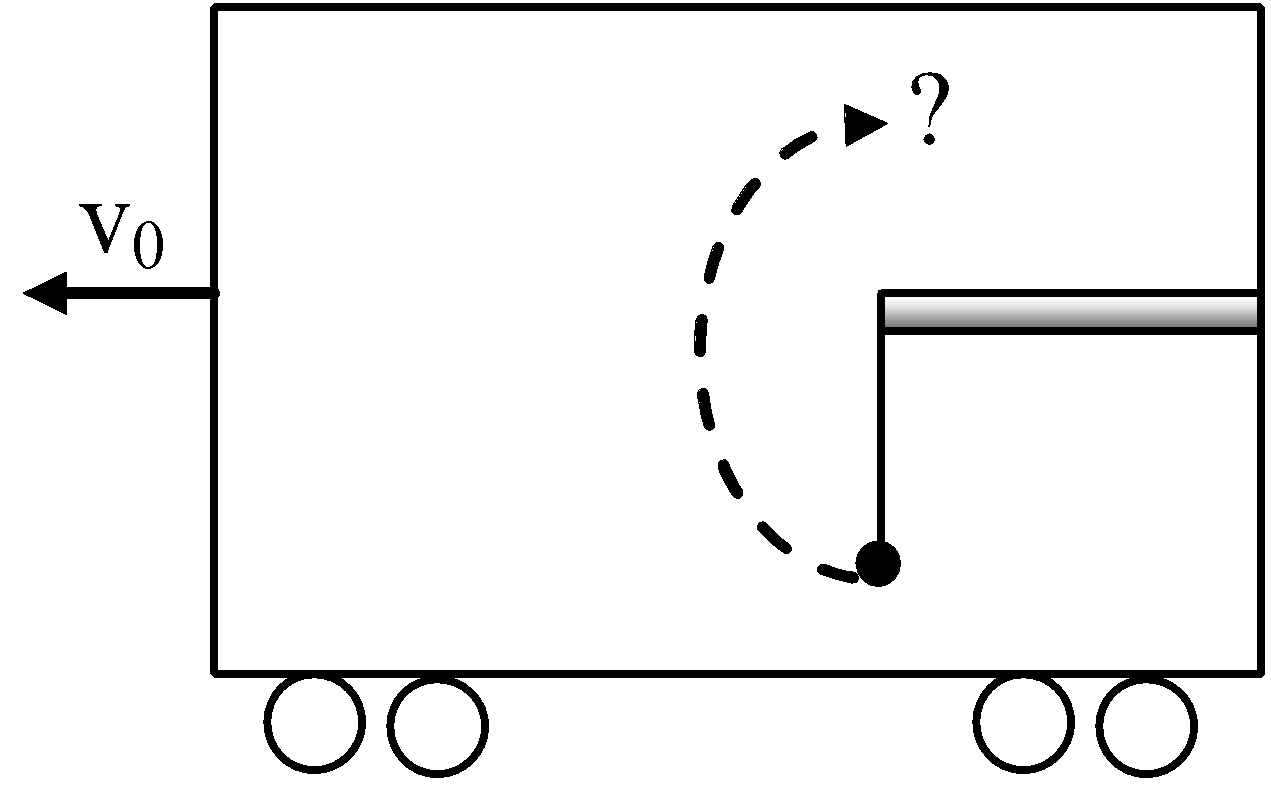
The carriage is brought to rest by a strong but uniform braking. Can the pendulum travel through 180º, so that the taut thread reaches the vertical?
Text Solution
Verified by ExpertsCHECK THE SOLUTION.
Sol. If the carriage brakes with deceleration a , then in the carriage reference frame, a “virtual inertial force’ of magnitude ma , in the direction of the carriage’s motion, will appear to act on the body.
If this inertial force acted permanently, the pendulum could certainly not reach the vertical, since, if it did, the net work done by the inertial force would be zero (the net displacement of its point of application would be perpendicular to its line of action) and the gravitational force would be negative, implying that the kinetic energy of the pendulum should be negative. This is impossible.
Consider now the fact that the carriage only brakes for a certain length of time (until it stops). If it stops when the thread of the pendulum is horizontal, the work done by the inertial force is W = maR , where R is the length of the thread. If the pendulum subsequently reaches a vertical position with speed v then from the conservation of energy.
maR – 2mgR =  .
.
For the thread to remain taut, even at the topmost point, requires mv 2 /R > mg , which together with the above relation from the velocity implies that the deceleration of the railway carriage a > 2.5 g. The conclusion is, therefore, that the taut thread can reach the vertical provided the deceleration is great enough and v 0 is larger enough for the pendulum to have time to reach the horizontal before the carriage has come to a halt.
Prepare Smarter with CGP Edu
Get practice questions, solutions, and test series in one place.
Write a Review
Share your experience with this question and solution.
Commentary
Send your comment, doubt, correction, or feedback to admin.
Similar Questions
Explore conceptually related problems