Published by:
CGP EDU Academic Team
Published on: September 12, 2026
The length of second's hand in watch is 1 cm. Find the magnitude of change in velocity of its tip in 15 seconds.
Text Solution
Verified by ExpertsThe correct answer is:
A
Step 1: Calculate the angular displacement in radians. Since the second's hand completes a full rotation (360 degrees) in 60 seconds, the angular velocity \( \omega \) can be calculated as:
\( \omega = \frac{2\pi \text{ radians}}{60 ext{ seconds}} = \frac{\pi}{30} \text{ radians/second} \).
Step 2: Find the angular displacement in 15 seconds. This can be calculated as:
\( \theta = \omega \cdot t = \frac{\pi}{30} imes 15 = \frac{\pi}{2} \text{ radians} \).
Step 3: Calculate the initial and final velocities of the tip of the second's hand. The radius \( r = 1 \text{ cm} \). Using the formula for linear velocity \( v = r\omega \), we find:
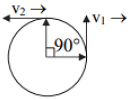
Initial velocity \( v_i = 1 \cdot \frac{\pi}{30} ext{ cm/s} \) and after the change, the final velocity is at an angle of \( \frac{\pi}{2} \), so:
Final velocity \( v_f = 1 \cdot \frac{\pi}{30} ext{ cm/s} \) but perpendicular to the initial velocity.
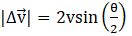
Step 4: The magnitude of change in velocity can be derived using the vector form. The change in velocity is not simply the difference in speed but also accounts for the change in direction.
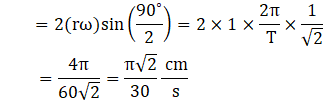
Therefore, using vector addition: \( |\Delta v| = v_f - v_i = \sqrt{(v_f^2) + (v_i^2)} = \sqrt{(\frac{\pi}{30})^2 + (\frac{\pi}{30})^2} = \sqrt{2(\frac{\pi^2}{900})} = \frac{\pi}{30}\sqrt{2} \text{ cm/s} , \approx 0.147 ext{ cm/s} \).
Therefore, the magnitude of change in velocity of the tip of the second's hand in 15 seconds is approximately 0.146 cm/s.
\( \omega = \frac{2\pi \text{ radians}}{60 ext{ seconds}} = \frac{\pi}{30} \text{ radians/second} \).
Step 2: Find the angular displacement in 15 seconds. This can be calculated as:
\( \theta = \omega \cdot t = \frac{\pi}{30} imes 15 = \frac{\pi}{2} \text{ radians} \).
Step 3: Calculate the initial and final velocities of the tip of the second's hand. The radius \( r = 1 \text{ cm} \). Using the formula for linear velocity \( v = r\omega \), we find:
Initial velocity \( v_i = 1 \cdot \frac{\pi}{30} ext{ cm/s} \) and after the change, the final velocity is at an angle of \( \frac{\pi}{2} \), so:
Final velocity \( v_f = 1 \cdot \frac{\pi}{30} ext{ cm/s} \) but perpendicular to the initial velocity.
Step 4: The magnitude of change in velocity can be derived using the vector form. The change in velocity is not simply the difference in speed but also accounts for the change in direction.
Therefore, using vector addition: \( |\Delta v| = v_f - v_i = \sqrt{(v_f^2) + (v_i^2)} = \sqrt{(\frac{\pi}{30})^2 + (\frac{\pi}{30})^2} = \sqrt{2(\frac{\pi^2}{900})} = \frac{\pi}{30}\sqrt{2} \text{ cm/s} , \approx 0.147 ext{ cm/s} \).
Therefore, the magnitude of change in velocity of the tip of the second's hand in 15 seconds is approximately 0.146 cm/s.
Prepare Smarter with CGP Edu
Get practice questions, solutions, and test series in one place.
Write a Review
Share your experience with this question and solution.
Commentary
Send your comment, doubt, correction, or feedback to admin.
Similar Questions
Explore conceptually related problems
A man swings a stone tied to a string of length in a vertical plane. The string remains stretched …
The driver of a car traveling at velocity v suddenly sees a broad wall in front of him at distance …
To anticipate the dip and hump in the road the driver of a car applies her brakes to produce a unif…
A certain rocket maintains a horizontal attitude of its axis during the powered phase of its fligh…
The turning of a car must be produced by an external force acting at an angle to the line of motion…
A body slips down a chute which is in the form of a loop as in fig. It starts from the lowest admis…