Published by:
CGP EDU Academic Team
Published on: September 12, 2026
A car is moving with speed 30 m/sec on a circular path of radius 500 m. Its speed is increasing at the rate of 2 m/sec 2 . What is the acceleration of the car at that moment ?
Text Solution
Verified by ExpertsThe correct answer is:
C
Step 1: Identify the types of acceleration
In circular motion, a body experiences two types of acceleration:
1. Centripetal Acceleration (a_c): This is due to the change in direction of the velocity vector and is given by the formula:
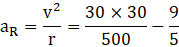
$$a_c = \frac{v^2}{r}$$
where v is the linear speed and r is the radius of the circular path.
2. Tangential Acceleration (a_t): This is due to the change in the magnitude of the velocity vector (speeding up or slowing down). It is given as the rate of change of speed.
Step 2: Calculate Centripetal Acceleration
Given:
Speed, v = 30 m/s
Radius, r = 500 m
Use the formula for centripetal acceleration:
$$a_c = \frac{(30 \text{ m/s})^2}{500 \text{ m}} = \frac{900}{500} = 1.8 \text{ m/s}^2$$
Step 3: Identify Tangential Acceleration
Given tangential acceleration, a_t = 2 m/s².
Step 4: Calculate the Total Acceleration
The total acceleration a is the vector sum of the centripetal and tangential accelerations. We can find the magnitude of this resultant acceleration using the Pythagorean theorem:
$$a = \sqrt{a_c^2 + a_t^2}$$
Substituting the values:
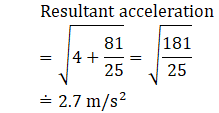
$$a = \sqrt{(1.8)^2 + (2)^2} = \sqrt{3.24 + 4} = \sqrt{7.24} \approx 2.69 \text{ m/s}^2$$
Step 5: Result
The acceleration of the car at that moment is approximately 2.69 m/s².
In circular motion, a body experiences two types of acceleration:
1. Centripetal Acceleration (a_c): This is due to the change in direction of the velocity vector and is given by the formula:
$$a_c = \frac{v^2}{r}$$
where v is the linear speed and r is the radius of the circular path.
2. Tangential Acceleration (a_t): This is due to the change in the magnitude of the velocity vector (speeding up or slowing down). It is given as the rate of change of speed.
Step 2: Calculate Centripetal Acceleration
Given:
Speed, v = 30 m/s
Radius, r = 500 m
Use the formula for centripetal acceleration:
$$a_c = \frac{(30 \text{ m/s})^2}{500 \text{ m}} = \frac{900}{500} = 1.8 \text{ m/s}^2$$
Step 3: Identify Tangential Acceleration
Given tangential acceleration, a_t = 2 m/s².
Step 4: Calculate the Total Acceleration
The total acceleration a is the vector sum of the centripetal and tangential accelerations. We can find the magnitude of this resultant acceleration using the Pythagorean theorem:
$$a = \sqrt{a_c^2 + a_t^2}$$
Substituting the values:
$$a = \sqrt{(1.8)^2 + (2)^2} = \sqrt{3.24 + 4} = \sqrt{7.24} \approx 2.69 \text{ m/s}^2$$
Step 5: Result
The acceleration of the car at that moment is approximately 2.69 m/s².
Prepare Smarter with CGP Edu
Get practice questions, solutions, and test series in one place.
Write a Review
Share your experience with this question and solution.
Commentary
Send your comment, doubt, correction, or feedback to admin.
Similar Questions
Explore conceptually related problems
A man swings a stone tied to a string of length in a vertical plane. The string remains stretched …
The driver of a car traveling at velocity v suddenly sees a broad wall in front of him at distance …
To anticipate the dip and hump in the road the driver of a car applies her brakes to produce a unif…
A certain rocket maintains a horizontal attitude of its axis during the powered phase of its fligh…
The turning of a car must be produced by an external force acting at an angle to the line of motion…
A body slips down a chute which is in the form of a loop as in fig. It starts from the lowest admis…