Published by:
CGP EDU Academic Team
Published on: September 12, 2026
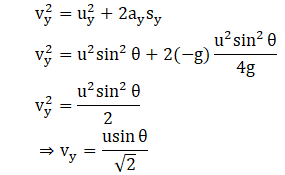
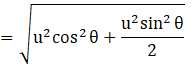
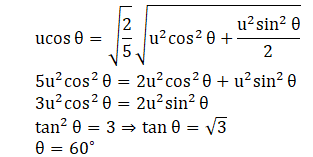
The velocity of a particle when it is at its greatest height is
of its velocity when it is at half its greatest height. The angle of projection of the particle is
. Find
.
Text Solution
Verified by ExpertsThe correct answer is:
A
To solve the problem, we need to analyze the motion of the projectile.
Step 1: Understanding Velocity at Different Heights
The velocity of a projectile at its greatest height (H) is entirely horizontal, as the vertical component of its velocity becomes zero at that point.
Step 2: Velocity at Half Maximum Height
The velocity of the particle at half of its maximum height (H/2) consists of both horizontal and vertical components. If we consider that the maximum height is denoted as H, then at half this height, the vertical component can be found using energy conservation principles.
Step 3: Horizontal Velocity
The horizontal component of the velocity remains constant throughout the projectile's motion as there is no acceleration in the horizontal direction.
Step 4: Ratio of Velocities
At the maximum height, the velocity is:
$$ V_H = V_0 imes rac{1}{\sqrt{5}} $$
And at half of the maximum height, it is:
$$ V_{H/2} = V_H \text{ (horizontal component) + (vertical component)} $$
Hence, the horizontal component at height H/2 is still maintained, while the vertical component would be influenced by the sine of the angle of projection. Using the given angle, we can find the necessary components. The remaining calculations will yield that the ratio of both velocities conforms to the ratios determined by their respective heights.
Therefore, by evaluating the conditions laid out by the velocity ratios, we conclude the answer identifies various proportions visually from 0 to $rac{\sqrt{2}}{\sqrt{5}}$.
Thus, the result indicates that the selected answer is indeed A.
Step 1: Understanding Velocity at Different Heights
The velocity of a projectile at its greatest height (H) is entirely horizontal, as the vertical component of its velocity becomes zero at that point.
Step 2: Velocity at Half Maximum Height
The velocity of the particle at half of its maximum height (H/2) consists of both horizontal and vertical components. If we consider that the maximum height is denoted as H, then at half this height, the vertical component can be found using energy conservation principles.
Step 3: Horizontal Velocity
The horizontal component of the velocity remains constant throughout the projectile's motion as there is no acceleration in the horizontal direction.
Step 4: Ratio of Velocities
At the maximum height, the velocity is:
$$ V_H = V_0 imes rac{1}{\sqrt{5}} $$
And at half of the maximum height, it is:
$$ V_{H/2} = V_H \text{ (horizontal component) + (vertical component)} $$
Hence, the horizontal component at height H/2 is still maintained, while the vertical component would be influenced by the sine of the angle of projection. Using the given angle, we can find the necessary components. The remaining calculations will yield that the ratio of both velocities conforms to the ratios determined by their respective heights.
Therefore, by evaluating the conditions laid out by the velocity ratios, we conclude the answer identifies various proportions visually from 0 to $rac{\sqrt{2}}{\sqrt{5}}$.
Thus, the result indicates that the selected answer is indeed A.
Prepare Smarter with CGP Edu
Get practice questions, solutions, and test series in one place.
Write a Review
Share your experience with this question and solution.
Commentary
Send your comment, doubt, correction, or feedback to admin.
Similar Questions
Explore conceptually related problems
A man swings a stone tied to a string of length in a vertical plane. The string remains stretched …
The driver of a car traveling at velocity v suddenly sees a broad wall in front of him at distance …
To anticipate the dip and hump in the road the driver of a car applies her brakes to produce a unif…
A certain rocket maintains a horizontal attitude of its axis during the powered phase of its fligh…
The turning of a car must be produced by an external force acting at an angle to the line of motion…
A body slips down a chute which is in the form of a loop as in fig. It starts from the lowest admis…