A tree trunk of diameter 20cm lies in a horizontal field. A lazy grass hopper wants to jump over the trunk. Find the minimum take-off speed of grasshopper that will suffice. (Air resistance is negligible).
Text Solution
Verified by ExpertsCHECK THE SOLUTION.
Sol. The trajectory of the grasshopper is a parabola, which touches the trunk at two symmetrically placed points, B and B* on the two sides of the trunk (at the moment we don’t know anything about these points-they may or may not coincide at the topmost point E. of the trunk). The grasshopper takes off from point A with an initial speed v 1 and at an angle θ with the horizontal, as shown in the figure. At the tangential points B and B* the grasshopper’s velocity is v 2 , making an angle β with the horizontal.
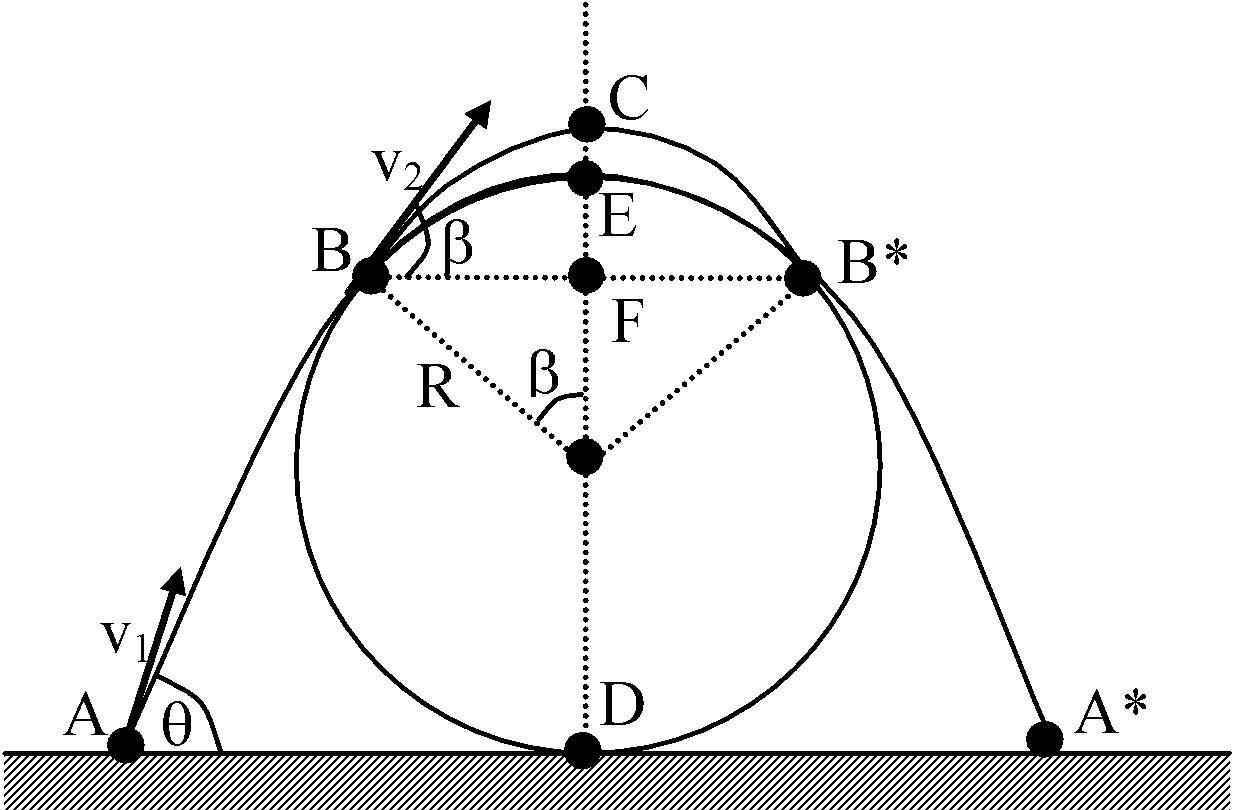
For the sake of simplicity we choose β as the independent variable of the problem. At point B the vertical component of velocity is
v 2 sin β = gt 2 ,
where t 2 is the time of flight for the BC section of trajectory (C is the peak of the parabola). The corresponding horizontal displacement BF is
v 2 t 2 cos β = R sin β .
Multiplying these equations together we obtain
 .
.
Conservation of energy between point A and B of the trajectory gives
 mv 1 2 =
  mv 2 2 + mg (R + R cos β ),
and so v 1 2 = v 2 2 + 2gR (1 + cos β )
=  + 2gR (1 + cos β )
= 2gR  .
.
We can calculate the minimum value of v 1 using differential calculus. However, there is a less complicated method available which uses the inequality between arithmetic and geometric means:

 >
>  =
=  .
.
So the minimum value of cos β + 1/(2cos β ) is equal to  and, therefore, β = 45º. The case β = 0 requires a larger initial velocity since 1.5 >
  ; it follows that the trajectory with the minimum initial speed does not in fact touch the trunk at its topmost point. The gravitational potential energy of the grasshopper is greater at the peak of the parabola than at the uppermost point of the trunk, but its kinetic energy and total energy are smaller than they would be for a top-touching trajectory.
The numerical value of the minimal initial speed is
v 1 min =  ≈ 2.2 ms —1 .
Prepare Smarter with CGP Edu
Get practice questions, solutions, and test series in one place.
Write a Review
Share your experience with this question and solution.
Commentary
Send your comment, doubt, correction, or feedback to admin.
Similar Questions
Explore conceptually related problems