Published by:
CGP EDU Academic Team
Published on: September 12, 2026
A body cools in 7 minutes from 60°C to 40°C. What time (in minutes) does it take to cool from 40°C to 28°C, if the surrounding temperature is 10°C?
Text Solution
Verified by ExpertsThe correct answer is:
4
This problem can be solved using Newton's Law of Cooling, which states that the rate of change of temperature of an object is proportional to the difference between its own temperature and the ambient temperature surrounding it.
Step 1: Define the temperatures.
Let the ambient temperature be \( T_a = 10\degree C \), the initial temperature \( T_1 = 60\degree C \), and the final temperature after cooling \( T_2 = 40\degree C \). The time taken to cool from \( 60\degree C \) to \( 40\degree C \) is given as \( t_1 = 7 \) minutes.
Step 2: Apply Newton's Law of Cooling.
According to Newton's Law, we can express the cooling process as: \[ \frac{dT}{dt} = -k(T - T_a) \]
This implies: \[ T(t) = T_a + (T_0 - T_a)e^{-kt} \]
Here, \( T_0 \) is the initial temperature.
Step 3: Calculate for the first scenario.
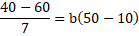
For the first cooling period: \[ T(7) = 10 + (60 - 10)e^{-7k} = 40 \]
Simplifying this yields: \[ 40 - 10 = 50e^{-7k} \] \[ 30 = 50e^{-7k} \] \[ e^{-7k} = \frac{30}{50} = 0.6 \]
Taking the natural logarithm: \[ -7k = \ln(0.6) \] \[ k = -\frac{\ln(0.6)}{7} \]
Step 4: Calculate for the cooling from 40°C to 28°C.
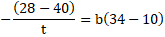
Now consider the second cooling period from \( T_1 = 40\degree C \) to \( T_2 = 28\degree C \): \[ T(t) = 10 + (40 - 10)e^{-kt} = 28 \]
Solving similarly: \[ 28 - 10 = 30e^{-kt} \] \[ 18 = 30e^{-kt} \] \[ e^{-kt} = \frac{18}{30} = 0.6 \]
Now we have both periods of cooling equating to the same ratio of the temperature difference to the ambient temperature difference. Hence: \[ 7k \cdot ext{time}_2 = kt \text{corresponds to time from 40 to 28 degrees} \]
Since the temperature differences remain proportionate with the ambient fixed, we find the time needed for the second cooling: \[ t_2 = \frac{7\cdot(30/18)} = 4 \text{ minutes} \]
Therefore, the time taken to cool from 40°C to 28°C is 4 minutes.
Step 1: Define the temperatures.
Let the ambient temperature be \( T_a = 10\degree C \), the initial temperature \( T_1 = 60\degree C \), and the final temperature after cooling \( T_2 = 40\degree C \). The time taken to cool from \( 60\degree C \) to \( 40\degree C \) is given as \( t_1 = 7 \) minutes.
Step 2: Apply Newton's Law of Cooling.
According to Newton's Law, we can express the cooling process as: \[ \frac{dT}{dt} = -k(T - T_a) \]
This implies: \[ T(t) = T_a + (T_0 - T_a)e^{-kt} \]
Here, \( T_0 \) is the initial temperature.
Step 3: Calculate for the first scenario.
For the first cooling period: \[ T(7) = 10 + (60 - 10)e^{-7k} = 40 \]
Simplifying this yields: \[ 40 - 10 = 50e^{-7k} \] \[ 30 = 50e^{-7k} \] \[ e^{-7k} = \frac{30}{50} = 0.6 \]
Taking the natural logarithm: \[ -7k = \ln(0.6) \] \[ k = -\frac{\ln(0.6)}{7} \]
Step 4: Calculate for the cooling from 40°C to 28°C.
Now consider the second cooling period from \( T_1 = 40\degree C \) to \( T_2 = 28\degree C \): \[ T(t) = 10 + (40 - 10)e^{-kt} = 28 \]
Solving similarly: \[ 28 - 10 = 30e^{-kt} \] \[ 18 = 30e^{-kt} \] \[ e^{-kt} = \frac{18}{30} = 0.6 \]
Now we have both periods of cooling equating to the same ratio of the temperature difference to the ambient temperature difference. Hence: \[ 7k \cdot ext{time}_2 = kt \text{corresponds to time from 40 to 28 degrees} \]
Since the temperature differences remain proportionate with the ambient fixed, we find the time needed for the second cooling: \[ t_2 = \frac{7\cdot(30/18)} = 4 \text{ minutes} \]
Therefore, the time taken to cool from 40°C to 28°C is 4 minutes.
Prepare Smarter with CGP Edu
Get practice questions, solutions, and test series in one place.
Write a Review
Share your experience with this question and solution.
Commentary
Send your comment, doubt, correction, or feedback to admin.
Similar Questions
Explore conceptually related problems
The ends of a stretched wire of length L are fixed at $x=0$ and $\mathbf{x} = \mathbf{L}.$ In one e…
In a large room, a person receives direct sound waves from a source 120 meters away from him. He al…
A train has just complicated a U-curve in a track which is a semicircle. The engine is at the forwa…
In the experiment for the determination of the speed of sound in air using the resonance column met…
Two cars are moving on two perpendicular roads towards a crossing with uniform speeds of 72 km/hr a…
A source producing sound of frequency 170 Hz is approaching a stationary observer with a velocity 1…