In an L–C circuit shown in figure,
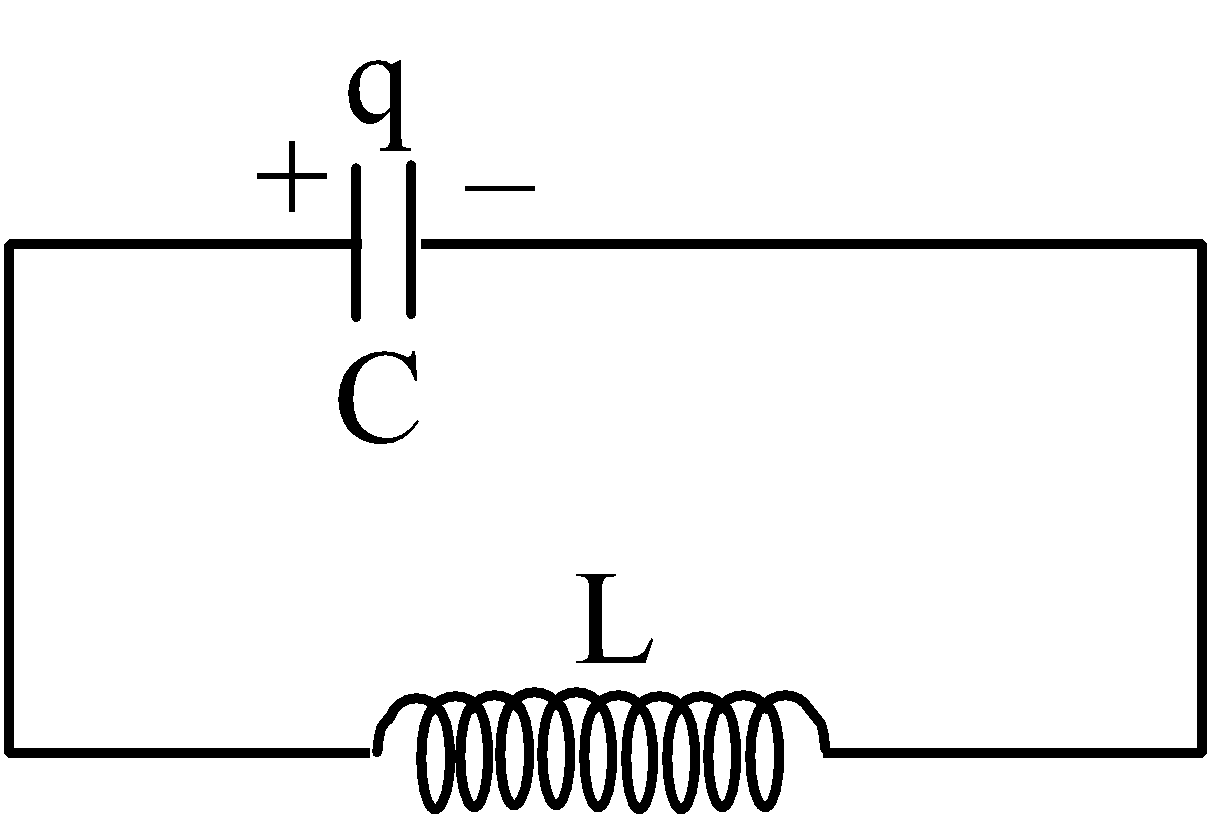
C = 1F, L = 4H.
At time t = 0, charge in the capacitor is 4C and it is decreasing at a rate of  .
.
(i) Maximum charge in the capacitor can be–
Text Solution
Verified by Experts(i) Sol; (ii) Sol; (iii) Sol
Ans.
(i)
Sol. At the given instant
i =  =
=  A
A
From conservation of energy

 =
= 
 +
+  Li 2 or q max =
=  = 6C
= 6C
(ii)
Sol. We have to find time taken from q = 4 C to
q = 6C. This we can find by calculating time from 6C to 4C and then subtract it from 

Here, ω =  =
=  rad/s
rad/s
∴  = cos
= cos  or t = 2 cos
–1 
T =  = (4π) sec
∴ Desired time is  – t =
– t =  sec
sec
(iii)
Sol. i max = (q max ω) = (6)  = 3A [as v max = ωA]
i = ω 
or  =
= 
q =  q max = 0.86 q max
Prepare Smarter with CGP Edu
Get practice questions, solutions, and test series in one place.
Write a Review
Share your experience with this question and solution.
Commentary
Send your comment, doubt, correction, or feedback to admin.
Similar Questions
Explore conceptually related problems