The given circuit shows an arrangement of four capacitors. A potential difference 30 V is applied across the combination. It is observed that potentials at points 'A' and 'B' differ by 5V with B at higher potential. Also if a conducting wire is connected between 'A' and 'B', electrons will flow from A to B. Of course, we have not connected any wire actually between A and B, We have described only an 'if' situation.
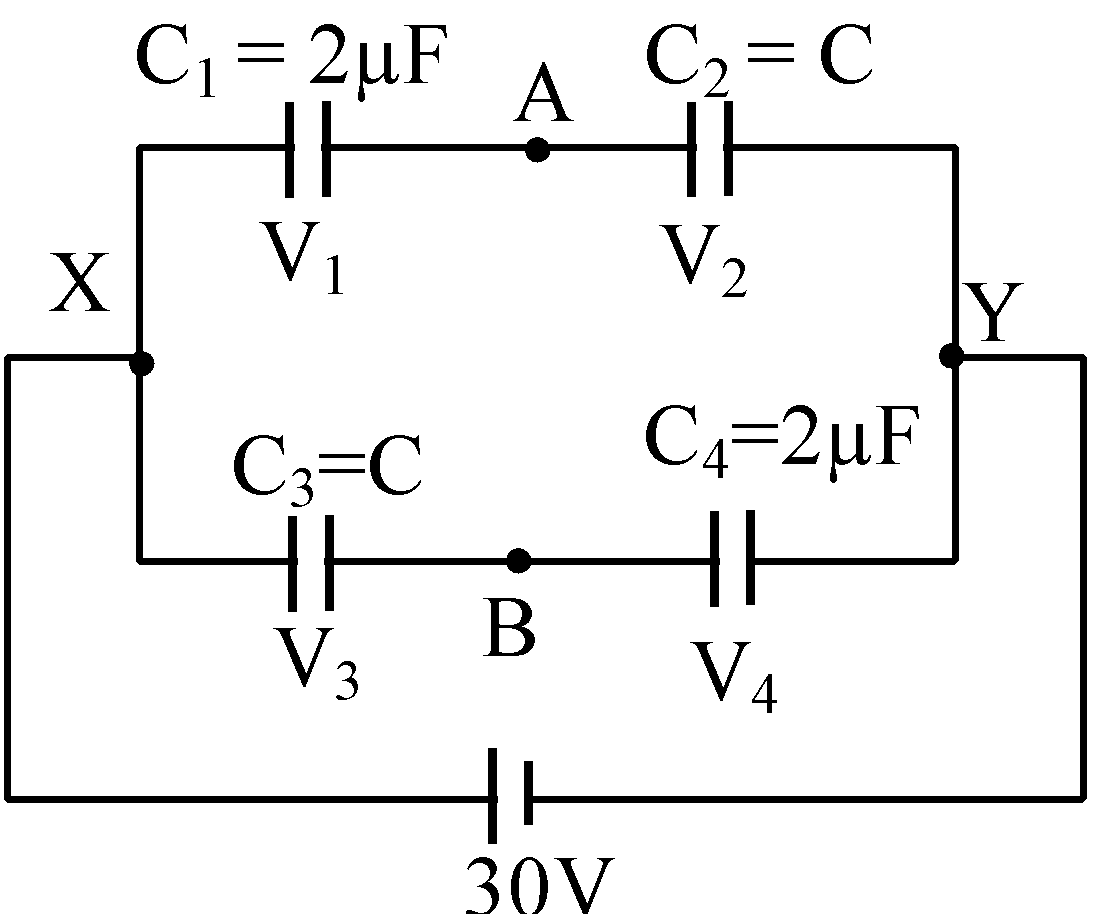
Let us now connect two more capacitors in the circuit. One of them, C 5 is connected in the parts of circuit between X and A. It could be either in series or in parallel with C 1 . The other, C 6 , is connected between A and B. It is observed whether we increase C 6 or reduce it, equivalent capacitance between X and Y has the same value.
Answer the following questions .
(i) Potential difference across C 4 before connecting two more capacitor is–
Text Solution
Verified by ExpertsC
Ans.
(i)
Sol. Potential difference across C 4 is V 4 .
V 4 = V 1
∴ V 4 = 17.5 V
So the correct answer is
(ii)
Sol. Consider any branch, say, ZAY.
Charge on C 1 = C 1 V 1 =2 × 17.5 = 35µC
Since C 1 and C 2 are in series, charge on C 2 is also 35µC.
Hence the correct option in Q.3 is
Using Q = CV for C 2 ,
C 2 = C =  =
=  = 2.8 µF
Equivalent capacitance of branch XAY is the series equivalent of C 1 = 2µ and C 2 = C = 2.8 µF, i.e.,  = 1.17µF
Equivalent capacitance of branch XBY is the series equivalent of C 3 = C = 2.8µF and C 4 = 2µF i.e. 1.17µF. These branches are in parallel between X and Y. Hence, equivalent capacitance between X and Y = 1.17 + 1.17 = 2.34 µF
Hence the correct option in Q. 2 in
(iii)
Sol. Capacitor C 6 is connected in the part of circuit between X and A either in series or parallel with C 1 = 2µF. Let the equivalent capacitance of C 1 and C 5 i.e., the equivalent capacitance between X and A be C´ 1 .
Capacitor C6 is connected between A and Y. Obviously, the circuit then becomes a Wheatstone bridge. Further, since equivalent capacitance between X and Y is independent of the value of C 6 , it implies that the bridge is in the balanced condition and potentials at A and B are now equal, so that:
 =
= 
∴  =
=  (C 2 = C 3 = 2.8µF, as or determined earlier)
C 1 = 3.92µF
C´ 1 is the equivalent capacitance of C 1 = 2µF and C 5 . Since C´ 1 > C 1 , therefore, we can conclude that C 1 and C 5 could not be connected in series. We know that series equivalent capacitance is less then each individual capacitance. Hence, C 1 and C 5 are are in parallel, so that
C´ 1 = C 1 + C 5
or C 5 = C´ 1 – C 1 = 3.92 – 2 = 1.92µF
Prepare Smarter with CGP Edu
Get practice questions, solutions, and test series in one place.
Write a Review
Share your experience with this question and solution.
Commentary
Send your comment, doubt, correction, or feedback to admin.
Similar Questions
Explore conceptually related problems