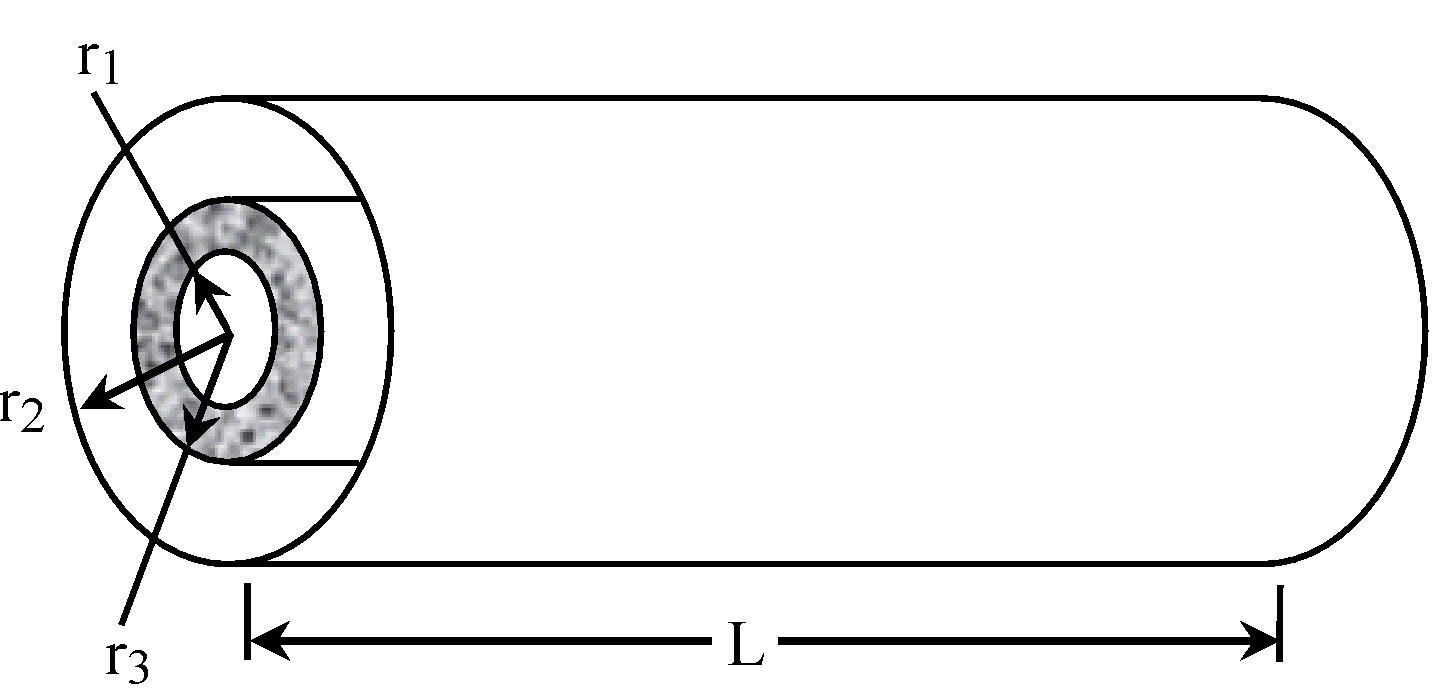
A capacitor is made of two concentric cylinders of radius r 1 and r 2 (r 1 < r 2 ) and length L.>> r 2 . The region between r 1 and r 3 =  is filled with a circular cylinder of length L and dielectric constant K (the remaining volume is an air gap).
Text Solution
Verified by ExpertsCHECK THE SOLUTION.
Sol. Let λ be the charge per unit length on the cylinder with radius r 1 . From Gauss's law we have
 dA =
dA =  ….. (1)
where the surface S is defined to be a cylinder of radius r and of unit length. Since E r is a function of r only, (1) immediately leads to
E r =  . ….. (2)
The potential difference between the two cylinders is
V =  =
= 
 ….. (3)
from which we find the capacitance C
C =  =
=  …. (4)
From (3), we can solve for the charge density
λ =  . ….. (5)
From Gauss's law we get
E =  for r 1 < r < r 3
=  for r 3 < r < r 2 ….. (6)
from which we obtain the displacement in the dielectric medium
When the potential difference between the two cylinders is kept constant, the system can no longer be isolated. There has to be some source of charge (battery) to supply energy. Let C' be the capacitance of the system without the dielectric material. From (4) we find
C' =  . ….. (7)
The work needed is
work needed =  C'V 2 –
  CV 2 – (Q' – Q)V
where Q' is the final total charge on one cylinder. Using Q' = C'V, we get
Work needed =  (C –C')
=  2π ε 0 L
where we have used (4) and (7).
Prepare Smarter with CGP Edu
Get practice questions, solutions, and test series in one place.
Write a Review
Share your experience with this question and solution.
Commentary
Send your comment, doubt, correction, or feedback to admin.
Similar Questions
Explore conceptually related problems