Inside a parallel-plate capacitor there is a plate parallel to the outer plates, whose thickness is equal to η = 0.60 of the gap width. When the plate is absent the capacitor capacitance equals C = 20 nF. First, the capacitor was connected in parallel to a constant voltage source producing V = 200 Volt, then it was disconnected from it, after which the plate was slowly removed from the gap. Find the work performed during the removal, if the plate is-
Text Solution
Verified by ExpertsCHECK THE SOLUTION.
Sol. If the space between plates is filled by a number of media, then
C = 
Step I: When plate is not introduced then
C =  = 20 × 10 –9 F
According to problem, the thickness of introducing plate is
t 2 = η d
The air gap is t 2 = d – η d = (1 – η )
C 1 = 
where ε is dielectric constant of introducing plate
∴ C 1 =  =
= 
=  =
= 
The corresponding circuit is shown in Fig.
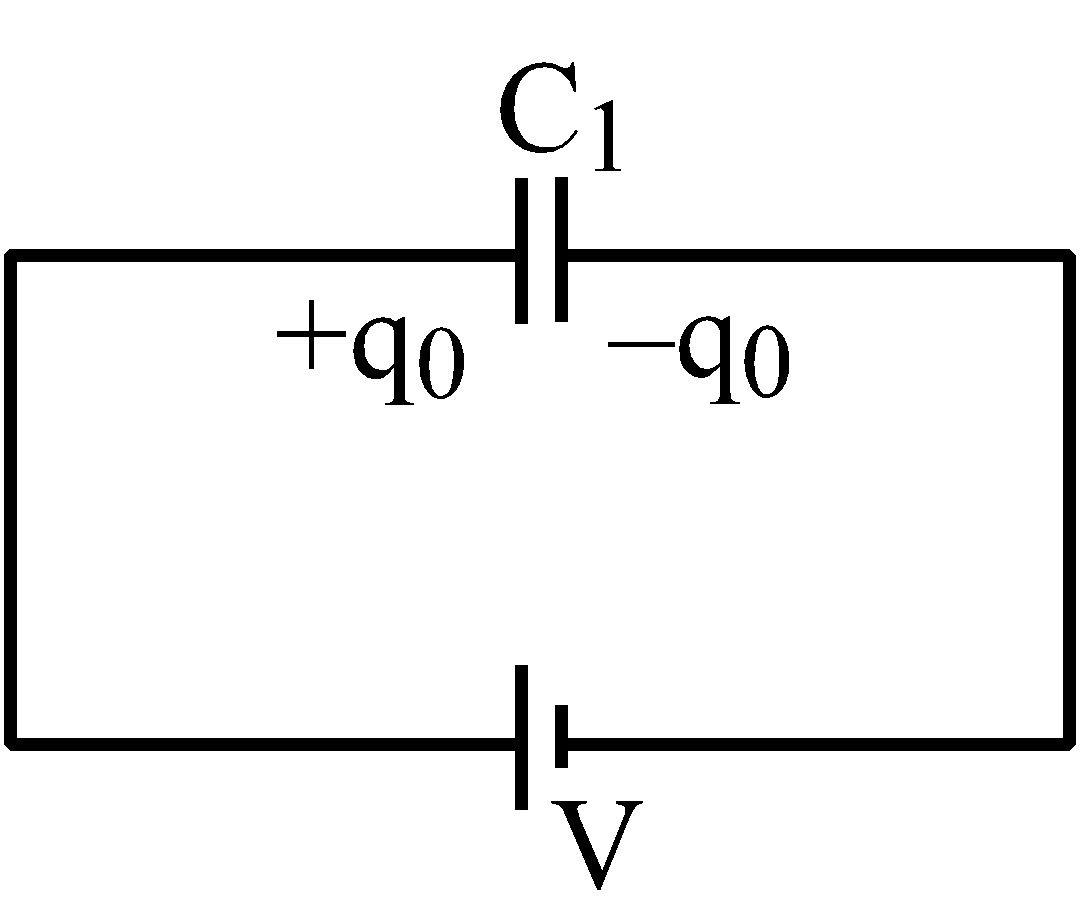
∴ q 0 = C 1 V
The energy stored on capacitor is U i =  .
.
Step II : Discuss the problem after removing the battery: When battery is disconnected from the capacitor, electric charge on plates of capacitor remains conserved.
Due to removal of the plate, capacity of capacitor changes. The new capacity of the capacitor is C = 
Now energy stored on the capacitor is U f = 
∴ Δ U = U f – U i = 

The work done by external agent is A ext = Δ U = 

On putting the value of C 1 , we get A ext = 

= 

or A ext = 
 =
= 

But q 0 = C 1 V = 
q 0 = 
∴ A ext = 


= 


For conductor, ε = ∞
∴ A ext =  = 1.5 mJ
 A ext =
 =
= 
For glass ε = 6
On putting the values, we get A ext = 0.8 mJ.
Prepare Smarter with CGP Edu
Get practice questions, solutions, and test series in one place.
Write a Review
Share your experience with this question and solution.
Commentary
Send your comment, doubt, correction, or feedback to admin.
Similar Questions
Explore conceptually related problems