A plate A of a parallel-plate capacitor is fixed, while a plate B is attached to the wall by a spring and can move, remaining parallel to the plate A (Fig.). After the key K is closed, the plate B starts moving and comes to rest in a new equilibrium position. The initial equilibrium separation d between the plates decreases in this case by 10%.
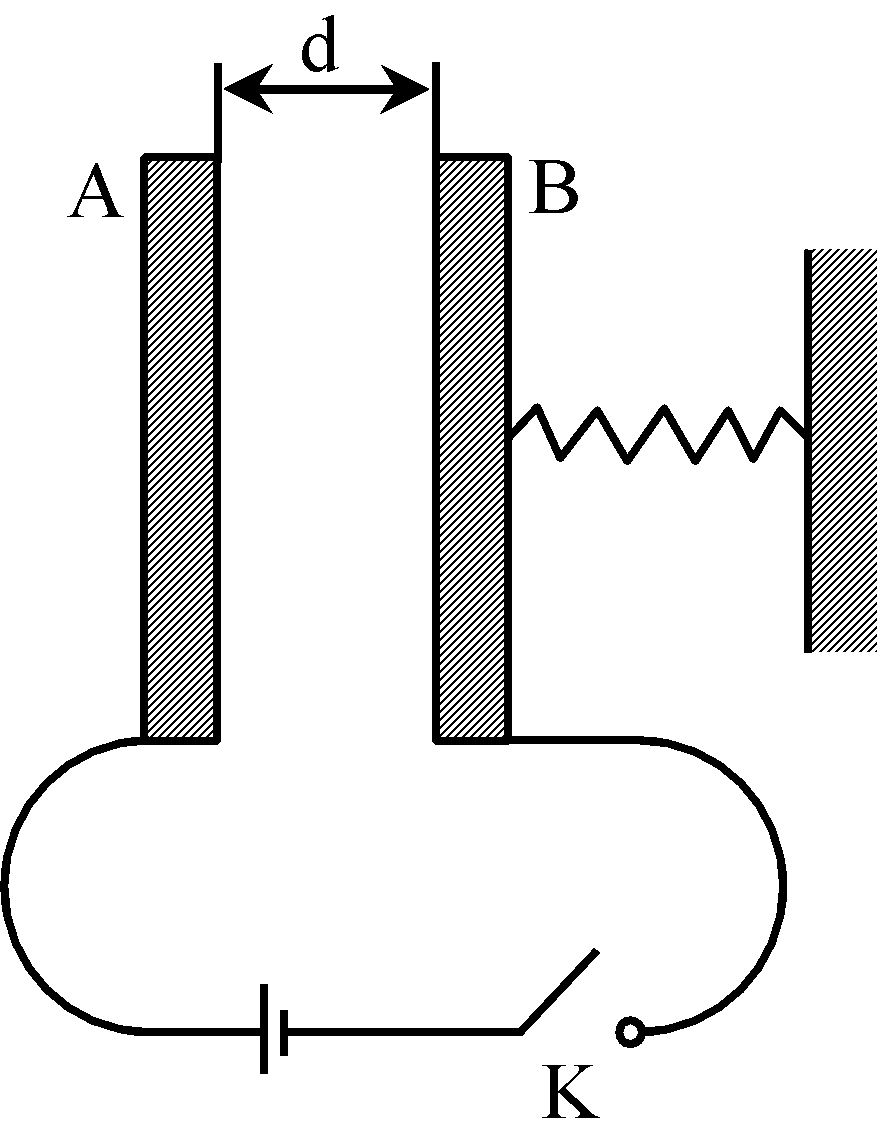

What will be the decrease in the equilibrium separation between the plates if the key K is closed for such a short time that the plate B cannot be shifted noticeably?
Text Solution
Verified by ExpertsCHECK THE SOLUTION.
Sol. When the key K is closed, the voltage across the capacitor is maintained constant and equal to the emf e of the battery. Let the displacement of the plate B upon the attainment of the new equilibrium position be –x 1 . In this case, the charge on the capacitor is q 1 = C 1 e = ε 0 S e/(d – x 1 ), where S is the area of the capacitor plates. The field strength in the capacitor is E 1 = e/(d – x 1 ), but it is produced by two plates. Therefore, the field strength produced by one plate is E 1 /2, and for the force acting on the plate B we can write
 =
=  = kx 1 , ….. (1)
where k is the rigidity of the spring.
Let us now consider the case when the key K is closed for a short time. The capacitor acquires a charge q 2 , = ε 0 Se/d (the plates have no time to shift), which remains unchanged. Let the displacement of the plate B in the new equilibrium position be x 2 . Then the field strength the capacitor becomes E 2 = q 2 /[C 2 (d – x 2 )] and C 2 = ε 0 S/(d – x 2 ). In this case, the equilibrium condition for the plate B can be written in the form
 =
=  =
=  = kx 2 . ….. (2)
Dividing Eqs. (1) and (2) termwise, we obtain x 2 = x 1 [(d – x 1 )/d] 2 . Considering that x 1 = 0.1 d by hypothesis, we get
x 2 = 0.08d.
Prepare Smarter with CGP Edu
Get practice questions, solutions, and test series in one place.
Write a Review
Share your experience with this question and solution.
Commentary
Send your comment, doubt, correction, or feedback to admin.
Similar Questions
Explore conceptually related problems