Published by:
CGP EDU Academic Team
Published on: September 12, 2026
Vessels A and B contain carbon dioxide (CO 2 ) and hydrogen; (H 2 ). Pressure-gauges M 1 and M 2 register equal pressures. In which direction will gas flow if the valve K is opened (Fig.)? What will happen if the same experiment is carried out with the vessels turned so that the pressure-gauges are underneath?
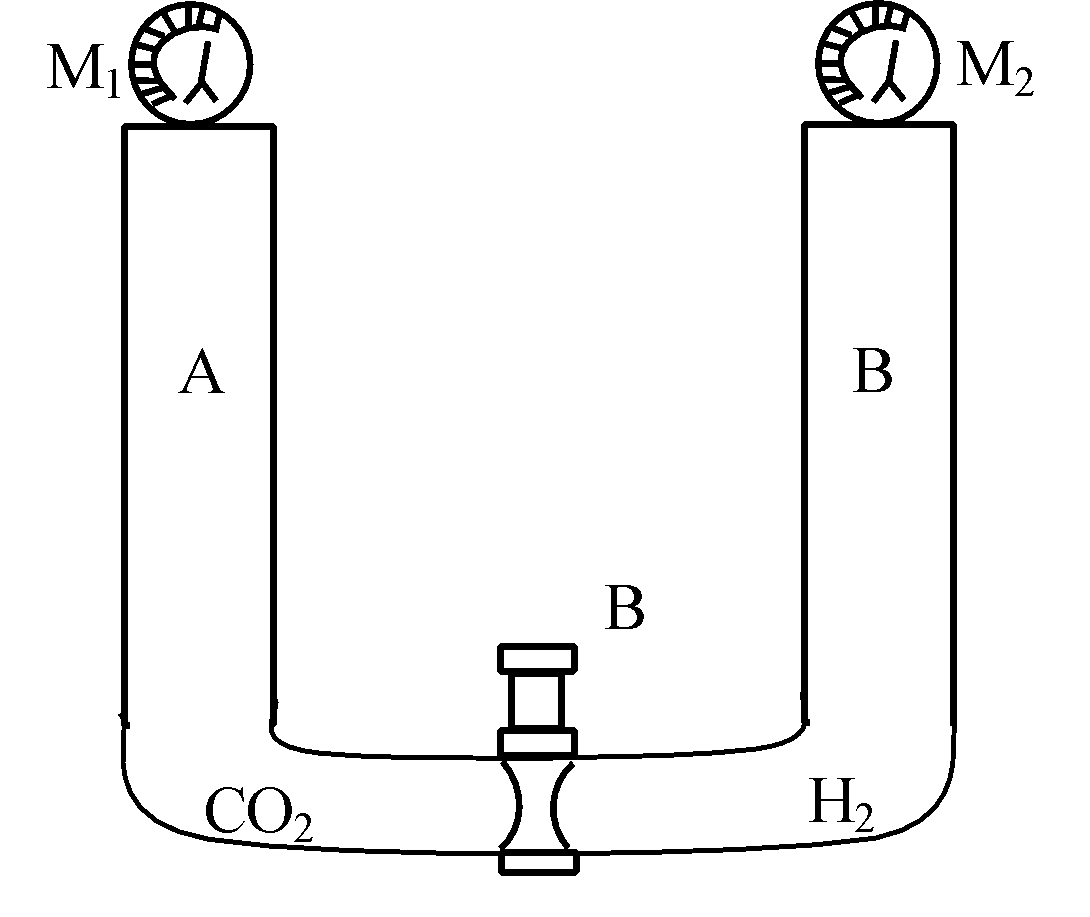
Text Solution
Verified by ExpertsThe correct answer is:
A
Step 1: Understand that gases flow from a region of high pressure to a region of low pressure when a valve is opened. In the given setup, both pressure gauges are registering equal pressures, indicating a balance.
Step 2: When the valve K is opened, the gases (CO2 from vessel A and H2 from vessel B) will tend to mix due to diffusion but will flow from the vessel that has a higher partial pressure of its respective gas due to molecular movement.
Step 3: Since the total pressures are equal in both vessels, there is no immediate pressure differential to drive the flow in one direction; hence, gases may flow in both directions but will mostly favor the direction toward lower molecular weight (H2) if there’s any preferential flow.
Step 4: If the experiment is conducted with the vessels turned such that the pressure gauges are beneath, due to potential changes in gas behavior and gravitational effects on density, the scenario may impact the flow direction differently, though fundamentally gases will still flow from high to low pressure on average regardless of orientation.
Therefore, based on the individual gas properties, likely flow would occur with the lighter gas H2 moving preferentially towards A.
Step 2: When the valve K is opened, the gases (CO2 from vessel A and H2 from vessel B) will tend to mix due to diffusion but will flow from the vessel that has a higher partial pressure of its respective gas due to molecular movement.
Step 3: Since the total pressures are equal in both vessels, there is no immediate pressure differential to drive the flow in one direction; hence, gases may flow in both directions but will mostly favor the direction toward lower molecular weight (H2) if there’s any preferential flow.
Step 4: If the experiment is conducted with the vessels turned such that the pressure gauges are beneath, due to potential changes in gas behavior and gravitational effects on density, the scenario may impact the flow direction differently, though fundamentally gases will still flow from high to low pressure on average regardless of orientation.
Therefore, based on the individual gas properties, likely flow would occur with the lighter gas H2 moving preferentially towards A.
Prepare Smarter with CGP Edu
Get practice questions, solutions, and test series in one place.
Write a Review
Share your experience with this question and solution.
Commentary
Send your comment, doubt, correction, or feedback to admin.
Similar Questions
Explore conceptually related problems
A U-tube in which the cross-sectional area of the limb on the left is one quarter, the limb on the …
A wooden block, with a coin placed on its top, floats in water as shown in fig. the distance l and …
A body floats in a liquid contained in a beaker. The whole system as shown falls freely under gravi…
A liquid is kept in a cylindrical vessel which is being rotated about a vertical axis through the c…
Water is filled in a cylindrical container to a height of 3m. The ratio of the cross-sectional area…
A large open tank has two holes in the wall. One is a square hole of side L at a depth y from the t…