Published by:
CGP EDU Academic Team
Published on: September 12, 2026
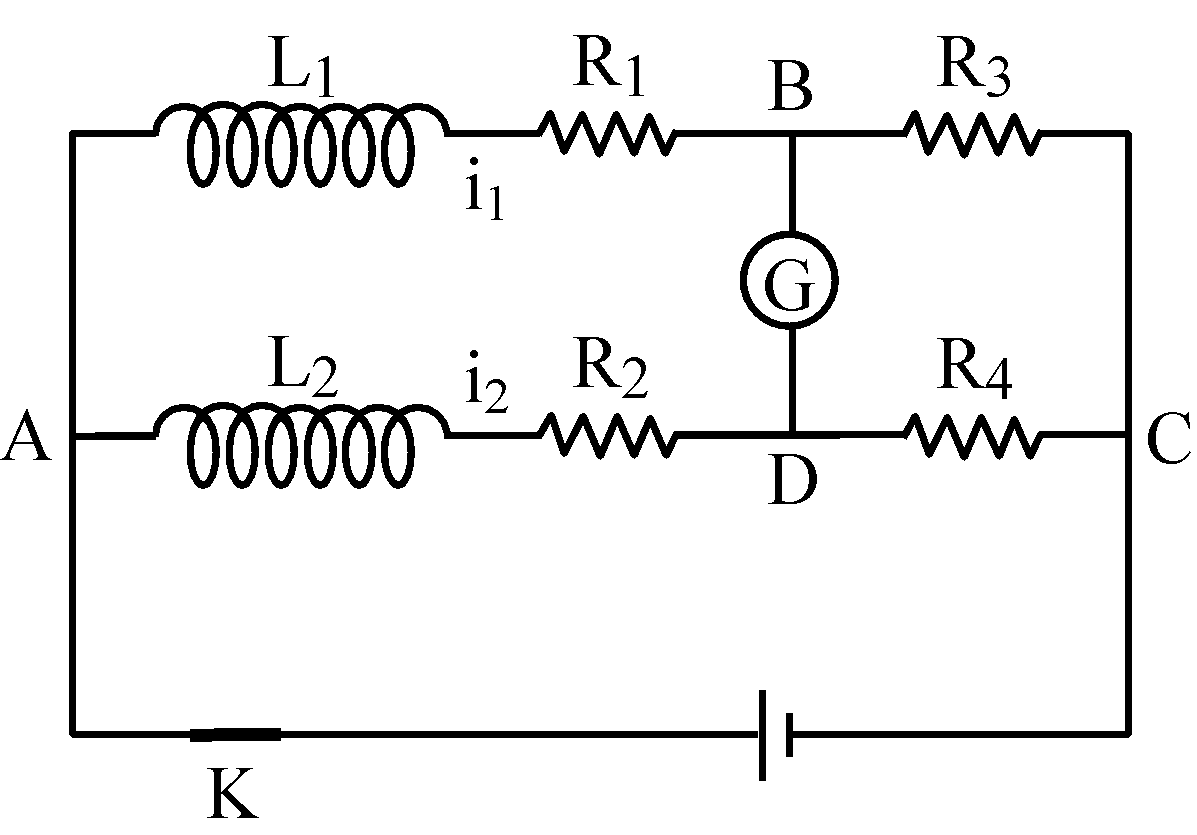
Two inductors of self-inductances L 1 and L 2 and of resistances R 1 and R 2 (not shown here) respectively, are connected in the circuit as shown in Fig. At the instant t = 0, key K is closed. Obtain an expression for which the galvanometer will show zero deflection at all times after the key is closed.
Text Solution
Verified by ExpertsThe correct answer is:
B
To find an expression ensuring the galvanometer shows zero deflection, we need to set the currents through the two inductors such that the net magnetic effect at the galvanometer is zero at all times after the key is closed.
Step 1: When the key K is closed at t = 0, inductors L1 and L2 will oppose the change in current due to their self-inductance. This induces an electromotive force (emf) that will affect the circuit.
Step 2: Applying Kirchhoff's loop rule to the circuit, we have:
$$ V - I_1 R_1 - L_1 \frac{dI_1}{dt} = 0 $$
$$ V - I_2 R_2 - L_2 \frac{dI_2}{dt} = 0 $$
where V is the applied voltage, I1 is the current through L1, and I2 is the current through L2.
Step 3: To ensure the galvanometer shows zero deflection, the currents I1 and I2 must be equal, i.e., I1 = I2 at all times.
Step 4: Thus, we can equate the expressions from the above currents:
$$ I_1 = \frac{V}{R_1} e^{-\frac{R_1}{L_1}t} $$
$$ I_2 = \frac{V}{R_2} e^{-\frac{R_2}{L_2}t} $$
Therefore, for zero deflection,
$$ \frac{V}{R_1} = \frac{V}{R_2} $$
which implies R1 = R2.
Conclusion: Therefore, the condition for the galvanometer to show zero deflection at all times is that the resistances R1 and R2 should be equal.
Step 1: When the key K is closed at t = 0, inductors L1 and L2 will oppose the change in current due to their self-inductance. This induces an electromotive force (emf) that will affect the circuit.
Step 2: Applying Kirchhoff's loop rule to the circuit, we have:
$$ V - I_1 R_1 - L_1 \frac{dI_1}{dt} = 0 $$
$$ V - I_2 R_2 - L_2 \frac{dI_2}{dt} = 0 $$
where V is the applied voltage, I1 is the current through L1, and I2 is the current through L2.
Step 3: To ensure the galvanometer shows zero deflection, the currents I1 and I2 must be equal, i.e., I1 = I2 at all times.
Step 4: Thus, we can equate the expressions from the above currents:
$$ I_1 = \frac{V}{R_1} e^{-\frac{R_1}{L_1}t} $$
$$ I_2 = \frac{V}{R_2} e^{-\frac{R_2}{L_2}t} $$
Therefore, for zero deflection,
$$ \frac{V}{R_1} = \frac{V}{R_2} $$
which implies R1 = R2.
Conclusion: Therefore, the condition for the galvanometer to show zero deflection at all times is that the resistances R1 and R2 should be equal.
Prepare Smarter with CGP Edu
Get practice questions, solutions, and test series in one place.
Write a Review
Share your experience with this question and solution.
Commentary
Send your comment, doubt, correction, or feedback to admin.
Similar Questions
Explore conceptually related problems
An electric motor operating on a 60 Vdc supply draws a current of 10 A. If the efficiency of the mo…
A thin semicircular conducting ring of the radius is falling with its plane vertical in a horizont…
At a place the value of horizontal component of the earth's magnetic field is Weber . A metallic…
A circular loop of radius carrying current I lies in plane with its centre at origin. The total m…
Two identical circular loops of metal wire are lying on a table without touching each other. Loop-A…
A small square loop of wire of side l is placed inside a large square loop of wire of side . The l…