A block of mass 15 kg is placed over a frictionless horizontal surface. Another block of mass 10 kg is placed over it, that is connected with a light string passing over two pulleys fastened to the 15 kg block. A force F = 80 N is applied horizontally to the free end of the string. Friction coefficient between two blocks is 0.6. The portion of the string between 10 kg block and the upper pulley is horizontal as shown in figure Pulley string & connecting rods are massless. (Take g = 10 m/s 2 )
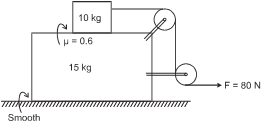
(i) The magnitude of acceleration of the 10 kg block is:
Text Solution
Verified by ExpertsCHECK THE SOLUTION.
(i) First, let us check upto what value of F, both blocks move together. Till friction becomes limiting, they will be moving together. Using the FBDs
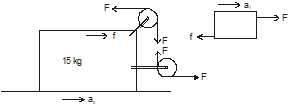
10 kg block will not slip over the 15 kg block till acceleration of 15 kg block becomes maximum as it is
created only by friction force exerted by 10 kg block on it
a 1 > a 2(max)
 =
=  for limiting condition as f maximum is 60 N.
F = 100 N.
Therefore, for F = 80 N, both will move together.
Their combined acceleration, by applying NLM using both as system F = 25a
a =  = 3.2 m/s 2
(ii) If F = 120 N, then there will be slipping, so using FBDs of both (friction will be 60 N)
For 10 kg block
120 – 60 = 10 a
a = 6 m/s 2
For 15 kg block
60 = 15a
a = 4 m/s 2
(iii) In case 80 N force is applied vertically, then
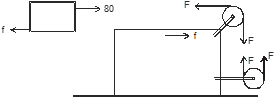
For 10 kg block 80 – 60 = 10a
a = 2 m/s 2
For 15 kg block in horizontal direction.
F – f = 15a
a = 4/3 m/s 2 , towards left.
Prepare Smarter with CGP Edu
Get practice questions, solutions, and test series in one place.
Write a Review
Share your experience with this question and solution.
Commentary
Send your comment, doubt, correction, or feedback to admin.
Similar Questions
Explore conceptually related problems