Published by:
CGP EDU Academic Team
Published on: September 12, 2026
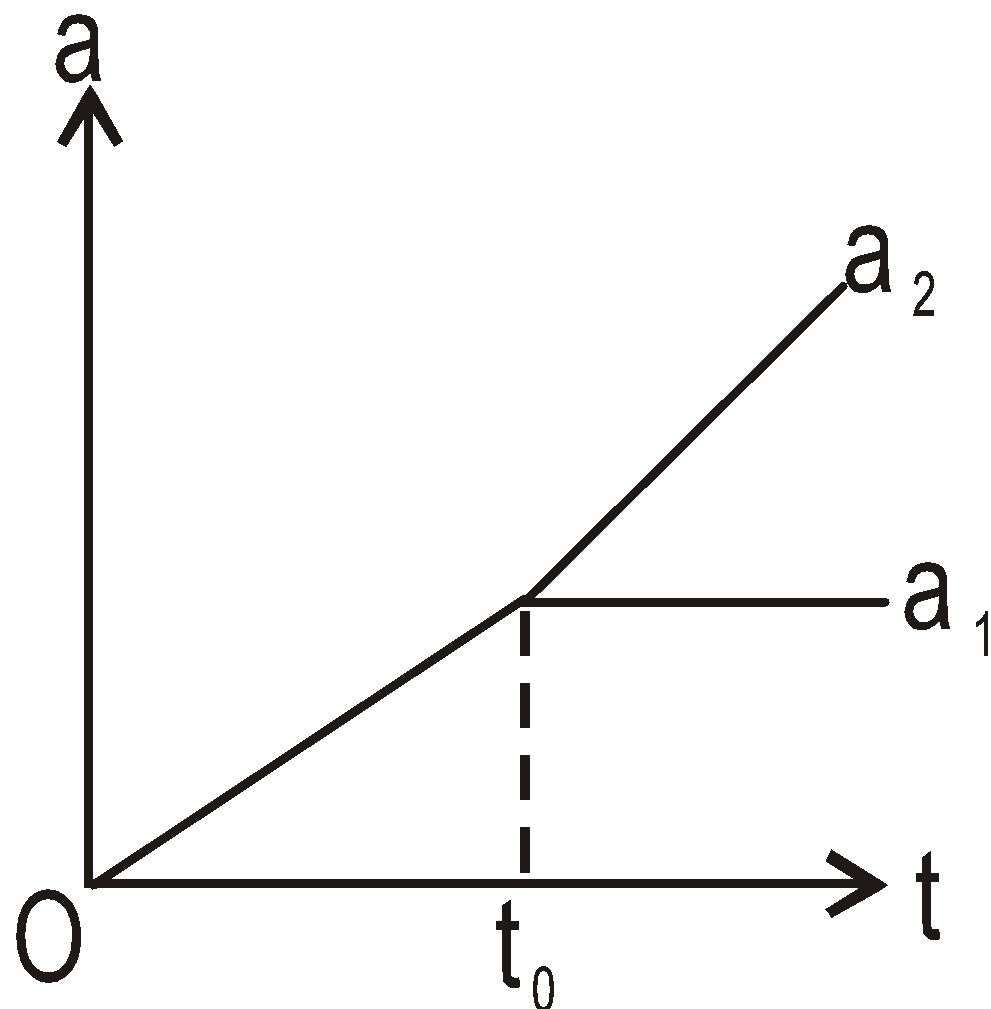
A plank of mass m 1 with a bar of mass m 2 placed on it lies on a smooth horizontal plane. A horizontal force growing with time t as F = kt (k is constant) is applied to the bar. Find how the accelerations of the plank a 1 and of the bar a 2 depend on t, if the coefficient of friction between the plank and the bar is equal to µ. Draw the approximate plots of these dependences.
Text Solution
Verified by ExpertsThe correct answer is:
A
To solve this problem, we need to analyze the system consisting of a plank with mass \( m_1 \) and a bar with mass \( m_2 \) placed on it. A force \( F = kt \) is applied to the bar, which produces motion. The key point to consider is the friction between the plank and the bar.
**Step 1: Analyzing Forces on Bar (m2)**
When the force \( F = kt \) is applied to the bar, the maximum frictional force that can act on the bar due to the plank is given by:
\[ f_{max} = \mu m_2 g \]\
This force is what allows the bar to accelerate along with the plank. If the applied force exceeds this maximum friction, the bar will start slipping.
**Step 2: Setting Up the Equations**
Using Newton's second law for the bar, we have:
\[ m_2 a_2 = kt - f \] where \( f \) is the frictional force. For the plank, the frictional force acting on it is equal in magnitude and opposite in direction:
\[ m_1 a_1 = f \]
So, we can express \( f \) in terms of \( a_1 \):
\[ f = m_1 a_1 \]
Thus, for the bar:
\[ m_2 a_2 = kt - m_1 a_1 \]
And for the plank:
\[ m_1 a_1 = \mu m_2 g \] (as long as the bar doesn't slip). If we assume that they don't slip, both objects will have the same acceleration because of static friction, i.e., \( a_1 = a_2 = a \).
**Step 3: Equal Accelerations**
We can set both equations with acceleration defined as \( a \):
\[ m_2 a = kt - \mu m_2 g \]
From this, we can express the acceleration of the bar (and the plank since they move together):
\[ a = \frac{kt - \mu m_2 g}{m_2} \]
**Step 4: Time Dependency on Accelerations**
1. For small values of time where \( kt \, < \, \mu m_2 g \):
\( F \) does not exceed maximum friction, and both the bar and plank accelerate:
\[ a = \frac{kt}{m_2} - \frac{\mu g}{m_2} \]\
2. At the point where \( kt = \mu m_2 g \), the friction limit is reached, and the bar begins to slide over the plank. After this point, the accelerations will diverge:
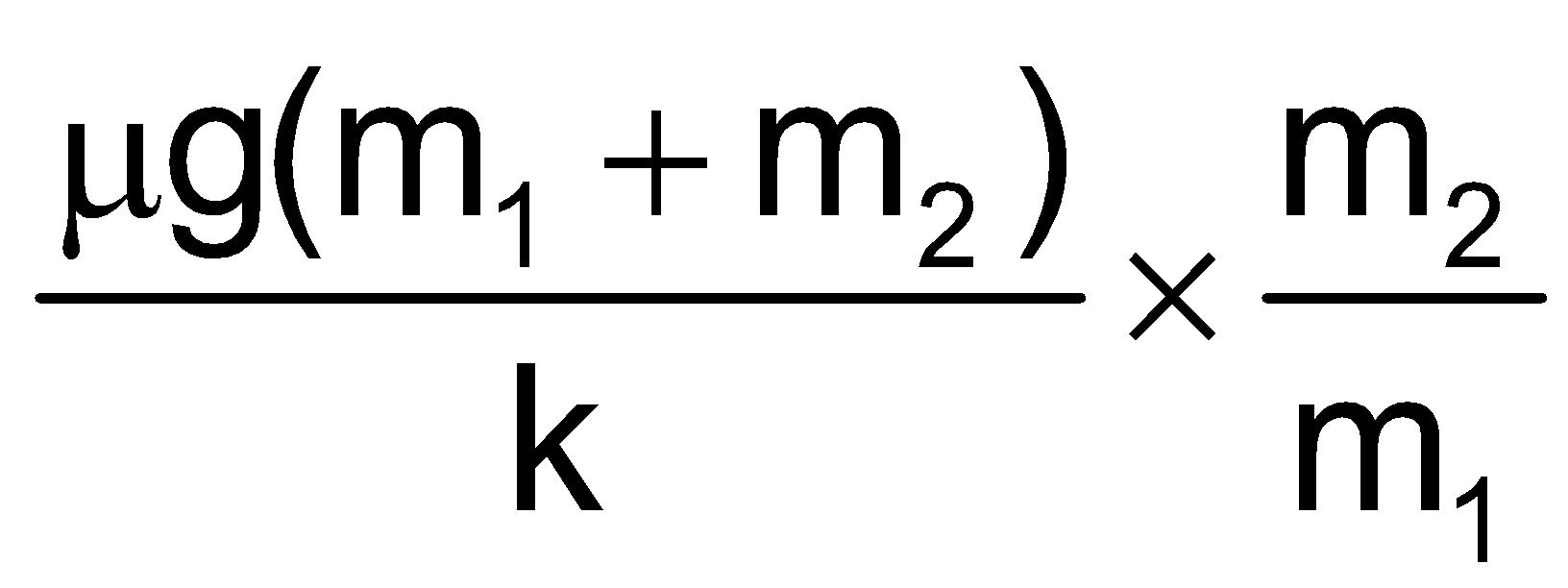
\[ a_1 = \frac{F}{m_1 + m_2} \] and \[ a_2 = \frac{kt}{m_2} \]
**Step 5: Conclusion and Plot**
The values of \( a_1 \) will be constant at \( \mu g \) before slipping and will begin to decrease afterward due to inertia. \( a_2 \) continues to increase linearly with time until the maximum friction is surpassed. Therefore, the graphs would depict the total acceleration of the bar increasing linearly until the limiting friction, after which the plank’s acceleration will become constant or less than that of the bar.
Final Result:
The relationship of the accelerations can be summarized as follows:
\[ a_1 = \begin{cases} \frac{kt}{m_1 + m_2}, & \text{if} \, kt < \mu m_2 g\ \mu g, & \text{if} \, kt = \mu m_2 g \end{cases} \] \[ a_2 = \frac{kt}{m_2} \]
Thus, the dependency of the accelerations is as described above.
**Step 1: Analyzing Forces on Bar (m2)**
When the force \( F = kt \) is applied to the bar, the maximum frictional force that can act on the bar due to the plank is given by:
\[ f_{max} = \mu m_2 g \]\
This force is what allows the bar to accelerate along with the plank. If the applied force exceeds this maximum friction, the bar will start slipping.
**Step 2: Setting Up the Equations**
Using Newton's second law for the bar, we have:
\[ m_2 a_2 = kt - f \] where \( f \) is the frictional force. For the plank, the frictional force acting on it is equal in magnitude and opposite in direction:
\[ m_1 a_1 = f \]
So, we can express \( f \) in terms of \( a_1 \):
\[ f = m_1 a_1 \]
Thus, for the bar:
\[ m_2 a_2 = kt - m_1 a_1 \]
And for the plank:
\[ m_1 a_1 = \mu m_2 g \] (as long as the bar doesn't slip). If we assume that they don't slip, both objects will have the same acceleration because of static friction, i.e., \( a_1 = a_2 = a \).
**Step 3: Equal Accelerations**
We can set both equations with acceleration defined as \( a \):
\[ m_2 a = kt - \mu m_2 g \]
From this, we can express the acceleration of the bar (and the plank since they move together):
\[ a = \frac{kt - \mu m_2 g}{m_2} \]
**Step 4: Time Dependency on Accelerations**
1. For small values of time where \( kt \, < \, \mu m_2 g \):
\( F \) does not exceed maximum friction, and both the bar and plank accelerate:
\[ a = \frac{kt}{m_2} - \frac{\mu g}{m_2} \]\
2. At the point where \( kt = \mu m_2 g \), the friction limit is reached, and the bar begins to slide over the plank. After this point, the accelerations will diverge:
\[ a_1 = \frac{F}{m_1 + m_2} \] and \[ a_2 = \frac{kt}{m_2} \]
**Step 5: Conclusion and Plot**
The values of \( a_1 \) will be constant at \( \mu g \) before slipping and will begin to decrease afterward due to inertia. \( a_2 \) continues to increase linearly with time until the maximum friction is surpassed. Therefore, the graphs would depict the total acceleration of the bar increasing linearly until the limiting friction, after which the plank’s acceleration will become constant or less than that of the bar.
Final Result:
The relationship of the accelerations can be summarized as follows:
\[ a_1 = \begin{cases} \frac{kt}{m_1 + m_2}, & \text{if} \, kt < \mu m_2 g\ \mu g, & \text{if} \, kt = \mu m_2 g \end{cases} \] \[ a_2 = \frac{kt}{m_2} \]
Thus, the dependency of the accelerations is as described above.
Prepare Smarter with CGP Edu
Get practice questions, solutions, and test series in one place.
Write a Review
Share your experience with this question and solution.
Commentary
Send your comment, doubt, correction, or feedback to admin.
Similar Questions
Explore conceptually related problems
A body of mass 5 kg is kept on a rough horizontal surface. It is found that the body does not slide…
In the given figures find the accelerations and the friction forces involved
(i)
(ii)
(iii)
(iv)
In the given figure find the accelerations of blocks A and B for the following cases (g = 10 m/s 2 …
Column II gives certain situations involving two blocks of mass 2 kg and 4 kg. The 4 kg block lies …
In the arrangement shown tension in the string connecting 4kg and 6kg masses is
In the given figure the coefficient of friction between 4kg and 5 kg blocks is 0.2 and between 5 kg…