Home Physics Atomic and Nuclear Physics General 100 millicuries of radon which emits - part…
Physics Atomic and Nuclear Physics General Subjective Type
Published on: September 12, 2026

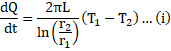
100 millicuries of radon which emits - particles are contained in a glass capillary tube 5 cm long with internal and external diameters 2 and 6 mm respectively Neglecting and effects and assuming that the inside of the tube is uniformly irradiated by the particles which are stopped at the surface calculate the temperature difference between the walls of a tube when steady thermal conditions have been reached.

Thermal conductivity of glass

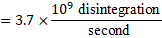
Curie disintegration per second
joule

Share this question

For Instagram sharing, use “Apps” on mobile or copy the link.

Text Solution

Verified by Experts
The correct answer is:
A
To calculate the temperature difference between the walls of the tube when steady thermal conditions have been reached, we will use the basic principles of heat transfer.
1. **Determine the energy emitted by radon per second**: Since we have 100 millicuries (mCi) of radon, we can convert this to disintegrations per second using the relation:
\[ 100\, \text{mCi} = 100 \times 3.7 \times 10^{10}\, \text{disintegrations/sec} = 3.7 \times 10^{12}\, \text{disintegrations/sec} \]
2. **Energy emitted**: Each decay releases 5.5 MeV. To convert this to joules:
\[ 5.5\, \text{MeV} = 5.5 \times 1.6 \times 10^{-13}\, J = 8.8 \times 10^{-13}\, J \]
Therefore, the total energy emitted per second is:
\[ E = 3.7 \times 10^{12} \times 8.8 \times 10^{-13} = 3.256 \times 10^{0}\, J \approx 3.26\, J/s \]
3. **Calculating heat transfer through the wall of the tube**: The thermal conductivity \( k \) of glass is given as 0.025 Cal cm$^{-2}$ s$^{-1}$ C$^{-1}$, which is approximately \( 0.025 \times 4.184\, J/cm^2 s C \approx 0.10401 \text{ J/cm}^2 ext{s C} \) (using \( 1 ext{ Cal} = 4.184 ext{ J} \)).
4. **Surface area of the tube**: The internal diameter (d) is 0.2 cm and the length (L) is 5 cm:
\[ A = \pi d L = \pi (0.2\, cm)(5\, cm) = \pi\, cm^2 \approx 0.6283\, cm^2 \]
5. **Heat transfer equation**: Using Fourier's law:
\[ \dot{Q} = k A \frac{\Delta T}{L} \Rightarrow \Delta T = \frac{\dot{Q} L}{k A} \]
Plugging in the values:
\[ \Delta T = \frac{3.26\, J/s \cdot 5\, cm}{0.10401\, J/cm^2\text{s C} \cdot 0.6283\, cm^2} \approx 24.3 C \]
Therefore, the temperature difference between the walls of the tube when steady-state thermal conditions are reached is approximately \(\Delta T \approx 24.3 C\).
Thus, the correct answer is A.

Prepare Smarter with CGP Edu

Get practice questions, solutions, and test series in one place.

Write a Review

Share your experience with this question and solution.

Commentary

Send your comment, doubt, correction, or feedback to admin.

Student Reviews

What students say about this solution

No reviews yet. Be the first to write a review.

Similar Questions

Explore conceptually related problems

CG
CGP Question Assistant Question Bank + AI Help
Hi! Type your question or upload one screenshot. First I will search related questions from CGP Edu Question Bank. If none match, type YES and I will solve it with AI.
Upload only one screenshot at a time. Flow: Question Bank first → If not matched, type YES for AI solution.