A radio nuclide with half life  second emits
  -particles of average kinetic energy
  11.25 eV . At an instant concentration of
  -particles at distance,
  from nuclide is
  per
per  .
.
(i) Calculate number of nuclei in the nuclide at that instant.
(ii) If a small circular plate is placed at distance r from nuclide such that  -particles strike the plate normally and come to rest, calculate pressure experienced by the plate due to collision of
  -particle. (Mass of
  -particle
Text Solution
Verified by ExpertsCHECK THE SOLUTION.
((i)  , (ii)
  )
)
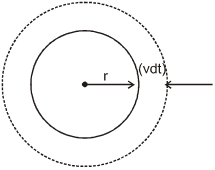
Let activity (rate of decay) of the nuclide be A nuclei per second. It means  -particles are emitted per second. If a spherical surface of radius
  with center at position of nuclide be considered then
  -particle cross this surface per second. It means during an elemental time interval dt a number (A.dt) of
  -particle cross this surface. If velocity of
  -particles be
  then above calculated (A. dt)
  -particle are in a space having shape of a spherical shell of radius
  and radial thickness ( v dt ) as shown in figure.
Volume of this space  (vdt)
(vdt)
∴ Concentration of  -particles at distance
  from nuclide is

or activity of the nuclide, 
But activity,  where N is number of nuclei
Hence,  but decay constant
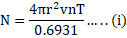
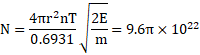
Kinetic energy of  -particle,

substituting this value in equation (i),
(ii) At distance  from the nuclide
  -particle cross unit area per second.
Let area of small circular plate be  , then number of
  -particle striking the plate per second

Momentum of each particle just before collision is mv and after collision particles come to rest or momentum becomes zero.
∴ Momentum transferred to plate due to collision is

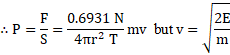
Due to transfer of momentum, the plate experiences a force which is equal to rate of transfer of momentum.
∴ Force,  no. of particles striking per second
or
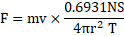
Pressure,


Prepare Smarter with CGP Edu
Get practice questions, solutions, and test series in one place.
Write a Review
Share your experience with this question and solution.
Commentary
Send your comment, doubt, correction, or feedback to admin.
Similar Questions
Explore conceptually related problems