Published by:
CGP EDU Academic Team
Published on: September 12, 2026
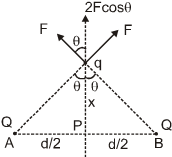
Two charged particles A and B, each having a charge Q are placed a distance d apart. Where should a third particle of charge q be placed on the perpendicular bisector of AB so that it experiences maximum force? Also find the magnitude of the maximum force.
Text Solution
Verified by ExpertsThe correct answer is:
A
Step 1: Understand the Configuration
Let the two charges A and B be placed at points (-d/2, 0) and (d/2, 0) on the x-axis. The third charge q will be placed at a point P on the perpendicular bisector, say at (0, y).
Step 2: Calculate the Distance from P to A and B
The distance from charge A to point P is given by:
$$ PA = \sqrt{\left(0 + \frac{d}{2}\right)^2 + y^2} = \sqrt{\frac{d^2}{4} + y^2} $$
Similarly, from charge B to point P:
$$ PB = \sqrt{\left(0 - \frac{d}{2}\right)^2 + y^2} = \sqrt{\frac{d^2}{4} + y^2} $$
Step 3: Calculate the Forces on Charge q
The electrostatic force between charges A and q is given by Coulomb's Law:
$$ F_A = k \frac{Qq}{PA^2} = k \frac{Qq}{\left(\frac{d^2}{4} + y^2\right)} $$
The same applies to charge B:
$$ F_B = k \frac{Qq}{PB^2} = k \frac{Qq}{\left(\frac{d^2}{4} + y^2\right)} $$
The net force acting on q in the y-direction (as the x-components cancel out) is:
$$ F_{net} = F_A + F_B = 2k \frac{Qq}{\left(\frac{d^2}{4} + y^2\right)} $$
Step 4: Maximize the Force
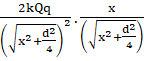
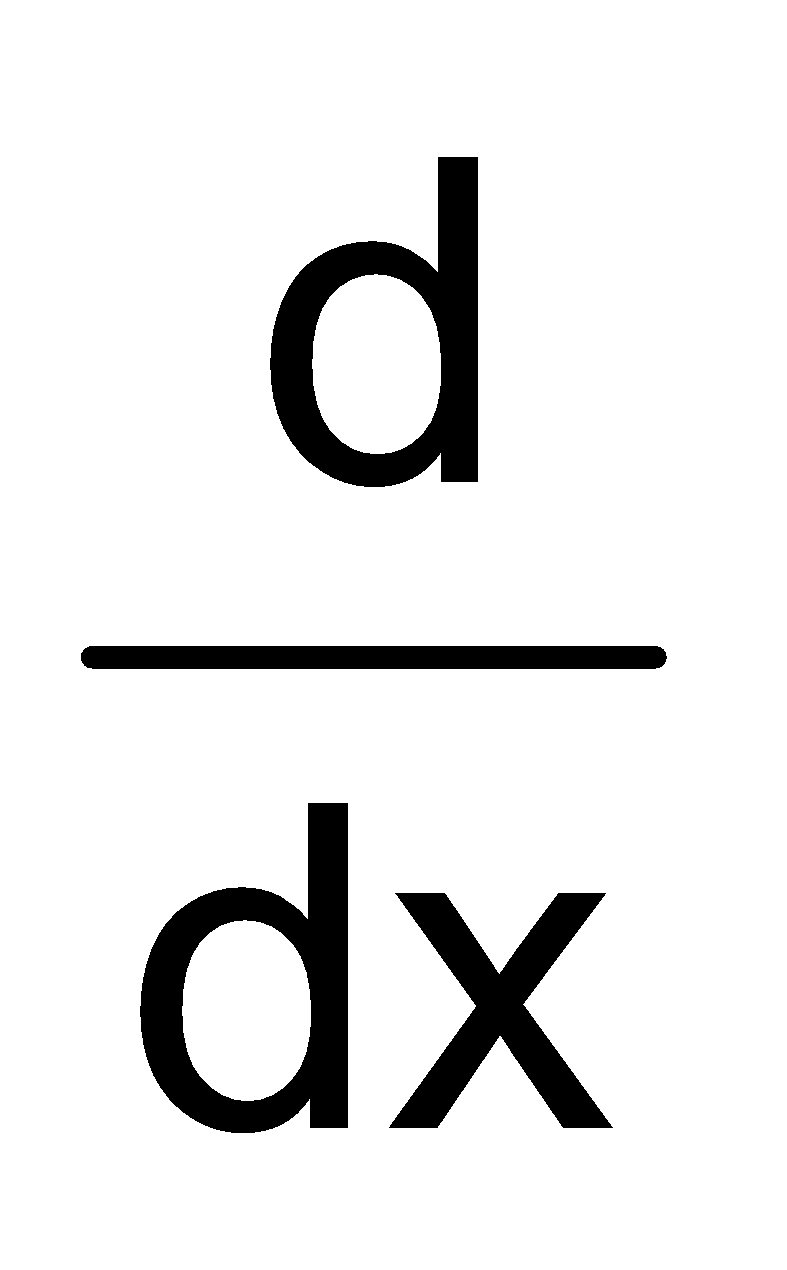
To find the maximum force, we differentiate F_net with respect to y and set it to zero:
$$ \frac{dF_{net}}{dy} = 0 $$
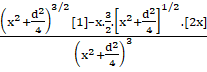
Applying the quotient rule yields:
$$ \frac{d}{dy} \left( 2k \frac{Qq}{\left(\frac{d^2}{4} + y^2\right)} \right) = 0 $$
Simplifying it, we find:
$$ 2kQq \cdot \frac{(-2y)}{\left(\frac{d^2}{4} + y^2\right)^2} = 0 $$
The critical points occur when:
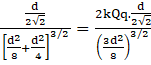
$$ y = \sqrt{\frac{d^2}{4}} = \frac{d}{2} $$
Step 5: Maximum Force
Substituting y = d/2 into the force equation gives us the magnitude of the maximum force:
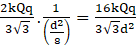
$$ F_{max} = 2k \frac{Qq}{\left(\frac{d^2}{4} + \left(\frac{d}{2}\right)^2\right)} = 2k \frac{Qq}{\frac{d^2}{2}} = k \frac{4Qq}{d^2} $$
Conclusion
The charge q experiences maximum force when placed at a distance of d/2 from the midpoint along the perpendicular bisector, and the magnitude of this force is given by:
$$ F_{max} = k \frac{4Qq}{d^2} $$
Therefore, the answer is option A.
Let the two charges A and B be placed at points (-d/2, 0) and (d/2, 0) on the x-axis. The third charge q will be placed at a point P on the perpendicular bisector, say at (0, y).
Step 2: Calculate the Distance from P to A and B
The distance from charge A to point P is given by:
$$ PA = \sqrt{\left(0 + \frac{d}{2}\right)^2 + y^2} = \sqrt{\frac{d^2}{4} + y^2} $$
Similarly, from charge B to point P:
$$ PB = \sqrt{\left(0 - \frac{d}{2}\right)^2 + y^2} = \sqrt{\frac{d^2}{4} + y^2} $$
Step 3: Calculate the Forces on Charge q
The electrostatic force between charges A and q is given by Coulomb's Law:
$$ F_A = k \frac{Qq}{PA^2} = k \frac{Qq}{\left(\frac{d^2}{4} + y^2\right)} $$
The same applies to charge B:
$$ F_B = k \frac{Qq}{PB^2} = k \frac{Qq}{\left(\frac{d^2}{4} + y^2\right)} $$
The net force acting on q in the y-direction (as the x-components cancel out) is:
$$ F_{net} = F_A + F_B = 2k \frac{Qq}{\left(\frac{d^2}{4} + y^2\right)} $$
Step 4: Maximize the Force
To find the maximum force, we differentiate F_net with respect to y and set it to zero:
$$ \frac{dF_{net}}{dy} = 0 $$
Applying the quotient rule yields:
$$ \frac{d}{dy} \left( 2k \frac{Qq}{\left(\frac{d^2}{4} + y^2\right)} \right) = 0 $$
Simplifying it, we find:
$$ 2kQq \cdot \frac{(-2y)}{\left(\frac{d^2}{4} + y^2\right)^2} = 0 $$
The critical points occur when:
$$ y = \sqrt{\frac{d^2}{4}} = \frac{d}{2} $$
Step 5: Maximum Force
Substituting y = d/2 into the force equation gives us the magnitude of the maximum force:
$$ F_{max} = 2k \frac{Qq}{\left(\frac{d^2}{4} + \left(\frac{d}{2}\right)^2\right)} = 2k \frac{Qq}{\frac{d^2}{2}} = k \frac{4Qq}{d^2} $$
Conclusion
The charge q experiences maximum force when placed at a distance of d/2 from the midpoint along the perpendicular bisector, and the magnitude of this force is given by:
$$ F_{max} = k \frac{4Qq}{d^2} $$
Therefore, the answer is option A.
Prepare Smarter with CGP Edu
Get practice questions, solutions, and test series in one place.
Write a Review
Share your experience with this question and solution.
Commentary
Send your comment, doubt, correction, or feedback to admin.
Similar Questions
Explore conceptually related problems
Two point charges q 1 = 2 × 10 –3 C and q 2 = –3 × 10 –6 C are separated by a distance x = 10 cm. F…
Two point charges q 1 = 20 µC and q 2 = 25 µC are placed at (–1, 1, 1) m and (3, 1, –2)m, with resp…
20 positively charged particles are kept fixed on the X-axis at points x = 1 m, 2 m, 3 m, ....., 20…
(i) Two charged particles having charge 4.0 × 10 –6 C and mass 24 × 10 –3 Kg each are joined by an …
Two identical conducting spheres (of negligible radius), having charges of opposite sign, attract e…
Two small spheres, each of mass 0.1 gm and carrying same charge 10 -9 C are suspended by threads of…