Published by:
CGP EDU Academic Team
Published on: September 12, 2026
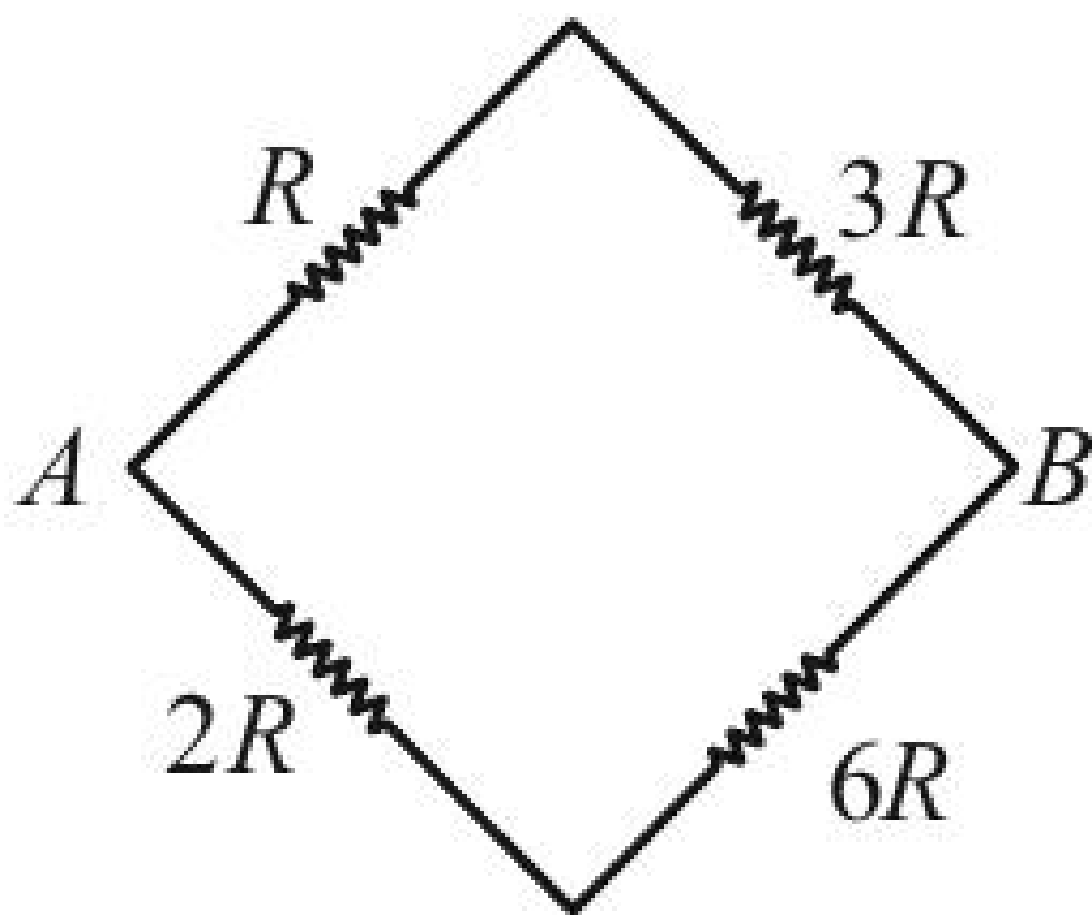
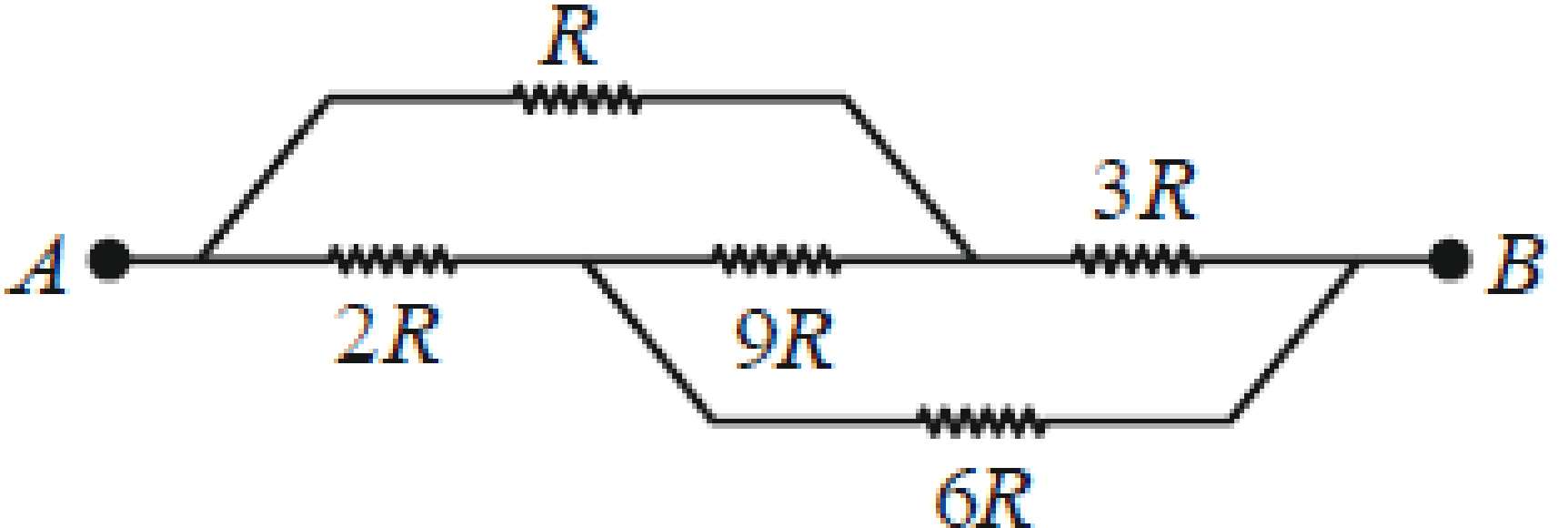
The equivalent resistance between A and B of the network shown in figure:
Text Solution
Verified by ExpertsThe correct answer is:
C
Step 1: Identify the Configuration
The given circuit consists of resistors arranged in a combination of series and parallel. Starting from point A, we have:
- A resistor of value 2R in series with a combination of resistors below it (R, 9R, and 6R).
Step 2: Solve the Parallel Combination
The three resistors (R, 9R, and 6R) are in parallel. The formula for the total resistance (Rparallel) for resistors in parallel is given by:
$$ \frac{1}{R_{parallel}} = \frac{1}{R} + \frac{1}{9R} + \frac{1}{6R} $$
Finding a common denominator (18R), we get:
$$ \frac{1}{R_{parallel}} = \frac{18}{18R} + \frac{2}{18R} + \frac{3}{18R} = \frac{23}{18R} $$
Thus,
$$ R_{parallel} = \frac{18R}{23} $$
Step 3: Total Resistance Calculation
Now, this equivalent resistance (Rparallel) is in series with the 2R resistor at the top. Therefore, the total resistance (Rtotal) between A and B can be calculated as follows:
$$ R_{total} = 2R + R_{parallel} = 2R + \frac{18R}{23} $$
To add these together, express 2R with a common denominator:
$$ R_{total} = \frac{46R}{23} + \frac{18R}{23} = \frac{64R}{23} $$
Final Answer
The equivalent resistance between A and B is therefore:
$$ R_{eq} = \frac{64R}{23} $$ which corresponds to option C.
The given circuit consists of resistors arranged in a combination of series and parallel. Starting from point A, we have:
- A resistor of value 2R in series with a combination of resistors below it (R, 9R, and 6R).
Step 2: Solve the Parallel Combination
The three resistors (R, 9R, and 6R) are in parallel. The formula for the total resistance (Rparallel) for resistors in parallel is given by:
$$ \frac{1}{R_{parallel}} = \frac{1}{R} + \frac{1}{9R} + \frac{1}{6R} $$
Finding a common denominator (18R), we get:
$$ \frac{1}{R_{parallel}} = \frac{18}{18R} + \frac{2}{18R} + \frac{3}{18R} = \frac{23}{18R} $$
Thus,
$$ R_{parallel} = \frac{18R}{23} $$
Step 3: Total Resistance Calculation
Now, this equivalent resistance (Rparallel) is in series with the 2R resistor at the top. Therefore, the total resistance (Rtotal) between A and B can be calculated as follows:
$$ R_{total} = 2R + R_{parallel} = 2R + \frac{18R}{23} $$
To add these together, express 2R with a common denominator:
$$ R_{total} = \frac{46R}{23} + \frac{18R}{23} = \frac{64R}{23} $$
Final Answer
The equivalent resistance between A and B is therefore:
$$ R_{eq} = \frac{64R}{23} $$ which corresponds to option C.
Prepare Smarter with CGP Edu
Get practice questions, solutions, and test series in one place.
Write a Review
Share your experience with this question and solution.
Commentary
Send your comment, doubt, correction, or feedback to admin.
Similar Questions
Explore conceptually related problems
Consider four conducting materials copper, tungsten, mercury and aluminium with resistivity and r…
Model a torch battery of length l to be made up of a thin cylindrical bar of radius 'a' and a conce…
Two resistors and are connected in series across a 6 V battery. The potential difference measured…
In the circuit, given in the figure currents in different branches and value of one resistor are sh…
A circuit to verify Ohm's law uses ammeter and voltmeter in series or parallel connected correctly …
In the figure shown, the current in the battery is close to