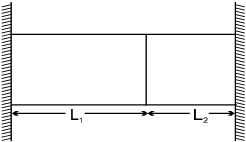
Two rods of different metals having same area of cross section A are placed end to end between two massive platforms, as shown in the figure. The first rod has a length L 1 , coefficient of linear expansion α 1 and Young's modulus Y 1 . The corresponding quantities for the second rod are L 2 , α 2 , and Y 2 . The temperature of both the rods is now increased by Tº C. Find the force with which the rods act on each other (at the higher temperature) in terms of given quantities. Also find the lengths of the rods at the higher temperature. Assume that there is no change in the cross-sectional area of the rods and that the rods do not bend. There is no deformation of the walls.
Text Solution
Verified by ExpertsCHECK THE SOLUTION.
L A = L 1 + x
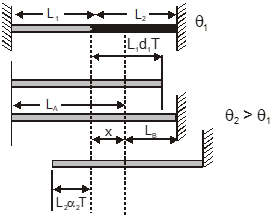
L B = L 2 – x
Y = 
e =  = extension or compression due to force
e = L 1 α 1 T – x =  ..............(1)
e = L 2 α 2 T + x =  ..............(2)
By adding equation (1) and equation (2)
We get F = 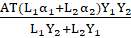
By dividing (1) and (2)
We get x = 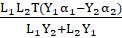
So, L A = L 1 + x; L B = L 2 – x
Prepare Smarter with CGP Edu
Get practice questions, solutions, and test series in one place.
Write a Review
Share your experience with this question and solution.
Commentary
Send your comment, doubt, correction, or feedback to admin.
Similar Questions
Explore conceptually related problems