Home Physics Motion in a Plane General A particles of mass m is attached at one end…
Physics Motion in a Plane General Subjective Type
Published on: September 12, 2026

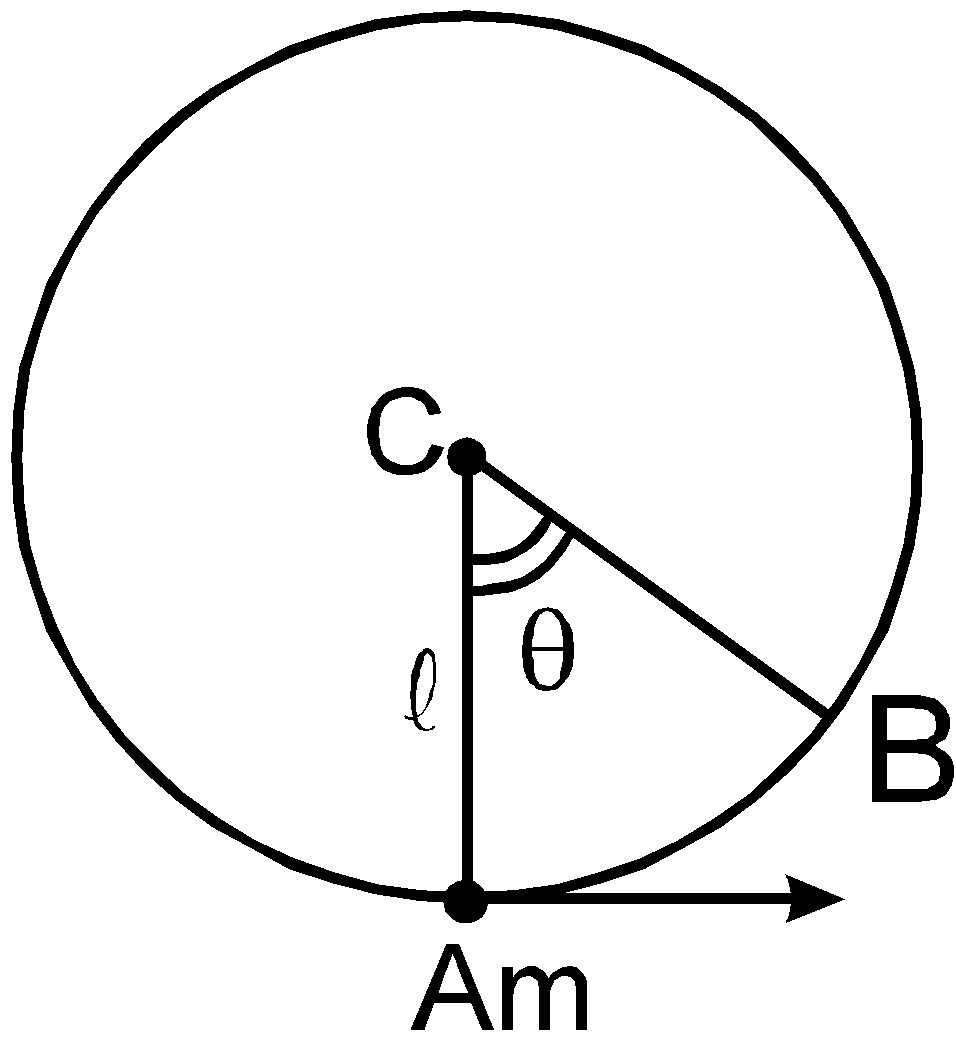
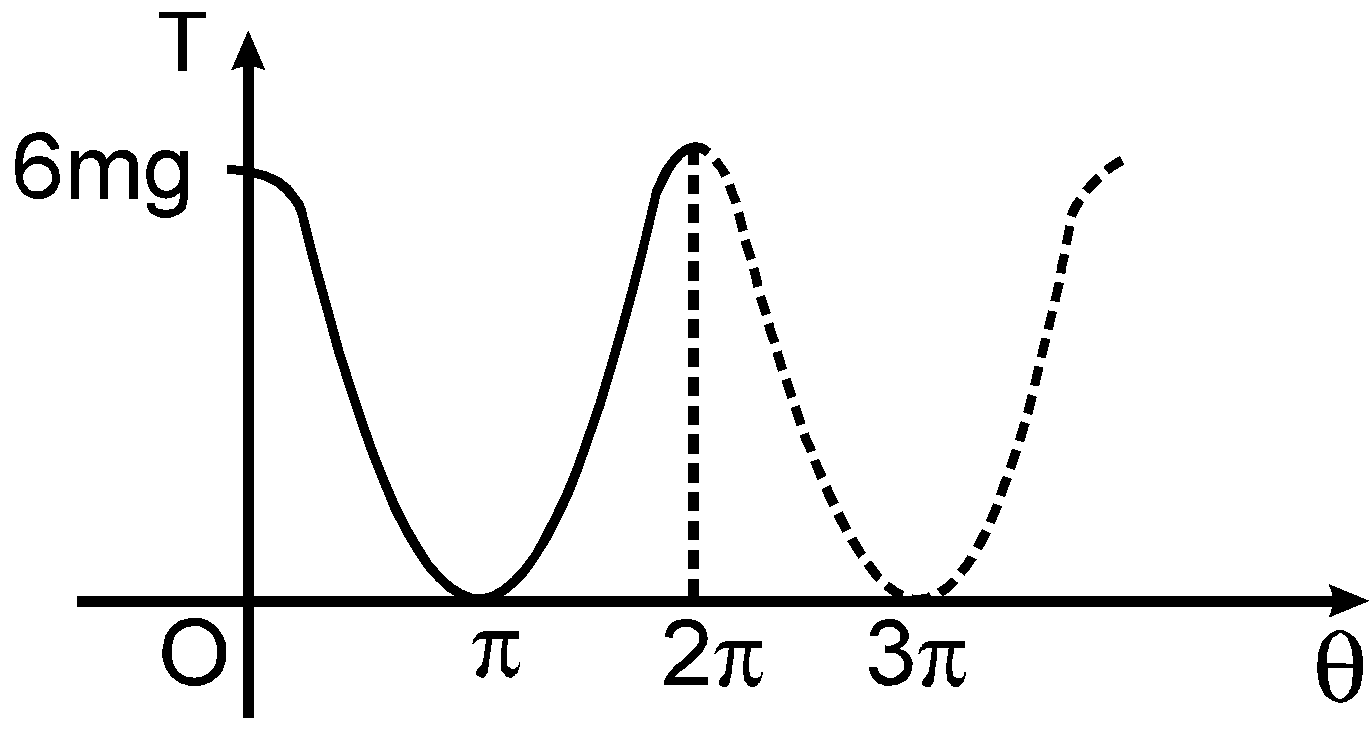
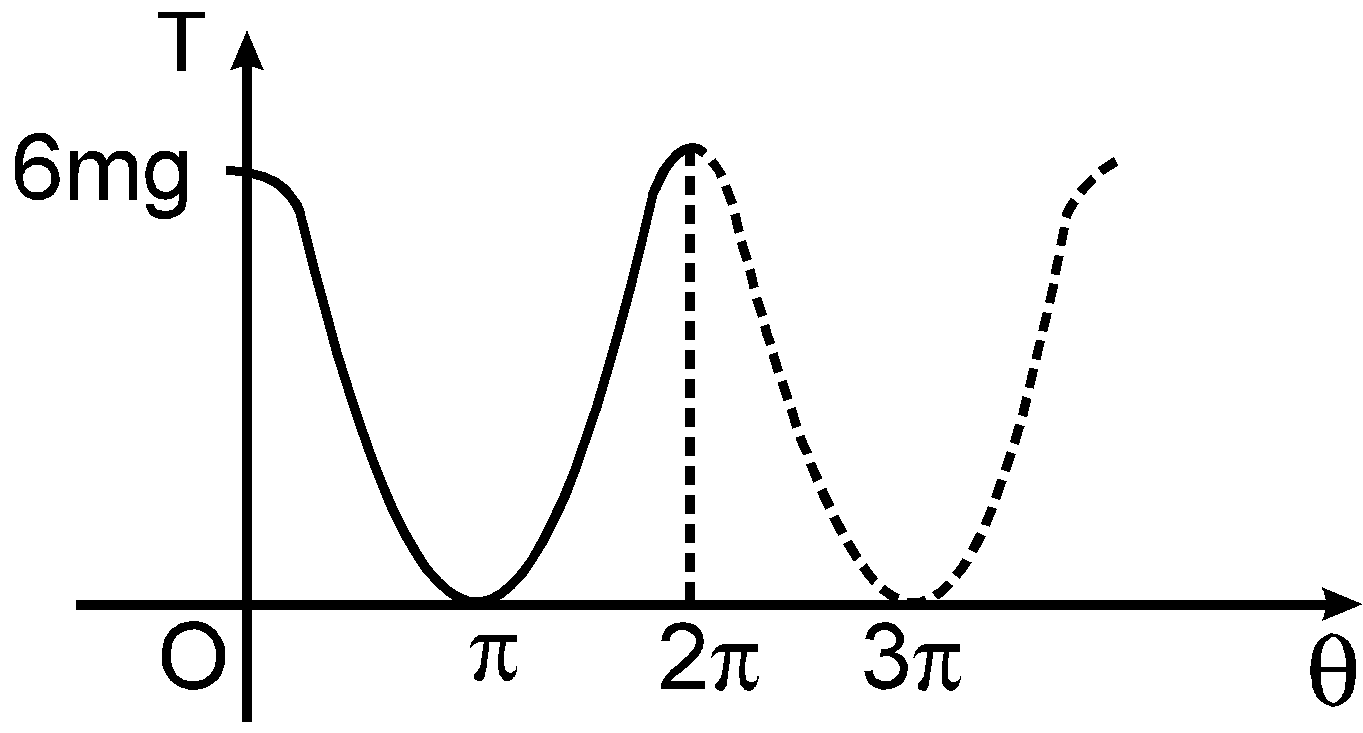
A particles of mass m is attached at one end of a light, inextensible string of length 𝓁 whose other end is fixed at the point C. At the lowest point the particle is given minimum velocity to complete the circular path in the vertical plane. As it moves in the circular path the tension in the string changes with . is defined in the figure. As varies from ‘0’ to ‘2 ’ (i.e. the particle completes one revolution) plot the variation of tension ‘T’ against ‘ ’.

Share this question

For Instagram sharing, use “Apps” on mobile or copy the link.

Text Solution

Verified by Experts
The correct answer is:
C
To determine the variation of tension in the string as the particle moves in a vertical circular path, we analyze the forces acting on the particle at different positions.
Step 1: At the topmost point of the circular path (when the angle \( \theta = 0 \)), the centripetal force required is provided by the weight of the particle and the tension in the string. The equation is given by:
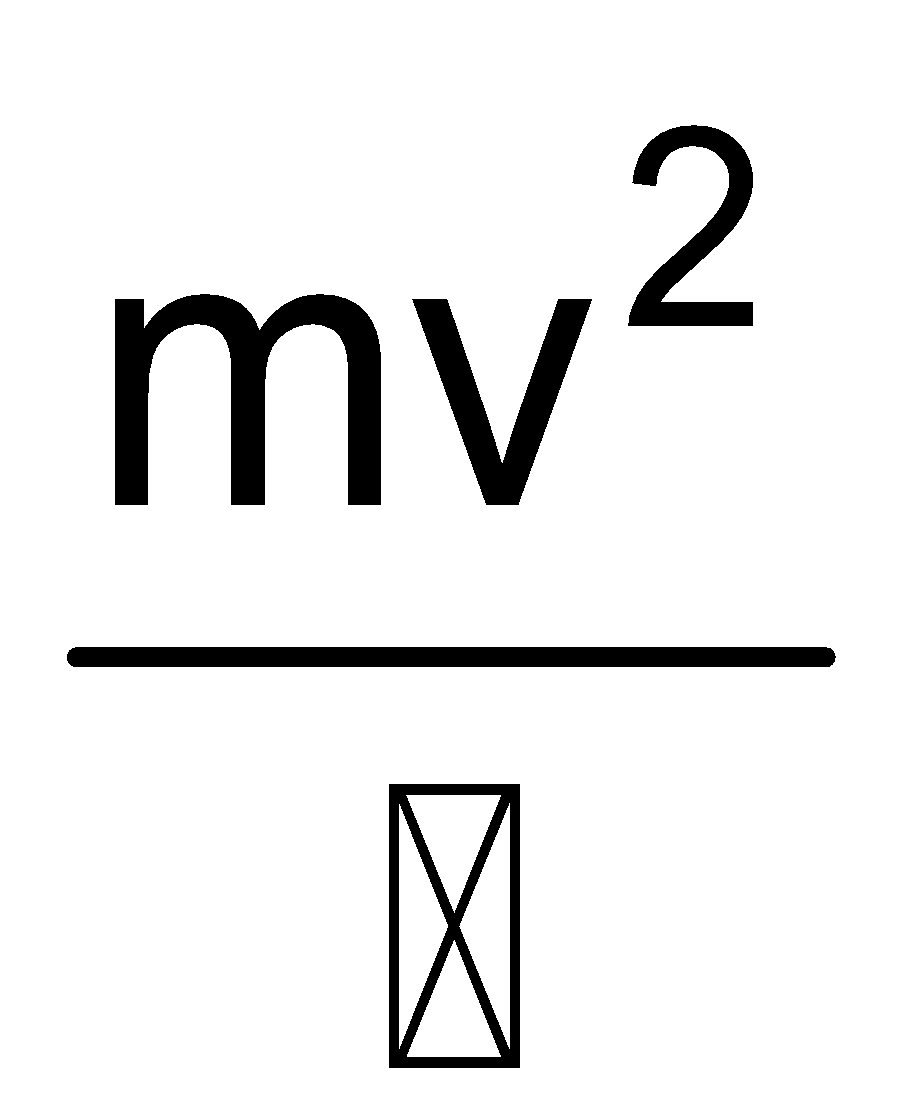
\[ T + mg = \frac{mv^2}{r} \]
where \( T \) is the tension, \( m \) is the mass, \( g \) is the acceleration due to gravity, and \( v \) is the tangential velocity.
Step 2: At the lowest point of the circular path (when the angle \( \theta = \pi \)), the forces acting on the particle are only the tension and its weight acting downward:
\[ T - mg = \frac{mv^2}{r} \]
Step 3: As the particle moves from the top to the bottom, it gains speed due to gravitational potential energy converting to kinetic energy. Thus, the tension will vary inversely as the speed changes as the particle moves along the path.
Step 4: The tension is at its minimum at the top of the circular path and at its maximum at the bottom. Therefore, a graph plotting tension against angle would show a curve increasing from zero tension at the top to a maximum at the bottom, then decreasing again as it reaches the next top. The final form would be similar to option C in the provided graphs.
Conclusion: The correct plot of tension against the angle \( \theta \) will resemble option C.

Prepare Smarter with CGP Edu

Get practice questions, solutions, and test series in one place.

Write a Review

Share your experience with this question and solution.

Commentary

Send your comment, doubt, correction, or feedback to admin.

Student Reviews

What students say about this solution

No reviews yet. Be the first to write a review.

Similar Questions

Explore conceptually related problems

CG
CGP Question Assistant Question Bank + AI Help
Hi! Type your question or upload one screenshot. First I will search related questions from CGP Edu Question Bank. If none match, type YES and I will solve it with AI.
Upload only one screenshot at a time. Flow: Question Bank first → If not matched, type YES for AI solution.