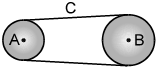
Wheel A of radius r A = 10cm is coupled by a belt C to another wheel of radius r B = 25 cm as in the figure. The belt does not slip. At time t = 0 wheel A increases it ’ s angular speed from rest at a uniform rate of  /2 rad/sec 2. Find the time in which wheel B attains a speed of 100 rpm (wheel are fixed).
Text Solution
Verified by ExpertsThe correct answer is:
CHECK THE SOLUTION.
(50/3 sec.)
Sol. Since belt is not slipping, speed at rim of A and B is same
ω A r A = ω B r B
ω A = 100 ×  = 250 rpm = 250 ×
  rad/sec.
=  rad/sec.
ω = ω 0 + α t
t =  =
=  sec.
sec.
Prepare Smarter with CGP Edu
Get practice questions, solutions, and test series in one place.
Write a Review
Share your experience with this question and solution.
Commentary
Send your comment, doubt, correction, or feedback to admin.
Similar Questions
Explore conceptually related problems
A man swings a stone tied to a string of length in a vertical plane. The string remains stretched …
The driver of a car traveling at velocity v suddenly sees a broad wall in front of him at distance …
To anticipate the dip and hump in the road the driver of a car applies her brakes to produce a unif…
A certain rocket maintains a horizontal attitude of its axis during the powered phase of its fligh…
The turning of a car must be produced by an external force acting at an angle to the line of motion…
A body slips down a chute which is in the form of a loop as in fig. It starts from the lowest admis…