A hemispherical bowl of radius r = 0.1m is rotating about its axis (which is vertical) with an angular velocity  . A particle of mass 10 -2 kg on the frictionless inner surface of the bowl is also rotating with the same
  . the particle is at a height h from the bottom of the bowl.
A
Obtain the relation between h and  . What is the minimum value of
  needed in order to have a nonzero value of h.
. What is the minimum value of needed in order to have a nonzero value of h.
B
It is desired to measure ‘ g ’ using this setup by measuring h accurately. Assuming that r and  are known precisely and that the least count in the measurement of h is 10 -4 m. What is minimum error g in the measured value of g. [g = 9.8m/s 2 ]
are known precisely and that the least count in the measurement of h is 10 -4 m. What is minimum error g in the measured value of g. [g = 9.8m/s 2 ]
Text Solution
Verified by ExpertsThe correct answer is:
CHECK THE SOLUTION.
 -9.8 x 10 -3 m/s 2
Sol.
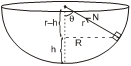

∴ tan θ = 
⇒  =
= 
⇒ ω 2 = g/ (r – h) ......(1)
h > 0 ⇒ r –  > 0
> 0
⇒ ω >  =
=  =
=  =
=  rad/second Ans.
g = ω 2 (r – h)
 = –
= – 
maximum value of h is 0.1 so that Δ g = –  = – 9.8 × 10 – 3 m/s 2
Prepare Smarter with CGP Edu
Get practice questions, solutions, and test series in one place.
Write a Review
Share your experience with this question and solution.
Commentary
Send your comment, doubt, correction, or feedback to admin.
Similar Questions
Explore conceptually related problems
A man swings a stone tied to a string of length in a vertical plane. The string remains stretched …
The driver of a car traveling at velocity v suddenly sees a broad wall in front of him at distance …
To anticipate the dip and hump in the road the driver of a car applies her brakes to produce a unif…
A certain rocket maintains a horizontal attitude of its axis during the powered phase of its fligh…
The turning of a car must be produced by an external force acting at an angle to the line of motion…
A body slips down a chute which is in the form of a loop as in fig. It starts from the lowest admis…