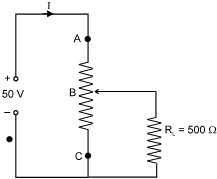
As shown in figure a variable rheostat of 2 k Ω Ω is used to control the potential difference across 500 ohm load.
(i) If the resistance AB is 500 Ω Ω , what is the potential difference across the load?
(ii) If the load is removed, what should be the resistance at BC to get 40 volt between B and C?
Text Solution
Verified by ExpertsThe correct answer is:
CHECK THE SOLUTION.
[(i)  = 21.43 V, (ii) 1600 Ω Ω ]
Sol. (i)
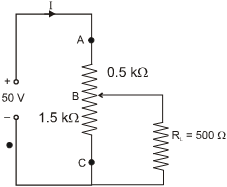
As V  R
R
V 2 = V BC =  V =
V =  50
50
=  50 =
50 =  = 21.43 V
(ii) V BC = 40 V
⇒ V BC =  V
V
⇒ 40 =  50
50
⇒ R BC = 1600 Ω Ω
Prepare Smarter with CGP Edu
Get practice questions, solutions, and test series in one place.
Write a Review
Share your experience with this question and solution.
Commentary
Send your comment, doubt, correction, or feedback to admin.
Similar Questions
Explore conceptually related problems
A wire has a resistance of 12 ohms. If it is bent in the form of a circle. The effective resistance…
A wire has a resistance 12 ohms. if it is bent in the form of a equilateral triangle. The resistanc…
There are five resistances of 1 ohm each. If the initial three resistance are joined in parallel an…
For the network of resistance shown in the figure the equivalent resistance of the network between …
If 2 bulbs rated 2.5 W – 110 V and 100 W – 110 V are connected in series to a 220 V supply then
A 50 W bulb is in series with a room heater and the combination is connected across the mains. To g…