Published by:
CGP EDU Academic Team
Published on: September 12, 2026
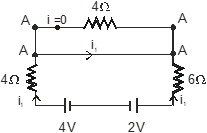
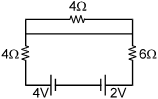
Find the currents through the three resistors shown in figure
Text Solution
Verified by ExpertsThe correct answer is:
C
Step 1: Analyze the circuit configuration.
The circuit contains three resistors: two 4Ω resistors in series and one 6Ω resistor in parallel with the combination of the two 4Ω resistors. The voltage sources are 4V and 2V.
Step 2: Find the equivalent resistance of the series resistors.
For the two 4Ω resistors in series:
$$ R_{series} = R_1 + R_2 = 4Ω + 4Ω = 8Ω $$
Step 3: Find the total resistance in the parallel configuration.
The 8Ω series combination is in parallel with the 6Ω resistor:
$$ \frac{1}{R_{total}} = \frac{1}{R_{series}} + \frac{1}{R_{6Ω}} = \frac{1}{8Ω} + \frac{1}{6Ω} $$
Finding a common denominator (24):
$$ \frac{1}{R_{total}} = \frac{3}{24} + \frac{4}{24} = \frac{7}{24} $$
So, the total resistance is:
$$ R_{total} = \frac{24}{7} Ω $$
Step 4: Calculate the total current using the voltage source.
The total voltage across the equivalent resistance is (4V - 2V) = 2V. The total current (I) is given by Ohm’s law:
$$ I = \frac{V}{R_{total}} = \frac{2V}{\frac{24}{7}Ω} = \frac{2V * 7}{24} = \frac{14}{24} A = \frac{7}{12} A $$
Step 5: Find the current through each resistor.
The current through the 6Ω resistor (I_{6Ω}) in parallel is:
$$ I_{6Ω} = \frac{V_{parallel}}{R_{6Ω}} = \frac{2V}{6Ω} = \frac{1}{3} A $$
The remaining current flows through the 8Ω (combination of the two 4Ω resistors). The voltage across it is still 2V, so:
$$ I_{8Ω} = I - I_{6Ω} = \frac{7}{12} A - \frac{1}{3} A = \frac{7}{12} - \frac{4}{12} = \frac{3}{12} A = \frac{1}{4} A $$
Final Step: Calculate the current through each 4Ω resistor.
Since the two 4Ω resistors are in series, the same current flows through both:
$$ I_{4Ω} = I_{8Ω} = \frac{1}{4} A $$
Therefore, the currents through the three resistors are:
1. Current through the 6Ω resistor: \frac{1}{3} A
2. Current through each 4Ω resistor: \frac{1}{4} A.
The circuit contains three resistors: two 4Ω resistors in series and one 6Ω resistor in parallel with the combination of the two 4Ω resistors. The voltage sources are 4V and 2V.
Step 2: Find the equivalent resistance of the series resistors.
For the two 4Ω resistors in series:
$$ R_{series} = R_1 + R_2 = 4Ω + 4Ω = 8Ω $$
Step 3: Find the total resistance in the parallel configuration.
The 8Ω series combination is in parallel with the 6Ω resistor:
$$ \frac{1}{R_{total}} = \frac{1}{R_{series}} + \frac{1}{R_{6Ω}} = \frac{1}{8Ω} + \frac{1}{6Ω} $$
Finding a common denominator (24):
$$ \frac{1}{R_{total}} = \frac{3}{24} + \frac{4}{24} = \frac{7}{24} $$
So, the total resistance is:
$$ R_{total} = \frac{24}{7} Ω $$
Step 4: Calculate the total current using the voltage source.
The total voltage across the equivalent resistance is (4V - 2V) = 2V. The total current (I) is given by Ohm’s law:
$$ I = \frac{V}{R_{total}} = \frac{2V}{\frac{24}{7}Ω} = \frac{2V * 7}{24} = \frac{14}{24} A = \frac{7}{12} A $$
Step 5: Find the current through each resistor.
The current through the 6Ω resistor (I_{6Ω}) in parallel is:
$$ I_{6Ω} = \frac{V_{parallel}}{R_{6Ω}} = \frac{2V}{6Ω} = \frac{1}{3} A $$
The remaining current flows through the 8Ω (combination of the two 4Ω resistors). The voltage across it is still 2V, so:
$$ I_{8Ω} = I - I_{6Ω} = \frac{7}{12} A - \frac{1}{3} A = \frac{7}{12} - \frac{4}{12} = \frac{3}{12} A = \frac{1}{4} A $$
Final Step: Calculate the current through each 4Ω resistor.
Since the two 4Ω resistors are in series, the same current flows through both:
$$ I_{4Ω} = I_{8Ω} = \frac{1}{4} A $$
Therefore, the currents through the three resistors are:
1. Current through the 6Ω resistor: \frac{1}{3} A
2. Current through each 4Ω resistor: \frac{1}{4} A.
Prepare Smarter with CGP Edu
Get practice questions, solutions, and test series in one place.
Write a Review
Share your experience with this question and solution.
Commentary
Send your comment, doubt, correction, or feedback to admin.
Similar Questions
Explore conceptually related problems
Six lead-acid type of secondary cells, each of emf 2.0 V and internal resistance 0.015 Ω Ω , are jo…
In the figure each cell has an emf of 1.5 V and internal resistance of 0.40 Ω Ω . Calculate:
(i) c…
In the circuit shown all five resistors have the same value 200 ohms and each cell has an emf 3 vol…
12 cells each having the same emf are connected in series and are kept in a closed box. Some of the…
Two cells of e.m.f. 10 V & 15 V are connected in parallel to each other between points A & B. The c…
N sources of current with different emf ’ s are connected as shown in figure. The emf ’ s of the so…