In the circuit shown the three ammeters (marked as 1, 2, 3) are identical, each have a resistance
R 0 = 2 Ω Ω . Between points A and B there is a constant potential difference of 19V. The first and second ammeter read I 1 = 2.5A and I 2 = 1.5A respectively.
Text Solution
Verified by ExpertsCHECK THE SOLUTION.
[ 1 A, 4 Ω Ω , 1.1 A]
Sol.
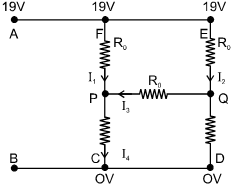
R 0 = 2 Ω Ω , I 1 = 2.5A
I 2 =1.5A
V P = 19 – R 0 I
= 19 – (2) × (2.5)
V P = 14V
Similarly
V Q = 16V
⇒ I 3 =  ⇒ I 3 = 1A
I 4 =  = I 1 + I 3
⇒ I 4 =  = I 1 + I 3
⇒  = 2.5+1
R = 4 Ω Ω
Applying KVL in FEQPF
– I 1 R 0 – I 3 R 0 + (I– I 1 ) ×R 0 = 0
I = I 3 + 2I 1 ... (i)
Applying KVL in AFEDCBA
V–I 1 R 1 – (I 1 – I 3 ) R X = 0
I 1 =  .........(ii)
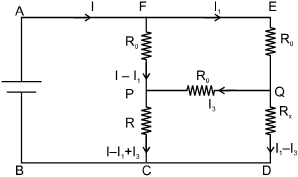
Applying KVL in AFCBA
V – (I–I 1 ) R 0 –  (I–I 1 +I 3 ) R = 0
V – I (R 0 +R) +I 1 (R 0 +R) –I 3 R = 0
V– (I 3 +2I 1 ) (R 0 +R 1 ) +I 1 (R 0 +R) – I 3 R = 0 Using (i)
V – I 3 (R 0 +2R) –I 1 (R 0 +R) = 0
V– I 3 (R 0 +2R) –  (R 0 +R) = 0 Using (ii)

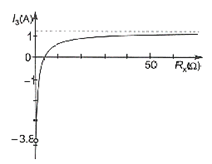
The graph of the function is a hyperbola. Its special points are: at R x = 0, I 3 = –3.8 A ; at R x ; = 4I 3 = 0; at
R x = 32 Ω Ω , I 3 = 1A ; If R x → ∞ , I 3 tends to 19/16 = 1.1875A.
Prepare Smarter with CGP Edu
Get practice questions, solutions, and test series in one place.
Write a Review
Share your experience with this question and solution.
Commentary
Send your comment, doubt, correction, or feedback to admin.
Similar Questions
Explore conceptually related problems