Published by:
CGP EDU Academic Team
Published on: September 12, 2026
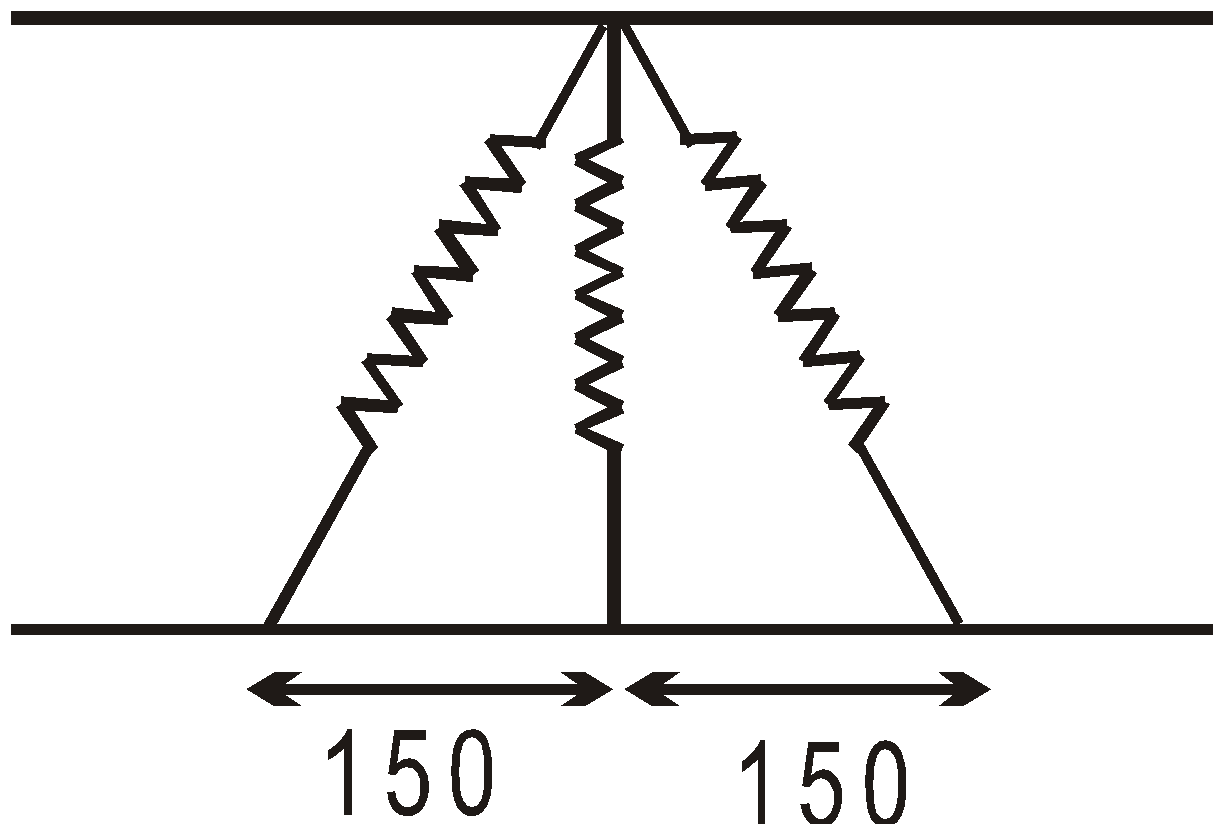
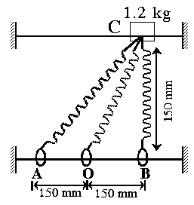
A 1.2 kg collar C may slide without friction along a fixed smooth horizontal rod. It is attached to three springs each of constant K = 400 N/m and 150 mm undeformed length. Knowing that the collar is released from rest in the position shown. Determine the maximum velocity it will reach in its motion. [Here A, O, B are fixed points.]
Text Solution
Verified by ExpertsThe correct answer is:
A
Step 1: Calculate the forces acting on the collar when released from position C. The potential energy stored in each spring can be calculated using the formula for spring potential energy, which is given by:
\[ PE = \frac{1}{2} k x^2 \]
where \( k \) is the spring constant, and \( x \) is the extension or compression from the original length.
Step 2: For each spring, determine the deformation. When the collar is released from rest, it stretches each of the three springs. Since the collar is at position C, and each spring is 150 mm (or 0.15 m) undeformed, the total deformation will be 150 mm for each spring.
Step 3: The potential energy in one spring will be:
\[ PE_{spring} = \frac{1}{2} (400 N/m) (0.15 m)^2 = \frac{1}{2} (400) (0.0225) = 4.5 J\]
Since there are three springs:
\[ PE_{total} = 3 \times 4.5 J = 13.5 J\]
Step 4: At the maximum velocity, all the potential energy will convert to kinetic energy. So, \( KE = \frac{1}{2} mv^2 \), where \( m = 1.2 kg \) is the mass of collar C, and \( v \) is its maximum velocity:
\[ KE = PE_{total} \]
\[ \frac{1}{2} (1.2 kg) v^2 = 13.5 J\]
Step 5: Solving for \( v \):
\[ v^2 = \frac{2 \times 13.5}{1.2} = 22.5\]
\[ v = \sqrt{22.5} = 4.74 m/s\]
Thus, the maximum velocity of the collar C is approximately 4.74 m/s. Therefore, the correct answer option is A.
\[ PE = \frac{1}{2} k x^2 \]
where \( k \) is the spring constant, and \( x \) is the extension or compression from the original length.
Step 2: For each spring, determine the deformation. When the collar is released from rest, it stretches each of the three springs. Since the collar is at position C, and each spring is 150 mm (or 0.15 m) undeformed, the total deformation will be 150 mm for each spring.
Step 3: The potential energy in one spring will be:
\[ PE_{spring} = \frac{1}{2} (400 N/m) (0.15 m)^2 = \frac{1}{2} (400) (0.0225) = 4.5 J\]
Since there are three springs:
\[ PE_{total} = 3 \times 4.5 J = 13.5 J\]
Step 4: At the maximum velocity, all the potential energy will convert to kinetic energy. So, \( KE = \frac{1}{2} mv^2 \), where \( m = 1.2 kg \) is the mass of collar C, and \( v \) is its maximum velocity:
\[ KE = PE_{total} \]
\[ \frac{1}{2} (1.2 kg) v^2 = 13.5 J\]
Step 5: Solving for \( v \):
\[ v^2 = \frac{2 \times 13.5}{1.2} = 22.5\]
\[ v = \sqrt{22.5} = 4.74 m/s\]
Thus, the maximum velocity of the collar C is approximately 4.74 m/s. Therefore, the correct answer option is A.
Prepare Smarter with CGP Edu
Get practice questions, solutions, and test series in one place.
Write a Review
Share your experience with this question and solution.
Commentary
Send your comment, doubt, correction, or feedback to admin.
Similar Questions
Explore conceptually related problems
A block A of mass m kg lies on block B of mass m kg. B in turn lies on smooth horizontal plane. The…
A block of mass m lies on wedge of mass M. The wedge in turn lies on smooth horizontal surface. Fri…
A block having mass 4 kg is pushed down along an inclined plane of inclination 53° with a force of …
Ram and Ali are two friends. Both work in a factory. Ali uses a camel to transport the load within …
In the figure the variation of potential energy of a particle of mass m = 2kg is represented w.r.t.…
A block of mass ' m ' is pushed against a spring of spring constant ' k ' fixed at one end to a wal…