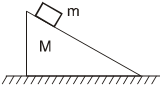
A block of mass m lies on wedge of mass M. The wedge in turn lies on smooth horizontal surface. Friction is absent everywhere. The wedge block system is released from rest. All situation given in column-I are to be estimated in duration the block undergoes a vertical displacement 'h' starting from rest (assume the block to be still on the wedge). Match the statement in column-I with the results in column-II. (g is acceleration due to gravity)
Column I | Column II |
(a) Work done by normal reaction acting on the block is | (p) positive |
(b) Work done by normal reaction (exerted by block) acting on wedge is | (q) negative |
(c) The sum of work done by normal reaction on block and work done by normal reaction (exerted by block) on wedge is | (r) zero |
(d) Net work done by all forces on block is | (s) less than mgh in magnitude |
Text Solution
Verified by ExpertsCHECK THE SOLUTION.
q, s - p, s - r, s - p, s
Sol. (Moderate)
The FBD of block is
Angle between velocity of block and normal
reaction on block is obtuse
 work by normal reaction on block is negative.
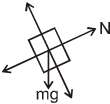
As the block fall by vertical distance h,
from work energy Theorem
Work done by mg + work done by N = KE of block
 |work done by N| = mgh –
  mv 2
mv 2

 mv 2 < mgh
 |work done by N| < mgh
Work done by normal reaction on wedge is positive
Since loss in PE of block = K.E. of wedge + K.E. of block
Work done by normal reaction on wedge = KE of wedge.
 Work done by N < mgh.
Net work done by normal reaction on block and wedge is zero.
Net work done by all forces on block is positive, because its kinetic energy has increased.
Also, KE of block < mgh
 Net work done on block = final KE of block < mgh.
Prepare Smarter with CGP Edu
Get practice questions, solutions, and test series in one place.
Write a Review
Share your experience with this question and solution.
Commentary
Send your comment, doubt, correction, or feedback to admin.
Similar Questions
Explore conceptually related problems