The sinusoidal waves can be produced on a string by continually oscillating one end of the string. If instead the end of the string is given a single shake, a wave pulse propagates down the string. A particular wave pulse is described by the function
y(x, t) = 
where A = 1.00 cm and v = 20.0 m/s.
 [Motion of a Wave Pulse].
Text Solution
Verified by ExpertsCHECK THE SOLUTION
,
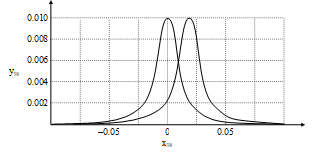
The displacement is a maximum when the term in parentheses in the denominator is zero; the denominator is the sum of two squares and is minimized when x = vt, and the maximum displacement is A. At x = 4.50 cm, the displacement is a maximum at t = (4.50 × 10 –2 m)/(20.0 m/s) = 2.25 × 10 –3 s. The displacement will be half of the maximum when (x – vt) 2 = A 2 , or t = (x ± A)/v = 1.75 × 10 –3 s and 2.75 × 10 –3 s.
Of the many ways to obtain the result, the method presented saves some algebra and minor calculus, relying on the chain rule for partial derivatives. Specifically, let u = u(x, t) = x – vt, so that if f(x, t) = g(u),  =
= 
 =
=  and
and  =
= 
 = –
= –  v.
v.
(In this form it may be seen that any function of this form satisfies the wave equation; In this case, y(x, t) = A 3 (A 2 + u 2 ) –1 , and so
 =
=  ,
,  = –
= – 
 = v
= v  ,
,  = – v 2
  ,
,
and so the given form for y(x, t) is a solution to the wave equation with speed v.
Prepare Smarter with CGP Edu
Get practice questions, solutions, and test series in one place.
Write a Review
Share your experience with this question and solution.
Commentary
Send your comment, doubt, correction, or feedback to admin.
Similar Questions
Explore conceptually related problems