Published by:
CGP EDU Academic Team
Published on: September 13, 2026
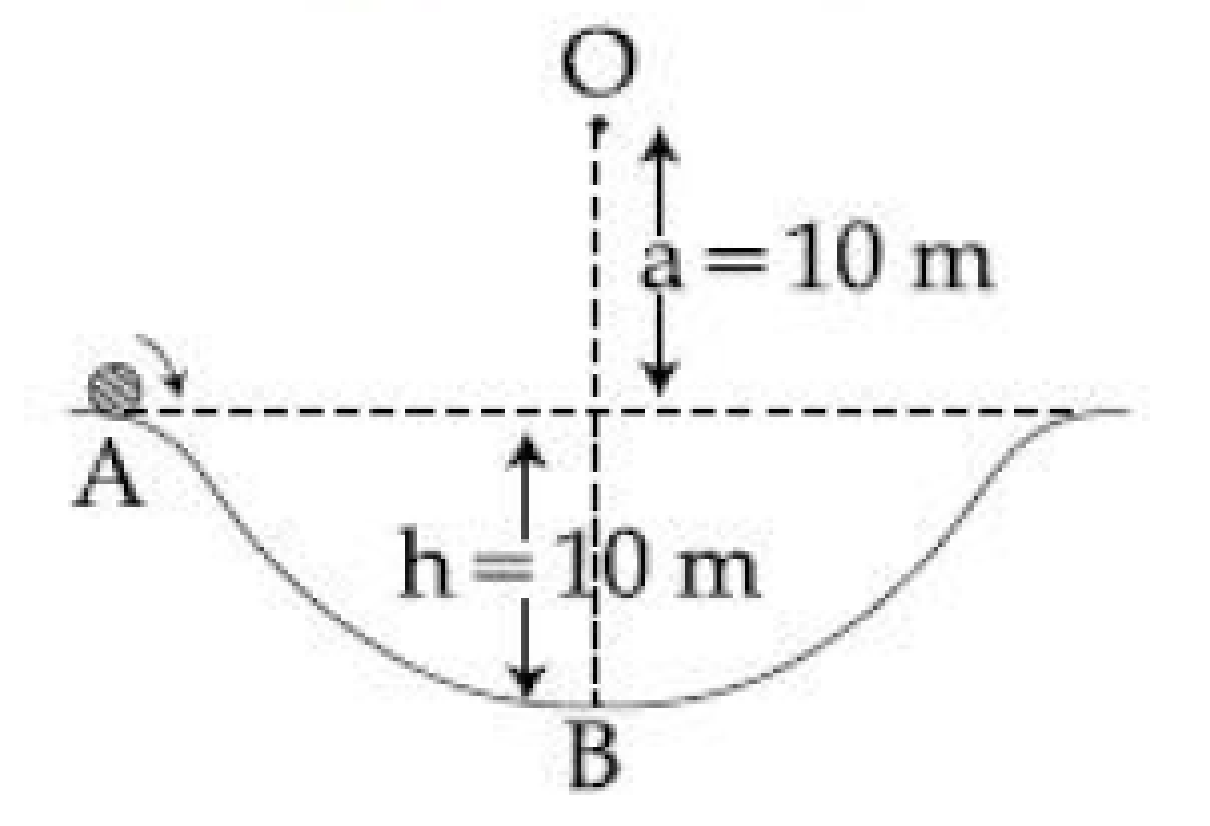
A particle of mass 20 g is released with an initial velocity 5 m/s along the curve from the point A, as shown in figure. The point A is at height h from point B. The particle sides along the frictionless surface. When the particle reaches point B, its angular momentum about O will be :
Text Solution
Verified by ExpertsThe correct answer is:
B
Applying conservation of energy

mgR = 
V 2 = 
= 
V 2 = 15 m/s
L 0 = mV B r
= 20 × 10 –3 × 20 × 15
L 0 = 6 kgm 2 /s
Prepare Smarter with CGP Edu
Get practice questions, solutions, and test series in one place.
Write a Review
Share your experience with this question and solution.
Commentary
Send your comment, doubt, correction, or feedback to admin.
Similar Questions
Explore conceptually related problems
Three blocks A, B and C are lying on a smooth horizontal surface, as shown in the figure. A and B h…
A piece of wood of mass 0.03 kg is dropped from the top of a 100 m height building. At the same tim…
A simple pendulum, made of a string of length λ and a bob of mass m, is released from a small angle…
The position vector of the centre of mass cm of an asymmetric uniform bar of negligible area of cr…
Three point particles of masses 1.0 kg, 1.5 kg and 2.5 kg are placed at three corners of a right an…
As shown in figure. When a spherical cavity (centred at O) of radius 1 is cut out of a uniform sphe…