A leaf electroscope is a simple apparatus to detect any charge on a body. It consists of two metal leaves OA and OB, free to rotate about O. Initially both are very slightly separated. When a charged object is touched to the metal knob at the top of the conducting rod, charge flows from knob to the leaves through the conducting rod. As the leaves are now charged similarly, they start repelling each other and get separated, (deflected by certain angle).
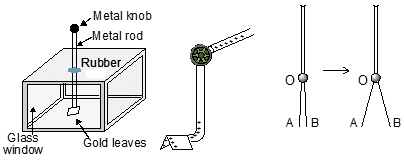
The angle of deflection in static equilibrium is an indicator of the amount of charge on the charged body.
(i) When a + 20 C rod is touched to the knob, the deflection of leaves was 5°, and when an identical rod of – 40 C is touched, the deflection was found to be 9°. If an identical rod of +30 C is touched, then the deflection may be:
Text Solution
Verified by Experts(i) For 30 C charge, angle ; (ii) In ; (iii) most of the positive charge with run away to the metal knob; (iii) Applying torque balance about hinge point O
(i) For 30 C charge, angle ∈ (5°, 9°) ⇒ 7°
(ii) In (iii) most of the positive charge with run away to the metal knob. So due to less charge on the leaves, the leaves will come closer than before.
(iii) Applying torque balance about hinge point O.
 ( λ cos
  ) = mg
  sin
sin 
for small θ, sin  →
→  , cos
, cos  → 1
→ 1
∴ θ = 
Prepare Smarter with CGP Edu
Get practice questions, solutions, and test series in one place.
Write a Review
Share your experience with this question and solution.
Commentary
Send your comment, doubt, correction, or feedback to admin.
Similar Questions
Explore conceptually related problems