A non-conducting disc of radius a and uniform positive surface charge density σ is placed on the ground, with its axis vertical. A particle of mass m and positive charge q is dropped, along the axis of the disc, from a height H with zero initial velocity. The particle has  =
=  .
.
(i) Find the value of H if the particle just reaches the disc.
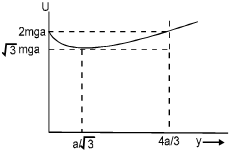
(ii) Sketch the potential energy of the particle as a function of its height and find its equilibrium position.
Text Solution
Verified by Experts(i) H ; (ii) U; (i) Particle is released from P and it just reaches point O; (ii) Potential energy of the particle at height H
(i) H = 4 a/3
(ii) U(y) = 2mg 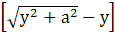 + mgy; at equilibrium
  y =
y = 
Sol. Potential at a height H on the axis of the disc ie. V(P): →
The charge dq contained in the ring shown in figure
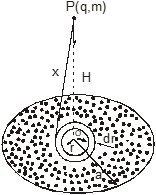
dq = (2πrdr)σ
Potential at P due to this ring,
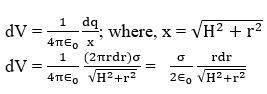
∴ Potential due to the complete disc,
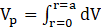 =
= 

or, V p = 
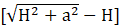
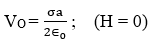
Potential at centre, (O) will be
(i) Particle is released from P and it just reaches point O. Therefore, from conservation of mechanical energy:
Decrease in gravitational potential energy = Increase in electrostatic potential energy
( Δ KE = 0 because K i = K f = 0)
∴ mgH = q [ V o – V p ]
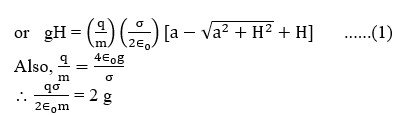
Substituting in (1), we get
gH = 2g [a + H – 
or = (a + H) – 
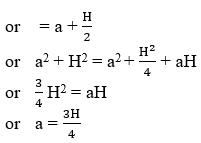
∴ H = (4/3)a
(ii) Potential energy of the particle at height H = Electrostatic potential energy + gravitational potential energy
∴ U = qV + mgH
Here V = Potential at height H
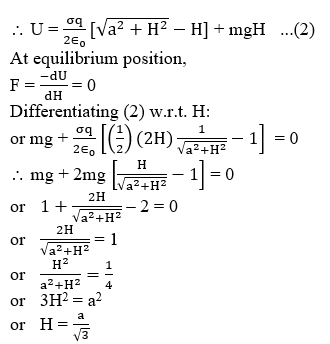
U–H equation as
U = mg 
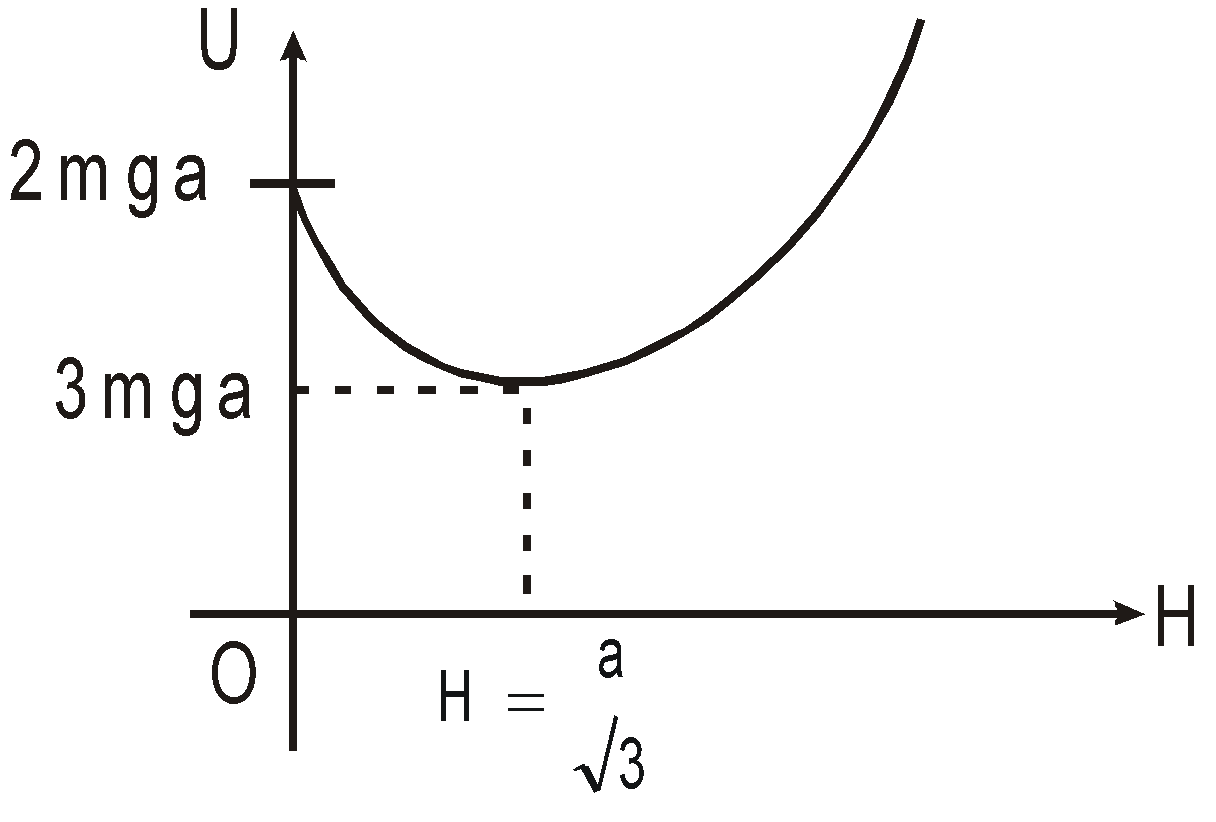
∴ U = 2mga at H = 0 and
U = U min =  mga at H =
Therefore U–H graph will be as shown.
Note that at H =  , U is minimum.
Therefore, H =  is stable equilibrium position.
Prepare Smarter with CGP Edu
Get practice questions, solutions, and test series in one place.
Write a Review
Share your experience with this question and solution.
Commentary
Send your comment, doubt, correction, or feedback to admin.
Similar Questions
Explore conceptually related problems