Two parallel beams of light P & Q (separation d) containing radiations of wavelengths 4000 Å & 5000 Å (which are mutually coherent in each wavelength separately) are incident normally on a prism as shown in figure. The refractive index of the prism as a function of wavelength is given by the relation,
μ ( λ ) = 1.20 +  , where λ is in Å & b is a positive constant. The value of b is such that the condition for total reflection at the face AC is just satisfied for one wavelength & is not satisfied for the other. A convergent lens is used to bring these transmitted beams into focus. If the intensities of the upper & the lower beams immediately after transmission from the face AC, are 4I & I respectively, find the resultant intensity at the focus.

Text Solution
Verified by Experts(9 I )
Sol. Values of μ , α etc. are given because there were 2 more parts asked in actual JEE paper based on value of ‘b’ and δ . But for finding the intensity, we don’t need any of this.
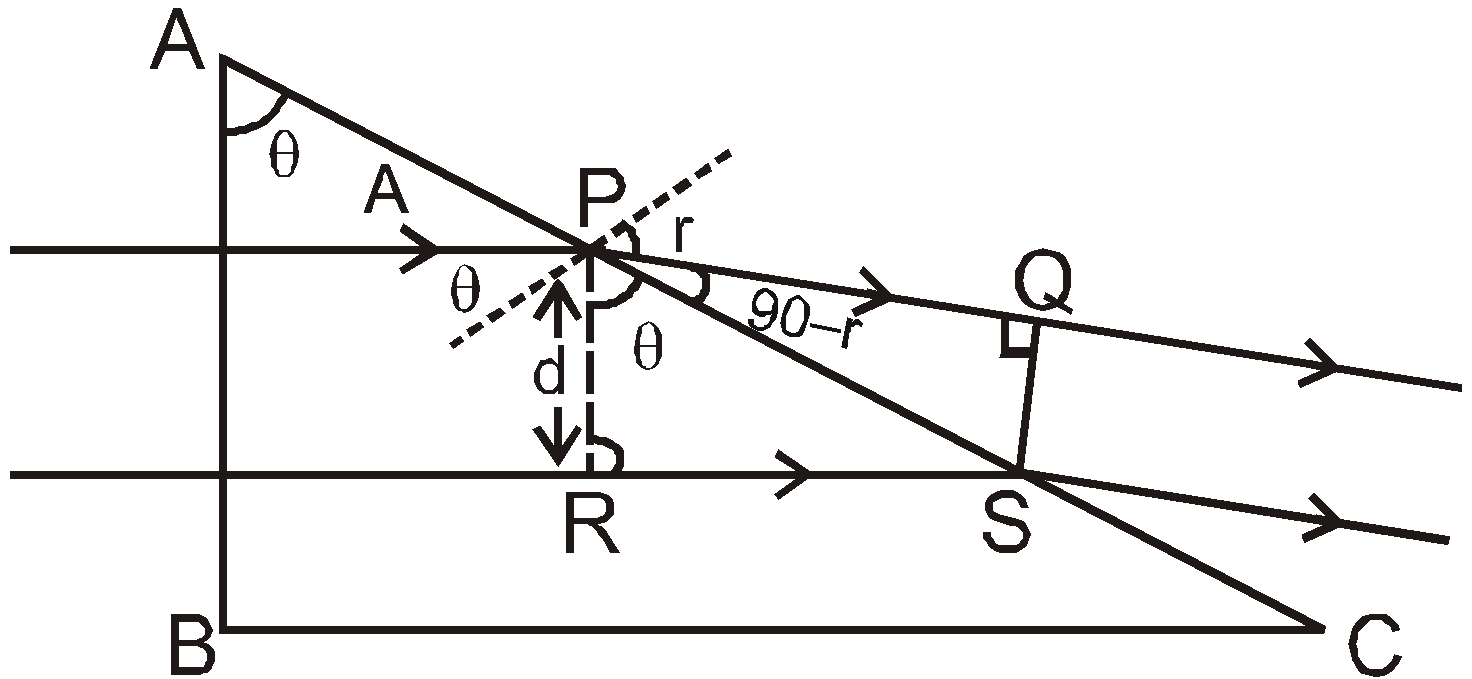
The paths of 2 rays is as shown. Clearly the path difference between them is.
PQ – μ RS
= (PS) cos(90–r) – μ .d tan θ
= (PS) sin r – μ d tan θ .
Now ; by snells. law.
μ sin θ = 1. sin r. and PS = 
we get path difference =  – μ d tan θ = 0 .
Hence the intensity is maximum at 9 I .
Prepare Smarter with CGP Edu
Get practice questions, solutions, and test series in one place.
Write a Review
Share your experience with this question and solution.
Commentary
Send your comment, doubt, correction, or feedback to admin.
Similar Questions
Explore conceptually related problems