Published by:
CGP EDU Academic Team
Published on: September 12, 2026
A particle having mass 10 g oscillates according to the equation x = (2.0 cm) sin [(100 s –1 ) t+  /6]. Find
Text Solution
Verified by ExpertsThe correct answer is:
B
2.0 cm,  s = 0.063 s, 100 N/m
1.0 cm,  m/s, –100 m/s 2
x = (2.0 cm) sin 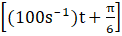
Compare this equation with
x = A sin (ꞷt + ɸ)
⇒ A = 2.0 cm
T =  =
=  = 0.0635
K = mꞷ 2 =  100 2 = 100 N/m
x t=0 = 2.0 sin 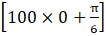 = 1 cm
v = 200 cos 
v t=0 = 200 cos 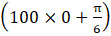
= 100  cm/s =
  m/s
m/s
a = –20000 sin 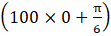 = 10000 cm/s 2
= –100 m/s 2
Prepare Smarter with CGP Edu
Get practice questions, solutions, and test series in one place.
Write a Review
Share your experience with this question and solution.
Commentary
Send your comment, doubt, correction, or feedback to admin.
Similar Questions
Explore conceptually related problems
The equation of S.H.M. is y = a sin (2 π nt + α), then its phase at time is
Two equation of two S.H.M. are x = a sin (ꞷt – α) and y = b cos(ꞷt – α). The phase difference betwe…
A particle is oscillating according to the equation X = 7 cos 0.5 π t, where t is in second. The po…
The amplitude and the periodic time of a S.H.M. are 5 cm and 6 sec respectively. At a distance of 2…
A 1.00 x 10 –20 kg particle is vibrating with simple harmonic motion with a period of 1.00 x 10 –5 …
The displacement of a particle moving in S.H.M. at any instant is given by y = a sin ꞷt. The accele…