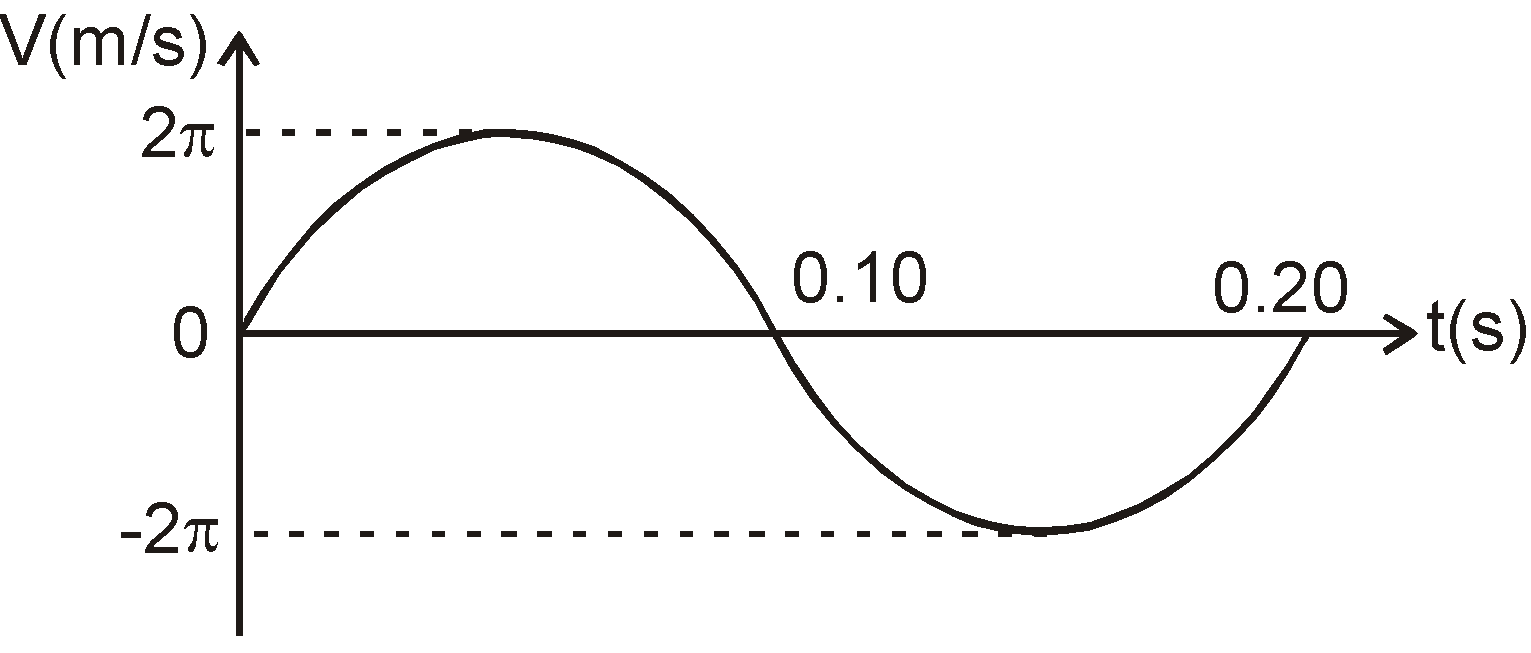
A simple harmonic oscillator consists of a block attached to a spring with k = 200 N/m. The block slides on a frictionless horizontal surface, with equilibrium point x = 0. A graph of the block’s velocity v as a function of time t is shown. Correctly match the required information in the left column with the values given in the right column. (use π 2 = 10)
Left Column | Right Column | ||
(a) | The block’s mass in kg | (p) | - 0.20 |
(b) | The block’s displacement at t = 0 in metres | (q) | - 200 |
(c) | The block’s acceleration at t = 0.10 s in m/s2 | (r) | 0.20 |
(d) | The block’s maximum kinetic energy in Joule | (s) | 4.0 |
Text Solution
Verified by Expertsr, p, q, s
Sol. V max = Aꞷ
⇒ A =  =
=  x (0.2) = 0.20m
T = 
⇒ m =  = 0.2 kg
At t = 0.1, acc. is maximum
⇒ a max = – ꞷ 2 A = –  × 0.2
× 0.2
= – 200 m/s 2
Maximum energy =  = 4 J
= 4 J
Prepare Smarter with CGP Edu
Get practice questions, solutions, and test series in one place.
Write a Review
Share your experience with this question and solution.
Commentary
Send your comment, doubt, correction, or feedback to admin.
Similar Questions
Explore conceptually related problems