
NCERT Solutions for Class 11 Physics Chapter 4, Laws of Motion, have been carefully prepared by experienced physics teachers to help students understand every concept clearly. Before solving the NCERT questions, students should thoroughly study the chapter theory, including Newton’s laws of motion, inertia, momentum, friction and circular motion. These step-by-step solutions make numerical and conceptual questions easier to understand and are useful for school exams, NEET and JEE preparation. Students can also access and download the complete NCERT solutions for all Class 11 Physics chapters in PDF format.
Class 11 Physics Chapter 4 Overview
The Laws of Motion chapter explains the basic principles that govern the motion of objects. Students learn about force, inertia, momentum and Newton’s three laws of motion. The chapter covers the conservation of linear momentum, equilibrium of forces, friction and circular motion. It also discusses the application of these concepts in solving real-life and numerical problems.
NCERT Solutions for Class 11 Physics
Chapter 4: Laws of Motion
Question 4.1
Give the magnitude and direction of the net force acting on:
a. a drop of rain falling down with a constant speed,
b. a cork of mass $10\text{ g}$ floating on water,
c. a kite skillfully held stationary in the sky,
d. a car moving with a constant velocity of $30\text{ km/h}$ on a rough road,
e. a high-speed electron in space far from all material objects, and free of electric and magnetic fields.
Solution :
a. As the rain drop is falling with a constant speed, its acceleration $a = 0$. Hence net force $F = ma = 0$.
b. As the cork is floating on water, its weight is balanced by the upthrust due to water. Therefore, the net force on the cork is $0$.
c. As the kite is held stationary, in accordance with the first law of motion, the net force on the kite is $0$.
d. Force is being applied to overcome the force of friction. But as velocity of the car is constant, its acceleration $a = 0$. Hence net force on the car $F = ma = 0$.
e. As the high speed electron in space is far away from all gravitating objects and free of electric and magnetic fields, the net force on electron is $0$.
Question 4.2
A pebble of mass $0.05\text{ kg}$ is thrown vertically upwards. Give the direction and magnitude of the net force on the pebble:
a. during its upward motion,
b. during its downward motion,
c. at the highest point where it is momentarily at rest.
Do your answers change if the pebble was thrown at an angle of $45^\circ$ with the horizontal direction? Ignore air resistance.
Solution :
$0.5\text{ N}$, in vertically downward direction, in all cases
Acceleration due to gravity, irrespective of the direction of motion of an object, always acts downward. The gravitational force is the only force that acts on the pebble in all three cases. Its magnitude is given by Newton’s second law of motion as:
$$F = m \times a$$
Where,
$F = \text{Net force}$
$m = \text{Mass of the pebble} = 0.05\text{ kg}$
$a = g = 10\text{ m s}^{-2}$
$$\therefore F = 0.05 \times 10 = 0.5\text{ N}$$
The net force on the pebble in all three cases is $0.5\text{ N}$ and this force acts in the downward direction.
If the pebble is thrown at an angle of $45^\circ$ with the horizontal direction, it will have both the horizontal and vertical components of velocity. At the highest point, only the vertical component of velocity becomes zero. However, the pebble will have the horizontal component of velocity throughout its motion. This component of velocity produces no effect on the net force acting on the pebble.
Question 4.3
Give the magnitude and direction of the net force acting on a stone of mass $0.1\text{ kg}$:
a. just after it is dropped from the window of a stationary train,
b. just after it is dropped from the window of a train running at a constant velocity of $36\text{ km/h}$,
c. just after it is dropped from the window of a train accelerating with $1\text{ m s}^{-2}$,
d. lying on the floor of a train which is accelerating with $1\text{ m s}^{-2}$, the stone being at rest relative to the train. Neglect air resistance throughout.
Solution :
a. Here, $m = 0.1\text{ kg}$, $a = +g = 10\text{ m s}^{-2}$
$$\text{Net force } F = ma = 0.1 \times 10 = 1.0\text{ N}$$
This force acts vertically downwards.
b. When the train is running at a constant velocity, its acceleration $= 0$. No force acts on the stone due to this motion. Therefore, force on the stone $F = \text{weight of stone} = mg = 0.1 \times 10 = 1.0\text{ N}$.
This force also acts vertically downwards.
c. When the train is accelerating with $1\text{ m s}^{-2}$, an additional force $F’ = ma = 0.1 \times 1 = 0.1\text{ N}$ acts on the stone in the horizontal direction. But once the stone is dropped from the train, $F’$ becomes zero and the net force on the stone is $F = mg = 0.1 \times 10 = 1.0\text{ N}$, acting vertically downwards.
d. As the stone is lying on the floor of the train, its acceleration is same as that of the train.
$$\therefore \text{Force acting on stone } F = ma = 0.1 \times 1 = 0.1\text{ N}$$
This force is along the horizontal direction of motion of the train.
*(Note that in each case, the weight of the stone is being balanced by the normal reaction).*
Question 4.4
One end of a string of length $l$ is connected to a particle of mass $m$ and the other to a small peg on a smooth horizontal table. If the particle moves in a circle with speed $v$ the net force on the particle (directed towards the centre) is:
(i) $T$, (ii) $T – \frac{mv^2}{l}$, (iii) $T + \frac{mv^2}{l}$, (iv) $0$
$T$ is the tension in the string. [Choose the correct alternative].
Solution :
**(i) $T$**
When a particle connected to a string revolves in a circular path around a centre, the centripetal force is provided by the tension produced in the string. Hence, in the given case, the net force on the particle is the tension $T$, i.e.,
$$F = T = \frac{mv^2}{l}$$
Where $F$ is the net force acting on the particle.
Question 4.5
A constant retarding force of $50\text{ N}$ is applied to a body of mass $20\text{ kg}$ moving initially with a speed of $15\text{ m s}^{-1}$. How long does the body take to stop?
Solution :
$$\text{Retarding force } F = -50\text{ N}$$
$$\text{Mass of the body } m = 20\text{ kg}$$
$$\text{Initial velocity of the body } u = 15\text{ m/s}$$
$$\text{Final velocity of the body } v = 0$$
Using Newton’s second law of motion, the acceleration ($a$) produced in the body can be calculated as:
$$F = ma$$
$$-50 = 20 \times a$$
$$\therefore a = \frac{-50}{20} = -2.5\text{ m s}^{-2}$$
Using the first equation of motion, the time ($t$) taken by the body to come to rest can be calculated as:
$$v = u + at$$
$$\therefore t = \frac{-u}{a} = \frac{-15}{-2.5} = 6\text{ s}$$
Question 4.6
A constant force acting on a body of mass $3.0\text{ kg}$ changes its speed from $2.0\text{ m s}^{-1}$ to $3.5\text{ m s}^{-1}$ in $25\text{ s}$. The direction of the motion of the body remains unchanged. What is the magnitude and direction of the force?
Solution :
$$\text{Mass of the body } m = 3\text{ kg}$$
$$\text{Initial speed of the body } u = 2\text{ m/s}$$
$$\text{Final speed of the body } v = 3.5\text{ m/s}$$
$$\text{Time } t = 25\text{ s}$$
Using the first equation of motion, the acceleration ($a$) produced in the body can be calculated as:
$$v = u + at$$
$$\therefore a = \frac{v – u}{t} = \frac{3.5 – 2}{25} = \frac{1.5}{25} = 0.06\text{ m s}^{-2}$$
As per Newton’s second law of motion, force is given as:
$$F = ma = 3 \times 0.06 = 0.18\text{ N}$$
Since the application of force does not change the direction of the body, the net force acting on the body is in the direction of its motion.
Question 4.7
A body of mass $5\text{ kg}$ is acted upon by two perpendicular forces $8\text{ N}$ and $6\text{ N}$. Give the magnitude and direction of the acceleration of the body.
Solution :
$$\text{Mass of the body } m = 5\text{ kg}$$
The resultant of two perpendicular forces is given as:
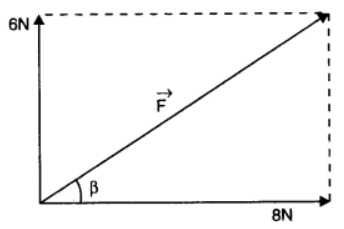
$$R = \sqrt{8^2 + 6^2} = \sqrt{64 + 36} = \sqrt{100} = 10\text{ N}$$
$\theta$ is the angle made by $R$ with the force of $8\text{ N}$:
$$\theta = \tan^{-1}\left(\frac{6}{8}\right) = \tan^{-1}(0.75) \approx 36.87^\circ$$
As per Newton’s second law of motion, the acceleration ($a$) of the body is given as:
$$F = ma$$
$$\therefore a = \frac{F}{m} = \frac{10}{5} = 2\text{ m s}^{-2}$$
Question 4.8
The driver of a three-wheeler moving with a speed of $36\text{ km/h}$ sees a child standing in the middle of the road and brings his vehicle to rest in $4.0\text{ s}$ just in time to save the child. What is the average retarding force on the vehicle? The mass of the three-wheeler is $400\text{ kg}$ and the mass of the driver is $65\text{ kg}$.
Solution :
$$\text{Initial speed of the three-wheeler } u = 36\text{ km/h} = 10\text{ m/s}$$
$$\text{Final speed of the three-wheeler } v = 0\text{ m/s}$$
$$\text{Time } t = 4\text{ s}$$
$$\text{Mass of the three-wheeler } m = 400\text{ kg}$$
$$\text{Mass of the driver } m’ = 65\text{ kg}$$
$$\text{Total mass of the system } M = 400 + 65 = 465\text{ kg}$$
Using the first law of motion, the acceleration ($a$) of the three-wheeler can be calculated as:
$$v = u + at$$
$$\therefore a = \frac{v – u}{t} = \frac{0 – 10}{4} = -2.5\text{ m s}^{-2}$$
The negative sign indicates that the velocity of the three-wheeler is decreasing with time.
Using Newton’s second law of motion, the net force acting on the three-wheeler can be calculated as:
$$F = Ma = 465 \times (-2.5) = -1162.5\text{ N}$$
The negative sign indicates that the force is acting against the direction of motion of the three-wheeler.
Question 4.9
A rocket with a lift-off mass $20,000\text{ kg}$ is blasted upwards with an initial acceleration of $5.0\text{ m s}^{-2}$. Calculate the initial thrust (force) of the blast.
Solution :
$$\text{Mass of the rocket } m = 20,000\text{ kg}$$
$$\text{Initial acceleration } a = 5\text{ m/s}^2$$
$$\text{Acceleration due to gravity } g = 10\text{ m/s}^2$$
Using Newton’s second law of motion, the net force (thrust) acting on the rocket is given by the relation:
$$F – mg = ma$$
$$F = m(g + a) = 20000 \times (10 + 5) = 20000 \times 15 = 3 \times 10^5\text{ N}$$
Question 4.10
A body of mass $0.40\text{ kg}$ moving initially with a constant speed of $10\text{ m s}^{-1}$ to the north is subject to a constant force of $8.0\text{ N}$ directed towards the south for $30\text{ s}$. Take the instant the force is applied to be $t = 0$, the position of the body at that time to be $x = 0$, and predict its position at $t = -5\text{ s}$, $25\text{ s}$, $100\text{ s}$.
Solution :
$$\text{Mass of the body } m = 0.40\text{ kg}$$
$$\text{Initial speed of the body } u = 10\text{ m/s due north}$$
$$\text{Force acting on the body } F = -8.0\text{ N}$$
$$\text{Acceleration produced in the body } a = \frac{F}{m} = \frac{-8.0}{0.40} = -20\text{ m s}^{-2}$$
(i) At $t = -5\text{ s}$
$$\text{Acceleration } a’ = 0 \text{ and } u = 10\text{ m/s}$$
$$s = ut + \frac{1}{2}a’t^2 = 10 \times (-5) = -50\text{ m}$$
(ii) At $t = 25\text{ s}$
$$\text{Acceleration } a” = -20\text{ m/s}^2 \text{ and } u = 10\text{ m/s}$$
$$s’ = ut’ + \frac{1}{2}a”t^2 = 10 \times 25 + \frac{1}{2} \times (-20) \times (25)^2 = 250 – 6250 = -6000\text{ m}$$
(iii) At $t = 100\text{ s}$
For $0 \le t \le 30\text{ s}$:
$$a = -20\text{ m s}^{-2}, \quad u = 10\text{ m/s}$$
$$s_1 = ut + \frac{1}{2}at^2 = 10 \times 30 + \frac{1}{2} \times (-20) \times (30)^2 = 300 – 9000 = -8700\text{ m}$$
For $30 < t \le 100\text{ s}$:
As per the first equation of motion, for $t = 30\text{ s}$, final velocity is given as:
$$v = u + at = 10 + (-20) \times 30 = -590\text{ m/s}$$
For motion between $30\text{ s}$ to $100\text{ s}$, i.e., in $70\text{ s}$:
$$s_2 = vt + \frac{1}{2}at^2 = -590 \times 70 = -41300\text{ m}$$
$$\therefore \text{Total distance } s” = s_1 + s_2 = -8700 – 41300 = -50000\text{ m} = -50\text{ km}$$
Question 4.11
A truck starts from rest and accelerates uniformly at $2.0\text{ m s}^{-2}$. At $t = 10\text{ s}$, a stone is dropped by a person standing on the top of the truck ($6\text{ m}$ high from the ground). What are the (a) velocity, and (b) acceleration of the stone at $t = 11\text{ s}$? (Neglect air resistance.)
Solution :
(a) Initial velocity of the truck $u = 0$
$$\text{Acceleration } a = 2\text{ m/s}^2, \quad \text{Time } t = 10\text{ s}$$
As per the first equation of motion, final velocity is given as:
$$v = u + at = 0 + 2 \times 10 = 20\text{ m/s}$$
The final velocity of the truck and hence, of the stone is $20\text{ m/s}$.
At $t = 11\text{ s}$, the horizontal component ($v_x$) of velocity, in the absence of air resistance, remains unchanged, i.e., $v_x = 20\text{ m/s}$.
The vertical component ($v_y$) of velocity of the stone is given by the first equation of motion as:
$$v_y = u + a_y \delta t$$
Where $\delta t = 11 – 10 = 1\text{ s}$ and $a_y = g = 10\text{ m s}^{-2}$:
$$\therefore v_y = 0 + 10 \times 1 = 10\text{ m/s}$$
The resultant velocity ($v$) of the stone is given as:
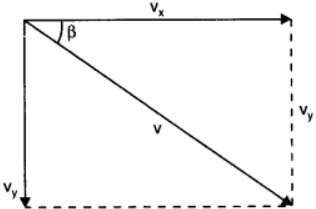
$$v = \sqrt{v_x^2 + v_y^2} = \sqrt{20^2 + 10^2} = \sqrt{500} \approx 22.36\text{ m/s}$$
(b) When the stone is dropped from the truck, the horizontal force acting on it becomes zero. However, the stone continues to move under the influence of gravity. Hence, the acceleration of the stone is $10\text{ m/s}^2$ and it acts vertically downward.
Question 4.12
A bob of mass $0.1\text{ kg}$ hung from the ceiling of a room by a string $2\text{ m}$ long is set into oscillation. The speed of the bob at its mean position is $1\text{ m s}^{-1}$. What is the trajectory of the bob if the string is cut when the bob is (a) at one of its extreme positions, (b) at its mean position.
Solution :
(a) **Vertically downward straight line:** At the extreme position, the velocity of the bob becomes zero. If the string is cut at this moment, then the bob will fall vertically on the ground.
(b) **Parabolic path:** At the mean position, the velocity of the bob is $1\text{ m/s}$. The direction of this velocity is tangential to the arc formed by the oscillating bob. If the string is cut at the mean position, then it will trace a projectile path having the horizontal component of velocity only. Hence, it will follow a parabolic path.
Question 4.13
A man of mass $70\text{ kg}$ stands on a weighing scale in a lift which is moving
(a) upwards with a uniform speed of $10\text{ m s}^{-1}$,
(b) downwards with a uniform acceleration of $5\text{ m s}^{-2}$,
(c) upwards with a uniform acceleration of $5\text{ m s}^{-2}$.
What would be the readings on the scale in each case?
(d) What would be the reading if the lift mechanism failed and it hurtled down freely under gravity?
Solution :
(a) Mass of the man $m = 70\text{ kg}$, Acceleration $a = 0$
Using Newton’s second law of motion:
$$R – mg = ma \implies R = mg$$
$$R = 70 \times 10 = 700\text{ N}$$
$$\therefore \text{Reading on the weighing scale} = \frac{700}{10} = 70\text{ kg}$$
(b) Acceleration $a = 5\text{ m/s}^2$ downward:
$$R + mg = ma \implies R = m(g – a)$$
$$R = 70(10 – 5) = 70 \times 5 = 350\text{ N}$$
$$\therefore \text{Reading on the weighing scale} = \frac{350}{10} = 35\text{ kg}$$
(c) Acceleration $a = 5\text{ m/s}^2$ upward:
$$R – mg = ma \implies R = m(g + a)$$
$$R = 70(10 + 5) = 70 \times 15 = 1050\text{ N}$$
$$\therefore \text{Reading on the weighing scale} = \frac{1050}{10} = 105\text{ kg}$$
(d) When the lift moves freely under gravity, acceleration $a = g$:
$$R = m(g – g) = 0\text{ N}$$
$$\therefore \text{Reading on the weighing scale} = \frac{0}{10} = 0\text{ kg}$$
The man will be in a state of weightlessness.
Question 4.14
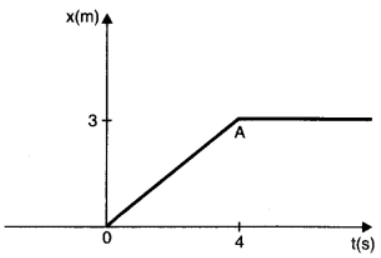
Figure 5.16 shows the position-time graph of a particle of mass $4\text{ kg}$. What is the (a) force on the particle for $t < 0$, $t > 4\text{ s}$, $0 < t < 4\text{ s}$? (b) impulse at $t = 0$ and $t = 4\text{ s}$? (Consider one-dimensional motion only).
Solution :
(a) For $t < 0$: The position of the particle is coincident with the time axis. It indicates that the displacement of the particle in this time interval is zero. Hence, the force acting on the particle is zero.
For $t > 4\text{ s}$: The position of the particle is parallel to the time axis. It indicates that the particle is at rest at a distance of $3\text{ m}$ from the origin. Hence, no force is acting on the particle.
For $0 < t < 4\text{ s}$: The position-time graph has a constant slope. Hence, the acceleration produced in the particle is zero. Therefore, the force acting on the particle is zero.
(b) At $t = 0$:
$$\text{Impulse} = \text{Change in momentum} = mv – mu$$
$$\text{Mass } m = 4\text{ kg}, \quad u = 0, \quad v = \frac{3}{4}\text{ m/s}$$
$$\therefore \text{Impulse} = 4 \left(\frac{3}{4} – 0\right) = 3\text{ kg m/s}$$
At $t = 4\text{ s}$:
$$u = \frac{3}{4}\text{ m/s}, \quad v = 0$$
$$\therefore \text{Impulse} = 4 \left(0 – \frac{3}{4}\right) = -3\text{ kg m/s}$$
Question 4.15
Two bodies of masses $10\text{ kg}$ and $20\text{ kg}$ respectively kept on a smooth, horizontal surface are tied to the ends of a light string. A horizontal force $F = 600\text{ N}$ is applied to (i) A, (ii) B along the direction of string. What is the tension in the string in each case?
Solution :
$$\text{Horizontal force } F = 600\text{ N}$$
$$\text{Mass of body A } m_1 = 10\text{ kg}$$
$$\text{Mass of body B } m_2 = 20\text{ kg}$$
$$\text{Total mass of the system } m = m_1 + m_2 = 30\text{ kg}$$
Using Newton’s second law of motion, the acceleration ($a$) produced in the system can be calculated as:
$$F = ma \implies a = \frac{F}{m} = \frac{600}{30} = 20\text{ m s}^{-2}$$
When force $F$ is applied on body A:
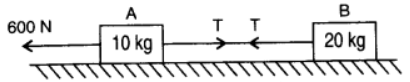
$$F – T = m_1 a \implies T = F – m_1 a = 600 – 10 \times 20 = 400\text{ N}$$
When force $F$ is applied on body B:
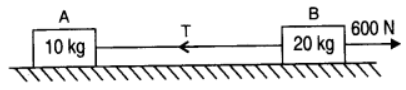
$$F – T = m_2 a \implies T = F – m_2 a = 600 – 20 \times 20 = 200\text{ N}$$
Question 4.16
Two masses $8\text{ kg}$ and $12\text{ kg}$ are connected at the two ends of a light inextensible string that goes over a frictionless pulley. Find the acceleration of the masses, and the tension in the string when the masses are released.
Solution :
The given system of two masses and a pulley can be represented as shown in the following figure:
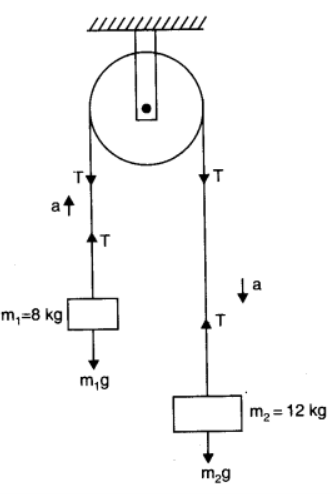
Smaller mass $m_1 = 8\text{ kg}$, Larger mass $m_2 = 12\text{ kg}$
$$\text{Acceleration } a = \left(\frac{m_2 – m_1}{m_1 + m_2}\right)g = \left(\frac{12 – 8}{12 + 8}\right) \times 10 = \frac{4 \times 10}{20} = 2\text{ m s}^{-2}$$
$$\text{Tension } T = \frac{2m_1 m_2 g}{m_1 + m_2} = \frac{2 \times 12 \times 8 \times 10}{12 + 8} = 96\text{ N}$$
Question 4.17
A nucleus is at rest in the laboratory frame of reference. Show that if it disintegrates into two smaller nuclei the products must move in opposite directions.
Solution :
Let $m, m_1,$ and $m_2$ be the respective masses of the parent nucleus and the two daughter nuclei. The parent nucleus is at rest.
$$\text{Initial momentum of the system} = 0$$
Let $v_1$ and $v_2$ be the respective velocities of the daughter nuclei. According to the law of conservation of momentum:
$$0 = m_1 v_1 + m_2 v_2 \implies v_1 = \frac{-m_2 v_2}{m_1}$$
The negative sign indicates that the fragments of the parent nucleus move in directions opposite to each other.
Question 4.18
Two billiard balls each of mass $0.05\text{ kg}$ moving in opposite directions with speed $6\text{ m s}^{-1}$ collide and rebound with the same speed. What is the impulse imparted to each ball due to the other?
Solution :
$$\text{Mass of each ball } m = 0.05\text{ kg}$$
$$\text{Initial velocity of each ball } u = 6\text{ m/s}$$
$$\text{Initial momentum } p_i = 0.3\text{ kg m/s}$$
After collision, the balls rebound with the same speed:
$$\text{Final momentum } p_f = -0.3\text{ kg m/s}$$
$$\text{Impulse imparted to each ball} = p_f – p_i = -0.3 – 0.3 = -0.6\text{ kg m/s}$$
The negative sign indicates that the impulses imparted are opposite in direction.
Question 4.19
A shell of mass $0.020\text{ kg}$ is fired by a gun of mass $100\text{ kg}$. If the muzzle speed of the shell is $80\text{ m s}^{-1}$, what is the recoil speed of the gun?
Solution :
$$\text{Mass of the gun } M = 100\text{ kg}$$
$$\text{Mass of the shell } m = 0.020\text{ kg}$$
$$\text{Muzzle speed of the shell } v = 80\text{ m/s}$$
By the law of conservation of momentum:
$$MV = mv \implies V = \frac{mv}{M} = \frac{0.020 \times 80}{100} = 0.016\text{ m/s}$$
Question 4.20
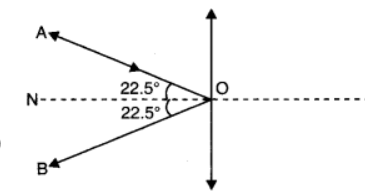
A batsman deflects a ball by an angle of $45^\circ$ without changing its initial speed which is equal to $54\text{ km/h}$. What is the impulse imparted to the ball? (Mass of the ball is $0.15\text{ kg}$.)
Solution :
The given system of two masses and a pulley can be represented as shown in the following figure:
$$\text{Mass of the ball } m = 0.15\text{ kg}$$
$$\text{Velocity } v = 54\text{ km/h} = 15\text{ m/s}$$
$$\text{Angle of deflection } \theta = 45^\circ \implies \text{Half angle} = 22.5^\circ$$
$$\text{Impulse} = 2mv \cos(22.5^\circ) = 2 \times 0.15 \times 15 \times \cos(22.5^\circ) = 4.5 \times 0.9239 \approx 4.16\text{ kg m/s}$$
Question 4.21
A stone of mass $0.25\text{ kg}$ tied to the end of a string is whirled round in a circle of radius $1.5\text{ m}$ with a speed of $40\text{ rev./min}$ in a horizontal plane. What is the tension in the string? What is the maximum speed with which the stone can be whirled around if the string can withstand a maximum tension of $200\text{ N}$?
Solution :
$$\text{Mass } m = 0.25\text{ kg}, \quad r = 1.5\text{ m}, \quad \text{Frequency } n = \frac{40}{60} = \frac{2}{3}\text{ rps}$$
$$\text{Tension } T = \frac{mv^2}{r} = mr(2\pi n)^2 = 0.25 \times 1.5 \times \left(2 \times 3.14 \times \frac{2}{3}\right)^2 \approx 6.57\text{ N}$$
$$\text{Maximum speed } v_{\text{max}} = \sqrt{\frac{T_{\text{max}} \times r}{m}} = \sqrt{\frac{200 \times 1.5}{0.25}} = \sqrt{1200} = 34.64\text{ m/s}$$
Question 4.22
If, in Exercise 4.21, the speed of the stone is increased beyond the maximum permissible value, and the string breaks suddenly, which of the following correctly describes the trajectory of the stone after the string breaks:
a. the stone moves radially outwards,
b. the stone flies off tangentially from the instant the string breaks,
c. the stone flies off at an angle with the tangent whose magnitude depends on the speed of the particle?
Solution :
**(b) the stone flies off tangentially from the instant the string breaks**
According to Newton’s first law of motion, the stone continues to move in the direction of its instantaneous velocity vector, which is directed along the tangent to the circular path at that instant.
Question 4.23
Explain why
a. a horse cannot pull a cart and run in empty space,
b. passengers are thrown forward from their seats when a speeding bus stops suddenly,
c. it is easier to pull a lawn mower than to push it,
d. a cricketer moves his hands backwards while holding a catch.
Solution :
a. While trying to pull a cart, a horse pushes the ground backward with some force. The ground in turn exerts an equal and opposite reaction force upon the feet of the horse. Empty space is devoid of any such reaction force. Therefore, a horse cannot pull a cart and run in empty space.
b. This is due to inertia of motion. When a speeding bus stops suddenly, the lower part of a passenger’s body comes to rest with the seat, but the upper part tends to remain in motion. As a result, the passenger’s upper body is thrown forward.
c. When pulling a lawnmower, the vertical component of the applied force acts upwards, reducing its effective weight and normal reaction (hence lower friction). When pushing, the vertical component acts downwards, increasing its effective weight and friction. Thus, it is easier to pull than to push.
d. By moving his hands backward, the cricketer increases the time of impact ($\Delta t$). According to $F \propto \frac{1}{\Delta t}$, a longer impact time decreases the stopping force experienced by his hands, preventing injury.
Additional Question 1
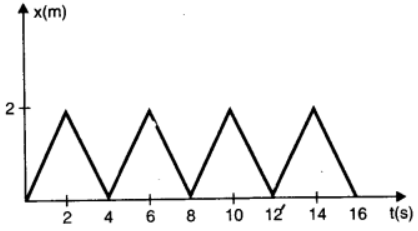
Figure 5.17 shows the position-time graph of a body of mass $0.04\text{ kg}$. Suggest a suitable physical context for this motion. What is the time between two consecutive impulses received by the body? What is the magnitude of each impulse?
Solution :
A ball rebounding between two walls located between at $x = 0$ and $x = 2\text{ cm}$; after every $2\text{ s}$, the ball receives an impulse of magnitude $0.08 \times 10^{-2}\text{ kg m/s}$ from the walls
The given graph shows that a body changes its direction of motion after every $2\text{ s}$. Physically, this situation can be visualized as a ball rebounding to and fro between two stationary walls situated between positions $x = 0$ and $x = 2\text{ cm}$. Since the slope of the $x\text{-}t$ graph reverses after every $2\text{ s}$, the ball collides with a wall after every $2\text{ s}$. Therefore, ball receives an impulse after every $2\text{ s}$.
$$\text{Mass of the ball, } m = 0.04\text{ kg}$$
The slope of the graph gives the velocity of the ball. Using the graph, we can calculate initial velocity ($u$) as:
$$u = \frac{(2 – 0) \times 10^{-2}}{2 – 0} = 10^{-2}\text{ m/s}$$
$$\text{Velocity of the ball before collision, } u = 10^{-2}\text{ m/s}$$
$$\text{Velocity of the ball after collision, } v = -10^{-2}\text{ m/s}$$
(Here, the negative sign arises as the ball reverses its direction of motion.)
$$\text{Magnitude of impulse} = |mv – mu|$$
$$= |0.04(v – u)|$$
$$= |0.04(-10^{-2} – 10^{-2})|$$
$$= 0.08 \times 10^{-2}\text{ kg m/s}$$
Additional Question 2
Figure 5.18 shows a man standing stationary with respect to a horizontal conveyor belt that is accelerating with $1\text{ m s}^{-2}$. What is the net force on the man? If the coefficient of static friction between the man’s shoes and the belt is $0.2$, up to what acceleration of the belt can the man continue to be stationary relative to the belt? (Mass of the man $= 65\text{ kg}$.)
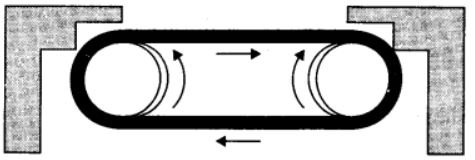
Solution :
$$\text{Mass of the man, } m = 65\text{ kg}$$
$$\text{Acceleration of the belt, } a = 1\text{ m/s}^2$$
$$\text{Coefficient of static friction, } \mu = 0.2$$
The net force $F$, acting on the man is given by Newton’s second law of motion as:
$$F_{\text{net}} = ma = 65 \times 1 = 65\text{ N}$$
The man will continue to be stationary with respect to the conveyor belt until the net force on the man is less than or equal to the frictional force $f_s$, exerted by the belt, i.e.,
$$F’_{\text{net}} = f_s$$
$$ma’ = \mu mg$$
$$\therefore a’ = 0.2 \times 10 = 2\text{ m/s}^2$$
Therefore, the maximum acceleration of the belt up to which the man can stand stationary is $2\text{ m/s}^2$.
Additional Question 3
A stone of mass $m$ tied to the end of a string revolves in a vertical circle of radius $R$. The net forces at the lowest and highest points of the circle directed vertically downwards are: [Choose the correct alternative]
| Lowest Point | Highest Point | |
|---|---|---|
| (a) | $mg – T_1$ | $mg + T_2$ |
| (b) | $mg + T_1$ | $mg – T_2$ |
| (c) | $mg + T_1 – \frac{m v_1^2}{R}$ | $mg – T_2 + \frac{m v_1^2}{R}$ |
| (d) | $mg – T_1 – \frac{m v_1^2}{R}$ | $mg + T_2 + \frac{m v_1^2}{R}$ |
$T_1$ and $v_1$ denote the tension and speed at the lowest point. $T_2$ and $v_2$ denote corresponding values at the highest point.
Solution :
(a) The free body diagram of the stone at the lowest point is shown in the following figure.
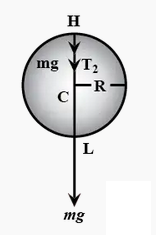
According to Newton’s second law of motion, the net force acting on the stone at this point is equal to the centripetal force, i.e.,
$$F_{\text{net}} = T – mg = \frac{m v_1^2}{R} \quad \dots\text{(i)}$$
Where, $v_1 = \text{Velocity at the lowest point}$
The free body diagram of the stone at the highest point is shown in the following figure.
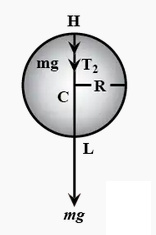
Using Newton’s second law of motion, we have:
$$T + mg = \frac{m v_2^2}{R} \quad \dots\text{(ii)}$$
Where, $v_2 = \text{Velocity at the highest point}$
It is clear from equations (i) and (ii) that the net force acting at the lowest and the highest points are respectively $(T – mg)$ and $(T + mg)$.
Additional Question 4
A helicopter of mass $1000\text{ kg}$ rises with a vertical acceleration of $15\text{ m s}^{-2}$. The crew and the passengers weigh $300\text{ kg}$. Give the magnitude and direction of the
a. force on the floor by the crew and passengers,
b. action of the rotor of the helicopter on the surrounding air,
c. force on the helicopter due to the surrounding air.
Solution :
a. Mass of the helicopter, $m_h = 1000\text{ kg}$
Mass of the crew and passengers, $m_p = 300\text{ kg}$
Total mass of the system, $m = 1300\text{ kg}$
Acceleration of the helicopter, $a = 15\text{ m/s}^2$
Using Newton’s second law of motion, the reaction force $R$, on the system by the floor can be calculated as:
$$R – m_p g = m_p a$$
$$= m_p (g + a)$$
$$= 300 (10 + 15) = 300 \times 25 = 7500\text{ N}$$
Since the helicopter is accelerating vertically upward, the reaction force will also be directed upward. Therefore, as per Newton’s third law of motion, the force on the floor by the crew and passengers is $7500\text{ N}$, directed downward.
b. Using Newton’s second law of motion, the reaction force $R’$, experienced by the helicopter can be calculated as:
$$R’ – mg = ma$$
$$= m(g + a)$$
$$= 1300 (10 + 15) = 1300 \times 25 = 32500\text{ N}$$
The reaction force experienced by the helicopter from the surrounding air is acting upward. Hence, as per Newton’s third law of motion, the action of the rotor on the surrounding air will be $32500\text{ N}$, directed downward.
c. The force on the helicopter due to the surrounding air is $32500\text{ N}$, directed upward.
Additional Question 5
A stream of water flowing horizontally with a speed of $15\text{ m s}^{-1}$ gushes out of a tube of cross-sectional area $10^{-2}\text{ m}^2$, and hits a vertical wall nearby. What is the force exerted on the wall by the impact of water, assuming it does not rebound?
Solution :
Speed of the water stream, $v = 15\text{ m/s}$
Cross-sectional area of the tube, $A = 10^{-2}\text{ m}^2$
Volume of water coming out from the pipe per second,
$$V = Av = 15 \times 10^{-2}\text{ m}^3\text{/s}$$
Density of water, $\rho = 10^3\text{ kg/m}^3$
Mass of water flowing out through the pipe per second $= \rho \times V = 150\text{ kg/s}$
The water strikes the wall and does not rebound. Therefore, the force exerted by the water on the wall is given by Newton’s second law of motion as:
$$F = \text{Rate of change of momentum} = \frac{\Delta P}{\Delta t}$$
$$= \frac{mv}{t}$$
$$= 150 \times 15 = 2250\text{ N}$$
Additional Question 6
Ten one-rupee coins are put on top of each other on a table. Each coin has a mass $m$. Give the magnitude and direction of
a. the force on the $7^{\text{th}}$ coin (counted from the bottom) due to all the coins on its top,
b. the force on the $7^{\text{th}}$ coin by the eighth coin,
c. the reaction of the $6^{\text{th}}$ coin on the $7^{\text{th}}$ coin.
Solution :
a. Force on the seventh coin is exerted by the weight of the three coins on its top.
$$\text{Weight of one coin} = mg$$
$$\text{Weight of three coins} = 3mg$$
Hence, the force exerted on the $7^{\text{th}}$ coin by the three coins on its top is $3mg$. This force acts vertically downward.
b. Force on the seventh coin by the eighth coin is because of the weight of the eighth coin and the other two coins (ninth and tenth) on its top.
$$\text{Weight of the eighth coin} = mg$$
$$\text{Weight of the ninth coin} = mg$$
$$\text{Weight of the tenth coin} = mg$$
$$\text{Total weight of these three coins} = 3mg$$
Hence, the force exerted on the $7^{\text{th}}$ coin by the eighth coin is $3mg$. This force acts vertically downward.
c. The $6^{\text{th}}$ coin experiences a downward force because of the weight of the four coins ($7^{\text{th}}, 8^{\text{th}}, 9^{\text{th}},$ and $10^{\text{th}}$) on its top.
Therefore, the total downward force experienced by the $6^{\text{th}}$ coin is $4mg$.
As per Newton’s third law of motion, the $6^{\text{th}}$ coin will produce an equal reaction force on the $7^{\text{th}}$ coin, but in the opposite direction. Hence, the reaction force of the $6^{\text{th}}$ coin on the $7^{\text{th}}$ coin is of magnitude $4mg$. This force acts in the upward direction.
Additional Question 7
An aircraft executes a horizontal loop at a speed of $720\text{ km/h}$ with its wings banked at $15^\circ$. What is the radius of the loop?
Solution :
Speed of the aircraft, $v = 720\text{ km/h} = 720 \times \frac{5}{18} = 200\text{ m/s}$
Acceleration due to gravity, $g = 10\text{ m/s}^2$
Angle of banking, $\theta = 15^\circ$
For radius $r$, of the loop, we have the relation:
$$\tan\theta = \frac{v^2}{rg}$$
$$r = \frac{v^2}{g \tan\theta}$$
$$= \frac{200^2}{10 \times \tan(15^\circ)}$$
$$= \frac{40000}{10 \times 0.2679} = \frac{4000}{0.2679} = 14925.37\text{ m} = 14.92\text{ km}$$
Additional Question 8
A train runs along an unbanked circular track of radius $30\text{ m}$ at a speed of $54\text{ km/h}$. The mass of the train is $10^6\text{ kg}$. What provides the centripetal force required for this purpose – The engine or the rails? What is the angle of banking required to prevent wearing out of the rail?
Solution :
Radius of the circular track, $r = 30\text{ m}$
Speed of the train, $v = 54\text{ km/h} = 15\text{ m/s}$
Mass of the train, $m = 10^6\text{ kg}$
The centripetal force is provided by the lateral thrust of the rail on the wheel. As per Newton’s third law of motion, the wheel exerts an equal and opposite force on the rail. This reaction force is responsible for the wear and tear of the rail
The angle of banking $\theta$, is related to the radius ($r$) and speed ($v$) by the relation:
$$\tan\theta = \frac{v^2}{rg} = \frac{15^2}{30 \times 10} = \frac{225}{300} = 0.75$$
$$\theta = \tan^{-1}(0.75) = 36.87^\circ$$
Therefore, the angle of banking is about $36.87^\circ$.
Additional Question 9
A block of mass $25\text{ kg}$ is raised by a $50\text{ kg}$ man in two different ways as shown in Fig. 5.19. What is the action on the floor by the man in the two cases? If the floor yields to a normal force of $700\text{ N}$, which mode should the man adopt to lift the block without the floor yielding?
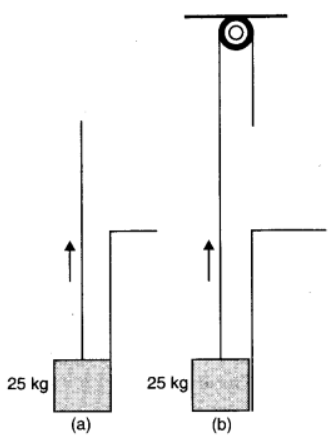
Solution :
$750\text{ N}$ and $250\text{ N}$ in the respective cases; Method (b)
Mass of the block, $m = 25\text{ kg}$
Mass of the man, $M = 50\text{ kg}$
Acceleration due to gravity, $g = 10\text{ m/s}^2$
Force applied on the block, $F = 25 \times 10 = 250\text{ N}$
Weight of the man, $W = 50 \times 10 = 500\text{ N}$
**Case (a): When the man lifts the block directly**
In this case, the man applies a force in the upward direction. This increases his apparent weight.
$$\therefore \text{Action on the floor by the man} = 250 + 500 = 750\text{ N}$$
**Case (b): When the man lifts the block using a pulley**
In this case, the man applies a force in the downward direction. This decreases his apparent weight.
$$\therefore \text{Action on the floor by the man} = 500 – 250 = 250\text{ N}$$
If the floor can yield to a normal force of $700\text{ N}$, then the man should adopt the second method to easily lift the block by applying lesser force.
Additional Question 10
A monkey of mass $40\text{ kg}$ climbs on a rope (Fig. 5.20) which can stand a maximum tension of $600\text{ N}$. In which of the following cases will the rope break: the monkey
a. climbs up with an acceleration of $6\text{ m s}^{-2}$
b. climbs down with an acceleration of $4\text{ m s}^{-2}$
c. climbs up with a uniform speed of $5\text{ m s}^{-1}$
d. falls down the rope nearly freely under gravity?
(Ignore the mass of the rope).
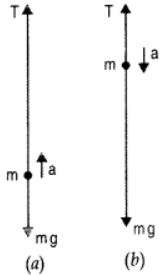
Solution :
**Case (a)**
Mass of the monkey, $m = 40\text{ kg}$
Acceleration due to gravity, $g = 10\text{ m/s}^2$
Maximum tension that the rope can bear, $T_{\text{max}} = 600\text{ N}$
Acceleration of the monkey, $a = 6\text{ m/s}^2$ upward
Using Newton’s second law of motion, we can write the equation of motion as:
$$T – mg = ma \implies T = m(g + a) = 40 (10 + 6) = 640\text{ N}$$
Since $T > T_{\text{max}}$, the rope will break in this case.
**Case (b)**
Acceleration of the monkey, $a = 4\text{ m/s}^2$ downward
Using Newton’s second law of motion, we can write the equation of motion as:
$$mg – T = ma \implies T = m (g – a) = 40(10 – 4) = 240\text{ N}$$
Since $T < T_{\text{max}}$, the rope will not break in this case.
**Case (c)**
The monkey is climbing with a uniform speed of $5\text{ m/s}$. Therefore, its acceleration is zero, i.e., $a = 0$.
Using Newton’s second law of motion, we can write the equation of motion as:
$$T – mg = ma \implies T – mg = 0 \implies T = mg = 40 \times 10 = 400\text{ N}$$
Since $T < T_{\text{max}}$, the rope will not break in this case.
**Case (d)**
When the monkey falls freely under gravity, its acceleration will become equal to the acceleration due to gravity, i.e., $a = g$
Using Newton’s second law of motion, we can write the equation of motion as:
$$mg – T = mg \implies T = m(g – g) = 0$$
Since $T < T_{\text{max}}$, the rope will not break in this case.
Additional Question 11
Two bodies A and B of masses $5\text{ kg}$ and $10\text{ kg}$ in contact with each other rest on a table against a rigid wall (Fig. 5.21). The coefficient of friction between the bodies and the table is $0.15$. A force of $200\text{ N}$ is applied horizontally to A. What are
a. the reaction of the partition
b. the action-reaction forces between A and B? What happens when the wall is removed? Does the answer to (b) change, when the bodies are in motion? Ignore the difference between $\mu_s$ and $\mu_k$.
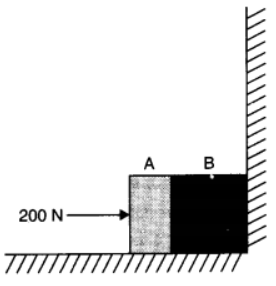
Solution :
a. Mass of body A, $m_A = 5\text{ kg}$, Mass of body B, $m_B = 10\text{ kg}$
Applied force, $F = 200\text{ N}$
Coefficient of friction, $\mu_s = 0.15$
The force of friction is given by the relation:
$$f_s = \mu (m_A + m_B)g = 0.15 (5 + 10) \times 10 = 1.5 \times 15 = 22.5\text{ N leftward}$$
$$\text{Net force acting on the partition} = 200 – 22.5 = 177.5\text{ N rightward}$$
As per Newton’s third law of motion, the reaction force of the partition will be in the direction opposite to the net applied force.
Hence, the reaction of the partition will be $177.5\text{ N}$, in the leftward direction.
b. Force of friction on mass A:
$$f_A = \mu m_A g = 0.15 \times 5 \times 10 = 7.5\text{ N leftward}$$
$$\text{Net force exerted by mass A on mass B} = 200 – 7.5 = 192.5\text{ N rightward}$$
As per Newton’s third law of motion, an equal amount of reaction force will be exerted by mass B on mass A, i.e., $192.5\text{ N}$ acting leftward.
When the wall is removed, the two bodies will move in the direction of the applied force.
$$\text{Net force acting on the moving system} = 177.5\text{ N}$$
The equation of motion for the system of acceleration $a$, can be written as:
$$\text{Net force} = (m_A + m_B) a$$
$$\therefore a = \frac{\text{Net force}}{m_A + m_B} = \frac{177.5}{5 + 10} = \frac{177.5}{15} = 11.83\text{ m s}^{-2}$$
$$\text{Net force causing mass A to move: } F_A = m_A a = 5 \times 11.83 = 59.15\text{ N}$$
$$\text{Net force exerted by mass A on mass B} = 192.5 – 59.15 = 133.35\text{ N}$$
This force will act in the direction of motion. As per Newton’s third law of motion, an equal amount of force will be exerted by mass B on mass A, i.e., $133.35\text{ N}$, acting opposite to the direction of motion.
Additional Question 12
A block of mass $15\text{ kg}$ is placed on a long trolley. The coefficient of static friction between the block and the trolley is $0.18$. The trolley accelerates from rest with $0.5\text{ m s}^{-2}$ for $20\text{ s}$ and then moves with uniform velocity. Discuss the motion of the block as viewed by (a) a stationary observer on the ground, (b) an observer moving with the trolley.
Solution :
a. Mass of the block, $m = 15\text{ kg}$
Coefficient of static friction, $\mu = 0.18$
Acceleration of the trolley, $a = 0.5\text{ m/s}^2$
As per Newton’s second law of motion, the force ($F$) on the block caused by the motion of the trolley is given by the relation:
$$F = ma = 15 \times 0.5 = 7.5\text{ N}$$
This force is acted in the direction of motion of the trolley.
Force of static friction between the block and the trolley:
$$f = \mu mg = 0.18 \times 15 \times 10 = 27\text{ N}$$
The force of static friction between the block and the trolley is greater than the applied external force. Hence, for an observer on the ground, the block will appear to be at rest.
When the trolley moves with uniform velocity there will be no applied external force. Only the force of friction will act on the block in this situation.
b. An observer, moving with the trolley, has some acceleration. This is the case of non-inertial frame of reference. The frictional force, acting on the trolley backward, is opposed by a pseudo force of the same magnitude. However, this force acts in the opposite direction. Thus, the trolley will appear to be at rest for the observer moving with the trolley.
Additional Question 13
The rear side of a truck is open and a box of $40\text{ kg}$ mass is placed $5\text{ m}$ away from the open end as shown in Fig. 5.22. The coefficient of friction between the box and the surface below it is $0.15$. On a straight road, the truck starts from rest and accelerates with $2\text{ m s}^{-2}$. At what distance from the starting point does the box fall off the truck? (Ignore the size of the box).
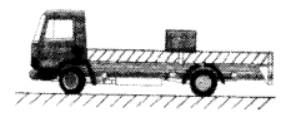
Solution :
Mass of the box, $m = 40\text{ kg}$
Coefficient of friction, $\mu = 0.15$
Initial velocity, $u = 0$
Acceleration, $a = 2\text{ m/s}^2$
Distance of the box from the end of the truck, $s’ = 5\text{ m}$
As per Newton’s second law of motion, the force on the box caused by the accelerated motion of the truck is given by:
$$F = ma = 40 \times 2 = 80\text{ N}$$
As per Newton’s third law of motion, a reaction force of $80\text{ N}$ is acting on the box in the backward direction. The backward motion of the box is opposed by the force of friction $f$, acting between the box and the floor of the truck. This force is given by:
$$f = \mu mg = 0.15 \times 40 \times 10 = 60\text{ N}$$
$$\therefore \text{Net force acting on the block: } F_{\text{net}} = 80 – 60 = 20\text{ N backward}$$
The backward acceleration produced in the box is given by:
$$a_{\text{back}} = \frac{F_{\text{net}}}{m} = \frac{20}{40} = 0.5\text{ m s}^{-2}$$
Using the second equation of motion, time $t$ can be calculated as:
$$s’ = ut + \frac{1}{2}a_{\text{back}}t^2$$
$$5 = 0 + \frac{1}{2} \times 0.5 \times t^2 \implies t = \sqrt{20}\text{ s}$$
Hence, the box will fall from the truck after $\sqrt{20}\text{ s}$ from start.
The distance $s$, travelled by the truck in $\sqrt{20}\text{ s}$ is given by the relation:
$$s = ut + \frac{1}{2}at^2 = 0 + \frac{1}{2} \times 2 \times (\sqrt{20})^2 = 20\text{ m}$$
Additional Question 14
A disc revolves with a speed of $100 / 3\text{ rev / min}$, and has a radius of $15\text{ cm}$. Two coins are placed at $4\text{ cm}$ and $14\text{ cm}$ away from the centre of the record. If the co-efficient of friction between the coins and the record is $0.15$, which of the coins will revolve with the record?
Solution :
Coin placed at $4\text{ cm}$ from the centre
Mass of each coin $= m$
Radius of the disc, $r = 15\text{ cm} = 0.15\text{ m}$
Frequency of revolution, $\nu = 100 / 3\text{ rev/min} = \frac{100}{3 \times 60} = \frac{5}{9}\text{ rev/s}$
Coefficient of friction, $\mu = 0.15$
In the given situation, the coin having a force of friction greater than or equal to the centripetal force provided by the rotation of the disc will revolve with the disc. If this is not the case, then the coin will slip from the disc.
**Coin placed at $4\text{ cm}$:**
Radius of revolution, $r’ = 4\text{ cm} = 0.04\text{ m}$
Angular frequency, $\omega = 2\pi\nu = 2 \times \frac{22}{7} \times \frac{5}{9} = 3.49\text{ s}^{-1}$
Frictional force, $f = \mu mg = 0.15 \times m \times 10 = 1.5m\text{ N}$
Centripetal force on the coin:
$$F_{\text{cent.}} = m r’ \omega^2 = m \times 0.04 \times (3.49)^2 = 0.49m\text{ N}$$
Since $f > F_{\text{cent.}}$, the coin will revolve along with the record.
**Coin placed at $14\text{ cm}$:**
Radius, $r” = 14\text{ cm} = 0.14\text{ m}$
Angular frequency, $\omega = 3.49\text{ s}^{-1}$
Frictional force, $f’ = 1.5m\text{ N}$
Centripetal force is given as:
$$F_{\text{cent.}} = m r” \omega^2 = m \times 0.14 \times (3.49)^2 = 1.7m\text{ N}$$
Since $f < F_{\text{cent.}}$, the coin will slip from the surface of the record.
Additional Question 15
You may have seen in a circus a motorcyclist driving in vertical loops inside a ‘death-well’ (a hollow spherical chamber with holes, so the spectators can watch from outside). Explain clearly why the motorcyclist does not drop down when he is at the uppermost point, with no support from below. What is the minimum speed required at the uppermost position to perform a vertical loop if the radius of the chamber is $25\text{ m}$?
Solution :
In a death-well, a motorcyclist does not fall at the top point of a vertical loop because both the force of normal reaction and the weight of the motorcyclist act downward and are balanced by the centripetal force. This situation is shown in the following figure.
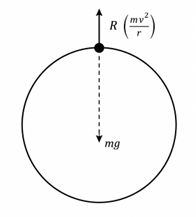
The net force acting on the motorcyclist is the sum of the normal force ($F_N$) and the force due to gravity ($F_g = mg$).
The equation of motion for the centripetal acceleration $a_c$, can be written as:
$$F_{\text{net}} = m a_c$$
$$F_N + F_g = m a_c$$
$$F_N + mg = \frac{m v^2}{r}$$
Normal reaction is provided by the speed of the motorcyclist. At the minimum speed ($v_{\text{min}}$), $F_N = 0$:
$$mg = \frac{m v_{\text{min}}^2}{r}$$
$$\therefore v_{\text{min}} = \sqrt{rg} = \sqrt{25 \times 10} = 15.8\text{ m/s}$$
Additional Question 16
A $70\text{ kg}$ man stands in contact against the inner wall of a hollow cylindrical drum of radius $3\text{ m}$ rotating about its vertical axis with $200\text{ rev/min}$. The coefficient of friction between the wall and his clothing is $0.15$. What is the minimum rotational speed of the cylinder to enable the man to remain stuck to the wall (without falling) when the floor is suddenly removed?
Solution :
Mass of the man, $m = 70\text{ kg}$
Radius of the drum, $r = 3\text{ m}$
Coefficient of friction, $\mu = 0.15$
Frequency of rotation, $\nu = 200\text{ rev/min} = \frac{200}{60} = \frac{10}{3}\text{ rev/s}$
The necessary centripetal force required for the rotation of the man is provided by the normal force ($F_N$).
When the floor revolves, the man sticks to the wall of the drum. Hence, the weight of the man ($mg$) acting downward is balanced by the frictional force ($f = \mu F_N$) acting upward.
Hence, the man will not fall until:
$$mg < f$$
$$mg < \mu F_N = \mu m r \omega^2$$
$$g < \mu r \omega^2 \implies \omega > \sqrt{\frac{g}{\mu r}}$$
The minimum angular speed is given as:
$$\omega_{\text{min}} = \sqrt{\frac{g}{\mu r}} = \sqrt{\frac{10}{0.15 \times 3}} = 4.71\text{ rad s}^{-1}$$
Additional Question 17
A thin circular loop of radius $R$ rotates about its vertical diameter with an angular frequency $\omega$. Show that a small bead on the wire loop remains at its lowermost point for $\omega \le \sqrt{g/R}$. What is the angle made by the radius vector joining the centre to the bead with the vertical downward direction for $\omega = \sqrt{2g/R}$? Neglect friction.
Solution :
Let the radius vector joining the bead with the centre make an angle $\theta$, with the vertical downward direction.
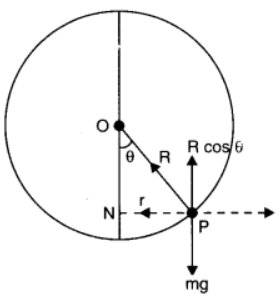
$\text{OP} = R = \text{Radius of the circle}$, $N = \text{Normal reaction}$
The respective vertical and horizontal equations of forces can be written as:
$$mg = N \cos\theta \quad \dots\text{(i)}$$
$$m l \omega^2 = N \sin\theta \quad \dots\text{(ii)}$$
In $\Delta\text{OPQ}$, we have:
$$\sin\theta = \frac{l}{R} \implies l = R \sin\theta \quad \dots\text{(iii)}$$
Substituting equation (iii) in equation (ii), we get:
$$m(R \sin\theta) \omega^2 = N \sin\theta \implies mR \omega^2 = N \quad \dots\text{(iv)}$$
Substituting equation (iv) in equation (i), we get:
$$mg = mR \omega^2 \cos\theta \implies \cos\theta = \frac{g}{R\omega^2} \quad \dots\text{(v)}$$
Since $\cos\theta \le 1$, the bead will remain at its lowermost point for $\frac{g}{R\omega^2} \le 1$, i.e., for $\omega \le \sqrt{\frac{g}{R}}$.
For $\omega = \sqrt{\frac{2g}{R}}$ or $\omega^2 = \frac{2g}{R} \quad \dots\text{(vi)}$
On equating equations (v) and (vi), we get:
$$\frac{2g}{R} = \frac{g}{R \cos\theta} \implies \cos\theta = \frac{1}{2} \implies \theta = \cos^{-1}(0.5) = 60^\circ$$
Why Class 11 Physics Chapter 4 Matters in NEET and JEE
Class 11 Physics Chapter 4, Laws of Motion, is important for NEET and JEE because it explains how forces affect the state of rest or motion of an object. Students learn about inertia, force, momentum, impulse and Newton’s three laws of motion. These concepts form the foundation for understanding later chapters such as Work, Energy and Power, Rotational Motion, Gravitation and Mechanical Properties of Matter.
NEET frequently includes direct conceptual and formula-based questions involving Newton’s laws, friction, momentum and circular motion. JEE commonly asks numerical questions based on free-body diagrams, connected bodies, pulleys, inclined planes, friction and the conservation of linear momentum. Students must understand how to identify all the forces acting on an object and apply the correct sign convention. A strong command of free-body diagrams and force equations helps students solve mechanics problems accurately and efficiently.
Preparation Tips for Class 11 Physics Chapter 4
Begin by understanding the concepts of force, inertia, momentum and impulse. Study Newton’s three laws of motion carefully and learn their practical applications. Pay special attention to the difference between mass and weight, action and reaction forces, and balanced and unbalanced forces.
Practise drawing free-body diagrams for objects placed on horizontal surfaces, inclined planes, connected strings and pulley systems. Identify forces such as weight, normal reaction, tension, friction and applied force before writing equations of motion.
Learn the important relations:
$$F = ma$$
$$p = mv$$
$$J = F\Delta t = \Delta p$$
$$F_c = \frac{mv^2}{r}$$
Study the law of conservation of linear momentum and practise collision and recoil-based questions. Understand static friction, limiting friction and kinetic friction, along with the relations:
$$f_l = \mu_s N$$
$$f_k = \mu_k N$$
Pay attention to the direction of friction, as it opposes relative motion or the tendency of relative motion. Revise all NCERT examples, derivations and diagrams regularly. Complete NCERT exercises before attempting NEET and JEE previous-year questions.
FAQs
1. What are the most important topics in Class 11 Physics Chapter 4?
The most important topics include Newton’s laws of motion, inertia, momentum, impulse, conservation of linear momentum, equilibrium of forces, friction, free-body diagrams and circular motion.
2. What is Newton’s first law of motion?
Newton’s first law states that an object remains at rest or continues moving with uniform velocity in a straight line unless an external unbalanced force acts on it. It is also known as the law of inertia.
3. What is Newton’s second law of motion?
Newton’s second law states that the rate of change of momentum of an object is directly proportional to the applied force and occurs in the direction of that force. For constant mass, it is written as:
$$F = ma$$
4. What is Newton’s third law of motion?
Newton’s third law states that for every action, there is an equal and opposite reaction. Action and reaction forces act simultaneously on two different objects.
5. What is inertia?
Inertia is the tendency of an object to resist any change in its state of rest or uniform motion. The mass of an object is a measure of its inertia.
6. What is momentum?
Momentum is the product of the mass and velocity of an object:
$$p = mv$$
It is a vector quantity and has the same direction as velocity.
7. What is impulse?
Impulse is the product of force and the time interval for which it acts. It is equal to the change in momentum:
$$J = F\Delta t = \Delta p$$
8. What is the law of conservation of linear momentum?
The law states that the total linear momentum of an isolated system remains constant when no external force acts on it. It is commonly applied in collision, explosion and recoil problems.
9. What is friction?
Friction is a contact force that opposes relative motion or the tendency of relative motion between two surfaces. It may be static, limiting or kinetic friction.
10. Is Class 11 Physics Chapter 4 important for NEET and JEE?
Yes. Laws of Motion is one of the most important mechanics chapters for NEET and JEE. Questions are frequently based on Newton’s laws, friction, pulleys, inclined planes, momentum conservation and circular motion. Regular numerical practice and accurate free-body diagrams are essential for scoring well.