
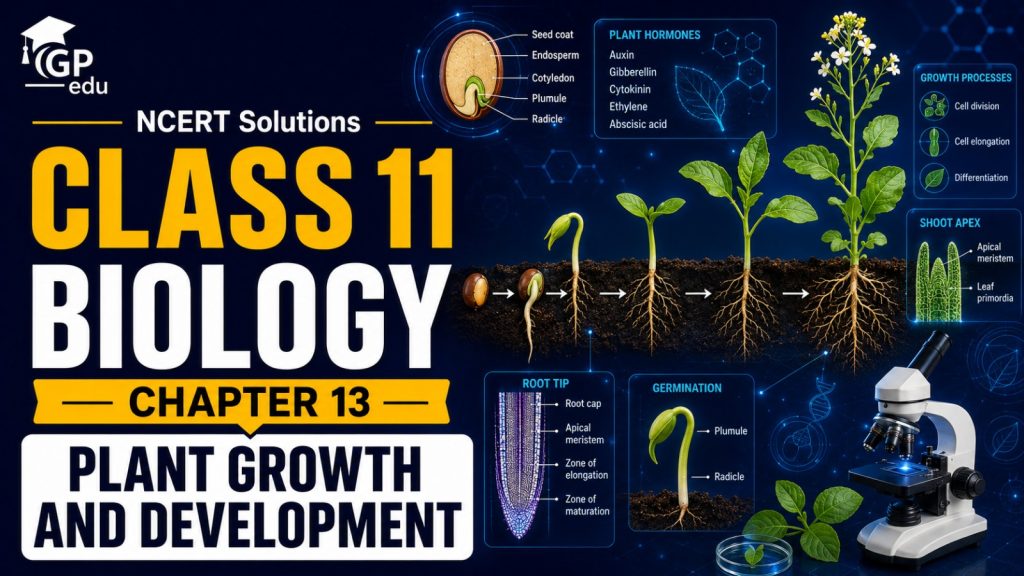
The chapter Plant Growth and Development introduces students to the processes through which plants grow, differentiate, and develop throughout their life cycle. It explains important concepts such as growth, growth phases, growth rates, differentiation, dedifferentiation, redifferentiation, and factors affecting plant growth.
Students learn about the different stages of plant growth, including the meristematic, elongation, and maturation phases, along with the role of plant growth regulators such as auxins, gibberellins, cytokinins, ethylene, and abscisic acid ($\text{ABA}$). The chapter also covers photoperiodism, vernalisation, seed dormancy, and flowering, explaining how plants respond to environmental and internal signals. A clear understanding of Plant Growth and Development provides a strong foundation for studying plant physiology, hormonal regulation, growth, development, and environmental responses, making it an important chapter for NEET preparation.
Class 11 Biology Chapter 13 Overview
Students learn about plant growth and development, including the phases of growth, growth rate, differentiation, dedifferentiation, and redifferentiation. The chapter also explains the role of plant growth regulators ($\text{PGRs}$) and their effects on various physiological processes.
Students are introduced to the major plant hormones—auxins, gibberellins, cytokinins, ethylene, and abscisic acid ($\text{ABA}$)—along with their functions and important applications. The chapter also covers photoperiodism, vernalisation, seed dormancy, and flowering, helping students understand how plants regulate growth and development in response to environmental conditions. A clear understanding of Plant Growth and Development helps students develop a strong foundation in plant physiology, hormonal regulation, growth processes, and plant responses, making it an important chapter for NEET preparation.
NCERT Solutions for Class 11 Biology Chapter 13 – Plant Growth and Development
Question 13.1. Define growth, differentiation, development, dedifferentiation, redifferentiation, determinate growth, meristem and growth rate.
Solution:
Growth is defined as a vital process which brings about an irreversible and permanent change in the shape, size, form, weight and volume of a cell, organ or whole organism, accompanied with increase in dry matter.
Differentiation is a localised qualitative change in size, biochemistry, structure and function of cells, tissues or organs, e.g., fibre, vessel, tracheid, sieve tube, mesophyll, leaf etc. Thus it is a change in form and physiological activity. It results in specialisation for particular functions.
Development may be defined as a process which includes growth, differentiation and maturation in a regular sequence in the life history of a cell, organ or organism viz., seed germination, growth, differentiation, flowering, seed formation and senescence.
Dedifferentiation is the process by which the differentiated cells which have lost the ability to divide under certain circumstances, become meristematic and regain the divisibility.
Redifferentiation is defined as maturation or differentiation of dedifferentiated cells to form cells which are unable to divide e.g., secondary xylem elements, cork cells etc., are formed by redifferentiation of secondary cambial cells.
Determinate growth is the ability of a cell, tissue or the organism to grow for a limited period of time.
Meristem is a tissue consisting of unspecialised immature cells, possessing the power of continuous cell division and adding new cells to the body.
Growth rate is defined as the increased growth per unit time.
Question 13.2. Why is not any one parameter good enough to demonstrate growth throughout the life of a flowering plant?
Solution:
A flowering plant consists of a number of organs viz., roots, stem, leaves, flowers, fruits etc. growing differently under different stages of life cycle. These plant organs require different parameters to demonstrate their growth. In plant organs like fruits, bulbs, corms etc. fresh weight is used for measuring their growth. In case of fruits, increase in volume, diameter etc., are also used as other parameters for the measurement of their growth. For flat organs like leaves, increase in surface area is used as the parameter. Stem and roots primarily grow in length and then in girth, thus increase in length and diameter are used for measuring their growth. Consequently, the flowering plants exhibit several parameters to demonstrate growth.
Question 13.3. Describe briefly
(a) Arithmetic growth
(b) Geometric growth
(c) Sigmoid growth curve
(d) Absolute and relative growth rates
Solution:
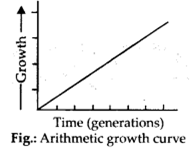
(a) Arithmetic growth: If the length of a plant organ is plotted against time it shows a linear curve, the growth is called arithmetic growth. In this growth, the rate of growth is constant and increase in growth occurs in arithmetic progression e.g., length of a plant is measured as $2, 4, 6, 8, 10, 12\text{ cm}$ at a definite interval of $24\text{ hrs}$. It is found in root or shoot elongating at constant rate. Arithmetic growth is expressed as:
$$L_t = L_0 + rt$$
Here, $L_t = \text{length after time } t$, $L_0 = \text{length at the beginning}$, $r = \text{growth rate}$.
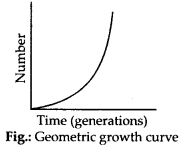
(b) Geometric growth: Geometric growth is the growth where both the progeny cells following mitosis retain the ability to divide and continue to do so. It occurs in many higher plants and in unicellular organisms when grown in nutrient-rich medium. Number of cells is initially small so that initial growth is slow which is called lag phase. Later on, there is rapid growth at exponential rate. It is called log or exponential phase.
(c) Sigmoid growth curve: Geometric growth cannot be sustained for long. Some cells die. Limited nutrient availability causes slowing down of growth. It leads to stationary phase. There may be actually a decline. Plotting the growth against time will give a typical sigmoid or S-curve.
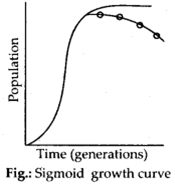
S-curve of growth is typical of most living organisms in their natural environment. It also occurs in cells, tissues and organs of plants.
(d) Absolute growth rate is the measurement of total growth per unit time. Relative growth rate is growth per unit time per unit initial growth.
$$\text{Relative Growth Rate} = \frac{\text{Growth in given time period}}{\text{Measurement at start of time period}}$$
Suppose two leaves have grown by $5\text{ cm}^2$ in one day. Initial size of leaf A was $5\text{ cm}^2$ while that of leaf B was $50\text{ cm}^2$. Though their absolute growth is the same ($5\text{ cm}^2/\text{day}$), relative rate of growth is faster in leaf A ($\frac{5}{5}$) because of initial small size than in leaf B ($\frac{5}{50}$).
Question 13.4. List five main groups of natural plant growth regulators. Write a note on discovery, physiological functions and agricultural/ horticultural applications of any one of them.
Solution:
There are five main groups of natural plant growth regulators which are very much recognised as natural hormones in plants. These are:
1. Auxins
2. Gibberellins
3. Cytokinins
4. Abscisic acid
5. Ethylene
Discovery of auxin: In 1880, Charles Darwin and Francis Darwin worked with the coleoptile of canary grass (Phalaris sp.) and found the existence of a substance in coleoptile tip, which was able to recognise the light stimulus and leads to the bending of tip towards light. Boysen and Jensen ($1910\text{–}1913$) worked on Avena seedling and explained that the substances secreted in the tip are soluble in water (gelatin). Paal (1919) reported that the substances secreted in the tip are translocated downwards and caused cell elongation in half portion which was on the dark side and hence bending was observed in opposite direction. F.W. Went (1928) further refined this experiment and supported the observations of Paal. He was the first person to isolate and name these substances of tip as auxins (Greek Auxein – means ‘to grow’). In 1931, Kogl and Haagen-Smith isolated crystalline compounds from human urine. These were named as auxin-a, auxin-b and heteroauxin.
Physiological functions of auxins:
– Auxins induce cambial cell divisions, shoot cell elongation and early differentiation of xylem and phloem in tissue culture experiments.
– In general, auxins initiate rooting but inhibit the growth of roots. $\text{IBA}$ is the most potent root initiator.
– Auxins inhibit the growth of axillary buds (apical dominance) but enhance the size of carpel and hence earlier fruit formation.
– Application of auxins retards the process of senescence (last degradative phase), the abscission of leaves, fruits, branches, etc.
– Auxins induce feminisation, i.e., on male plant, female flowers are produced.
Agricultural/horticultural application of auxins:
– Application of auxins like $\text{IAA}$, $\text{IBA}$, $\text{NAA}$ induce rooting in stem cuttings of many plants. This method is widely used to multiply several economically useful plants.
– Normally, auxins inhibit flowering however in litchi and pineapple, application of auxin promotes flowering thus used in orchards.
– Auxin induces parthenocarpy in some plants including tomato, pepper, cucumber and Citrus, thus, produces seedless fruits of more economic value.
– Auxins like $2,4\text{-D}$ and $2,4,5\text{-T}$ are commercially used as weedicides, due to their low cost and greater chemical stability. They are selective herbicides (killing broad-leaved plants, but not grasses).
– For checking premature fruit drop, auxins are applied which prevent the formation of abscission zone in the petiole or just below the fruit.
– Auxin, produced in the apical bud, suppresses the development of lateral buds, i.e., apical dominance. Thus practically used in prolonging the dormancy period of potato tubers.
– Naphthalene acetamide is used to prevent the lodging or falling of crops.
– Auxin ($2,4\text{-D}$) promotes callus formation in tissue culture.
Question 13.5. What do you understand by photoperiodism and vernalisation? Describe their significance.
Solution:
The physiological mechanism for flowering is controlled by two factors: photoperiod or light period, i.e., photoperiodism and low temperature, i.e., vernalisation.
Photoperiodism is defined as the flowering response of a plant to relative lengths of light/dark period. Significance of photoperiodism:
(i) Photoperiodism determines the season in which a particular plant shall flower (e.g., short day plants, long day plants).
(ii) Knowledge of photoperiodic effect is useful in keeping some plants in vegetative growth to obtain higher yield of tubers, rhizomes etc.
(iii) A plant can be made to flower throughout the year by providing favourable photoperiod.
(iv) Helps plant breeders in effective cross-breeding.
Vernalisation is promotion or induction of flowering by exposing a plant to low temperature for some time. Significance of vernalisation:
(i) Crops can be grown earlier.
(ii) Plants can be grown in regions where normally they do not grow.
(iii) Yield of the plant is increased.
(iv) Resistance to cold, frost, and fungal diseases is increased.
Question 13.6. Why is abscisic acid also known as stress hormone?
Solution:
A fairly high concentration of abscisic acid ($\text{ABA}$) is found in leaves of plants growing under stress conditions, such as drought, flooding, injury, mineral deficiency etc. It is accompanied by loss of turgor and closure of stomata. When such plants are transferred to normal conditions, they regain normal turgor and $\text{ABA}$ concentration decreases. Since the synthesis of $\text{ABA}$ is accelerated under stress condition and the same is destroyed or inactivated when stress is relieved, it is also known as stress hormone.
Question 13.7. ‘Both growth and differentiation in higher plants are open’. Comment.
Solution:
Plant growth is generally indeterminate. Higher plants possess specific areas called meristems which take part in the formation of new cells. The body of plants is built on a modular fashion where structure is never complete because the tips (with apical meristem) are open-ended – always growing and forming new organs to replace the older or senescent ones. Growth is invariably associated with differentiation. Not only the growth of plants is open-ended, their differentiation is also open. The same apical meristem cells give rise to different types of cells at maturity, e.g., xylem, phloem, parenchyma, sclerenchyma fibres, collenchyma, etc. Thus, both the processes are indeterminate, unlimited and develop into different structures at maturity i.e., both are open.
Question 13.8. ‘Both a short day plant and a long day plant can produce flower simultaneously in a given place’. Explain.
Solution:
A short day plant ($\text{SDP}$) flowers only when it receives a long dark period and short photoperiod, e.g., Xanthium, Dahlia etc. On the other hand, a long day plant ($\text{LDP}$) will flower only when it receives a long photoperiod and short dark period, e.g., wheat, oat etc. Thus critical photoperiod is that continuous duration of light which must not be exceeded in $\text{SDP}$ and should always be exceeded in $\text{LDP}$ in order to bring them to flower. Xanthium requires light for less than $15.6\text{ hrs}$ and Henbane requires light for more than $11\text{ hrs}$. Xanthium (an $\text{SDP}$) and Henbane ($\text{LDP}$) will flower simultaneously in light period between $11$ to $15.6\text{ hrs}$.
Question 13.9. Which one of the plant growth regulators would you use if you are asked to
(a) induce rooting in a twig
(b) quickly ripen a fruit
(c) delay leaf senescence
(d) induce growth in axillary buds
(e) ‘bolt’ a rosette plant
(f) induce immediate stomatal closure in leaves.
Solution:
(a) Auxins like $\text{IBA}$, $\text{NAA}$.
(b) Ethylene
(c) Cytokinins
(d) Cytokinins
(e) Gibberellins
(f) Abscisic acid ($\text{ABA}$)
Question 13.10. Would a defoliated plant respond to photoperiodic cycle? Why?
Solution:
No, a defoliated plant would not respond to photoperiodic cycle because photoperiodic stimulus is picked up by the leaves only. Even one leaf or a part of it is sufficient for this purpose. For perception of photoperiodic cycle, there must be the presence of leaves under inductive photoperiod, so that, the hormone responsible for flowering can be produced.
Question 13.11. What would be expected to happen if:
(a) $\text{GA}_3$ is applied to rice seedlings
(b) dividing cells stop differentiating
(c) a rotten fruit gets mixed with unripe fruits
(d) you forget to add cytokinin to the culture medium.
Solution:
(a) The coleoptile will elongate rapidly, as $\text{GA}_3$ helps in cell growth.
(b) The development of callus (mass of undifferentiated cells) will take place.
(c) The unripe fruits will ripen quickly because of the increased rate of respiration due to emission of ethylene from rotten fruit.
(d) Cell division will retard and shoot will not initiate from the callus.
Why Class 11 Biology Chapter 13 Matters in NEET
Class 11 Biology Chapter 13: Plant Growth and Development is highly important for NEET because it explains how plants grow, develop, and respond to internal and external factors throughout their life cycle. Students learn important concepts such as growth, differentiation, dedifferentiation, redifferentiation, plant growth phases, growth regulators, photoperiodism, vernalisation, and seed dormancy. NEET frequently includes direct NCERT-based questions on auxins, gibberellins, cytokinins, ethylene, abscisic acid ($\text{ABA}$), growth phases, apical dominance, bolting, seed dormancy, photoperiodism, and vernalisation. A thorough understanding of this chapter helps students build a strong foundation in plant physiology, growth regulation, development, and plant responses while improving their performance in the examination.
Preparation Tips for Class 11 Biology Chapter 13
Begin by understanding the basic concepts of plant growth and development, including growth phases, growth rate, differentiation, dedifferentiation, and redifferentiation. Study the different phases of plant growth, especially the meristematic, elongation, and maturation phases, and understand the factors that influence plant growth.
Study the major plant growth regulators carefully, including auxins, gibberellins, cytokinins, ethylene, and abscisic acid ($\text{ABA}$). Focus on their major functions, physiological effects, and important applications. Pay special attention to concepts such as apical dominance, cell elongation, bolting, fruit growth, breaking of dormancy, fruit ripening, and stress responses.
Revise important concepts such as photoperiodism, vernalisation, seed dormancy, and flowering. Prepare comparison tables for different plant hormones and their functions for quick revision. Practise identifying the effects and applications of plant growth regulators from NCERT examples and diagrams. Complete all NCERT diagrams, tables, examples, and exercise questions. Finally, practise NEET previous-year questions regularly and revise important hormones, functions, examples, and terminology to improve accuracy, speed, and confidence.
FAQs
1. What are the most important topics in Class 11 Biology Chapter 13?
The most important topics include plant growth, growth phases, growth rate, differentiation, dedifferentiation, redifferentiation, plant growth regulators, auxins, gibberellins, cytokinins, ethylene, $\text{ABA}$, photoperiodism, vernalisation, and seed dormancy. These topics are frequently tested in NEET.
2. What is plant growth?
Plant growth is an irreversible and permanent increase in the size, volume, dry weight, or number of cells of a plant or its parts. It occurs through processes such as cell division, cell enlargement, and cell differentiation.
3. What are plant growth regulators?
Plant growth regulators ($\text{PGRs}$) are chemical substances that influence plant growth and development. The major PGRs discussed in the chapter are auxins, gibberellins, cytokinins, ethylene, and abscisic acid ($\text{ABA}$).
4. What are the main functions of auxins?
Auxins promote cell elongation, particularly in shoots, and are involved in apical dominance, root initiation, tropic responses, and fruit development. They can also be used to promote rooting in plant cuttings.
5. What are the main functions of gibberellins?
Gibberellins promote stem elongation, bolting, seed germination, and fruit growth. They can also help break seed dormancy and promote growth in certain plants.
6. What is the role of cytokinins?
Cytokinins promote cell division and influence cell differentiation. They also help delay leaf senescence and promote the growth of lateral buds.
7. What is the role of ethylene?
Ethylene is a gaseous plant growth regulator that plays an important role in fruit ripening, senescence, and abscission. It can also promote flowering in some plants and is associated with the triple response in seedlings.
8. What is the role of abscisic acid ($\text{ABA}$)?
Abscisic acid ($\text{ABA}$) generally acts as a growth-inhibiting regulator and plays an important role in seed dormancy, stomatal closure, and plant responses to environmental stress, particularly water stress.
9. What is photoperiodism?
Photoperiodism is the response of plants to the relative lengths of day and night, particularly in relation to flowering. Plants may be classified as short-day, long-day, or day-neutral plants based on their flowering response.