
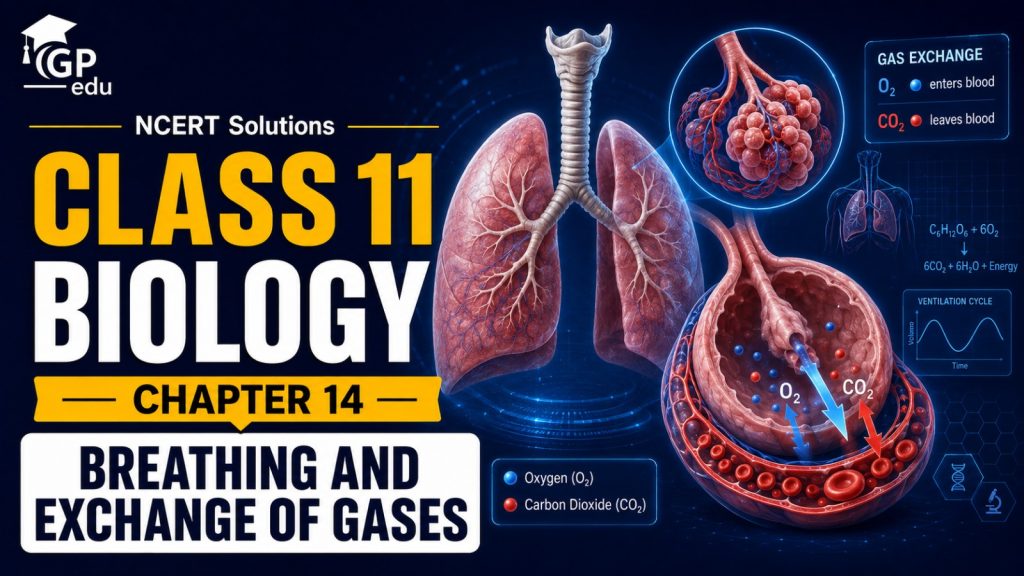
The chapter Breathing and Exchange of Gases introduces students to the mechanisms of breathing and the exchange of respiratory gases between the atmosphere, lungs, and tissues. It explains the structure and functions of the human respiratory system, including the respiratory organs, mechanism of breathing, and transport of gases.
Students learn about respiratory volumes and capacities, pulmonary ventilation, exchange of gases across alveolar membranes, transport of oxygen and carbon dioxide by blood, regulation of respiration, and common respiratory disorders. A clear understanding of Breathing and Exchange of Gases provides a strong foundation for studying human physiology, gas transport, cellular respiration, and respiratory health, making it an important chapter for NEET preparation.
Class 11 Biology Chapter 14 Overview
Students learn about the human respiratory system, including the nose, pharynx, larynx, trachea, bronchi, and lungs, along with the mechanism of pulmonary ventilation (inspiration and expiration). The chapter explains partial pressures of gases, alveolar gas exchange, and the transport of oxygen and carbon dioxide.
Students are introduced to oxygen-haemoglobin dissociation curves, factors affecting oxygen dissociation, and the transport of $\text{CO}_2$ as bicarbonate, carbaminohaemoglobin, and in dissolved state. The chapter also covers the neural and chemical regulation of respiration, and respiratory disorders such as asthma, emphysema, and occupational respiratory disorders. A clear understanding of Breathing and Exchange of Gases helps students develop a strong foundation in human physiology, gas transport, and respiratory mechanisms, making it an important chapter for NEET preparation.
NCERT Solutions for Class 11 Biology Chapter 14 – Breathing And Exchange Of Gases
Question 14.1. Define vital capacity. What is its significance?
Solution:
Vital capacity is defined as the maximum volume of air a person can breathe in after a forced expiration or the maximum volume of air a person can breathe out after a forced inspiration. It represents the maximum amount of air one can renew in the respiratory system in a single respiration. Thus, the greater the vital capacity the more is the energy available to the body.
Question 14.2. State the volume of air remaining in the lungs after normal breathing.
Solution:
When a person breathes normally, the amount which remains in the lung after normal expiration is called functional residual capacity. It is the sum of residual volume and the expiratory reserve volume ($\text{FRC} = \text{RV} + \text{ERV}$). It is about $2100\text{ – }2300\text{ mL}$ of air.
Question 14.3. Diffusion of gases occurs in the alveolar region only and not in the other parts of respiratory system. Why?
Solution:
For efficient exchange of gases, respiratory surface must have certain characteristics such as (i) it must be thin, moist and permeable to respiratory gases (ii) it must have large surface area, (iii) it must be highly vascular. Only alveolar region has these characteristics. Thus, diffusion of gases occurs in this region only.
Question 14.4. What are the major transport mechanisms for $\text{CO}_2$? Explain.
Solution:
Nearly $20\text{–}25$ percent of $\text{CO}_2$ is transported by haemoglobin of $\text{RBC}$s, $70$ percent of it is carried as bicarbonate ion in plasma and about $7$ percent of $\text{CO}_2$ is carried in a dissolved state through plasma. $\text{CO}_2$ is carried by haemoglobin as carbamino-haemoglobin. This binding is related to the partial pressure of $\text{CO}_2$.
Question 14.5. What will be the $p\text{O}_2$ and $p\text{CO}_2$ in the atmospheric air compared to those in the alveolar air?
(i) $p\text{O}_2$ lesser, $p\text{CO}_2$ higher
(ii) $p\text{O}_2$ higher, $p\text{CO}_2$ lesser
(iii) $p\text{O}_2$ higher, $p\text{CO}_2$ higher
(iv) $p\text{O}_2$ lesser, $p\text{CO}_2$ lesser
Solution:
(ii) Air that has entered the alveoli through the bronchioles is called alveolar air. It has a different partial pressure of $\text{CO}_2$ and $\text{O}_2$ compared to atmospheric air. Then, there occurs gaseous exchange between the adjacent blood capillaries and the alveoli. $\text{CO}_2$ diffuses from blood into the alveolar air and $\text{O}_2$ diffuses from alveolar air to the blood. As a result, alveolar air has higher $p\text{CO}_2$ and lesser $p\text{O}_2$ than the atmospheric air (meaning atmospheric air has higher $p\text{O}_2$ and lesser $p\text{CO}_2$).
Question 14.6. Explain the process of inspiration under normal conditions.
Solution:
Inspiration is a process by which fresh air enters the lungs. The diaphragm, intercostal muscles and abdominal muscles play an important role. The muscles of the diaphragm and external intercostal muscles are principal muscles of inspiration. Volume of thoracic cavity increases by contraction of diaphragm and external intercostal muscles. During inspiration, relaxation of abdominal muscles also occurs which allows compression of the abdominal organs by diaphragm. Thus, overall volume of the thoracic cavity increases and as a result, there is a decrease of the air pressure in the lungs. The greater pressure outside the body now causes air to flow rapidly into the lungs.
Question 14.7. How is respiration regulated?
Solution:
Respiration is under both nervous and chemical regulation.
The respiratory centre in the brain is composed of groups of neurons located in the medulla oblongata and pons varolii. The respiratory centre regulates the rate and depth of breathing.
– Dorsal respiratory group of neurons are located in the dorsal portion of the medulla oblongata. This group of neurons mainly causes inspiration.
– Ventral group of neurons are located in the ventrolateral part of the medulla oblongata. These can cause either inspiration or expiration.
– Pneumotaxic centre is located in the dorsal part of pons varolii. It sends signals to all the neurons of dorsal respiratory group and only to inspiratory neurons of ventral respiratory group. Its job is primarily to limit inspiration.
Chemically, respiration is regulated by the large numbers of chemoreceptors located in the carotid bodies and in the aortic bodies. Excess carbon dioxide or hydrogen ions mainly stimulate the respiratory centre of the brain and increases the inspiratory and expiratory signals to the respiratory muscles. Increased $\text{CO}_2$ lowers the pH resulting in acidosis. The role of oxygen in the regulation of respiratory rhythm is quite insignificant.
Question 14.8. What is the effect of $p\text{CO}_2$ on oxygen transport?
Solution:
Increase in $p\text{CO}_2$ tension in blood brings a rightward shift of the oxygen dissociation curve of haemoglobin thereby decreasing the affinity of haemoglobin for oxygen. This effect is called Bohr’s effect. It plays an important role in the release of oxygen in the tissues.
Question 14.9. What happens to the respiratory process in a man going up a hill?
Solution:
Rate of breathing will increase in order to supply sufficient oxygen to blood because air in mountainous regions is deficient in oxygen.
Question 14.10. What is the site of gaseous exchange in an insect?
Solution:
Tracheae (Tracheal respiration) is the site of gaseous exchange in an insect.
Question 14.11. Define oxygen dissociation curve. Can you suggest any reason for its sigmoidal pattern?
Solution:
The relationship between the partial pressure of oxygen ($p\text{O}_2$) and percentage saturation of the haemoglobin with oxygen ($\text{O}_2$) is graphically illustrated by a curve called oxygen haemoglobin dissociation curve (also called oxygen dissociation curve).
The sigmoidal pattern of oxygen haemoglobin dissociation curve is the result of two properties which play a significant role in the transport of oxygen. These two properties are:
(i) Minimal loss of oxygen from haemoglobin occurs above $p\text{O}_2$ of $70\text{–}80\text{ mm Hg}$ despite significant changes in tension of oxygen beyond this. This is depicted by the relatively flat portion of the curve.
(ii) Any further decline in $p\text{O}_2$ from $40\text{ mm Hg}$ causes a disproportionately greater release of oxygen from the haemoglobin. It results in the steeper portion of the curve and causes the curve to be sigmoid.
Question 14.12. Have you heard about hypoxia? Try to gather information about it, and discuss with your friends.
Solution:
Hypoxia is a condition of oxygen shortage in the tissues. It is of two types:
(i) Artificial hypoxia: It results from shortage of oxygen in the air as at high altitude. It causes mountain sickness characterised by breathlessness, headache, dizziness and bluish tinge on skin.
(ii) Anaemic hypoxia: It results from the reduced oxygen carrying capacity of the blood due to anaemia or carbon monoxide poisoning. In both cases, less haemoglobin is available for carrying $\text{O}_2$.
Question 14.13. Distinguish between
(a) IRV and ERV
(b) Inspiratory capacity and expiratory capacity.
(c) Vital capacity and total lung capacity.
Solution:
(a) Differences between IRV and ERV:
| Inspiratory Reserve Volume (IRV) | Expiratory Reserve Volume (ERV) |
|---|---|
| Maximum volume of air a person can inspire by a forced inspiration. | Maximum volume of air a person can expire by a forced expiration. |
(b) Differences between inspiratory capacity and expiratory capacity:
| Inspiratory Capacity (IC) | Expiratory Capacity (EC) |
|---|---|
| Total volume of air a person can inspire after a normal expiration ($\text{TV} + \text{IRV}$). | Total volume of air a person can expire after a normal inspiration ($\text{TV} + \text{ERV}$). |
(c) Differences between vital capacity and total lung capacity:
| Vital Capacity (VC) | Total Lung Capacity (TLC) |
|---|---|
| Maximum volume of air a person can breathe in after a forced expiration ($\text{TV} + \text{IRV} + \text{ERV}$). | Total volume of air accommodated in the lungs at the end of a forced inspiration ($\text{VC} + \text{RV}$). |
Question 14.14. What is tidal volume? Find out the tidal volume (approximate value) for a healthy human in an hour.
Solution:
Tidal volume is the volume of air inspired or expired with each normal breath. This is about $500\text{ mL}$ in an adult person. It is composed of about $350\text{ mL}$ of alveolar volume and about $150\text{ mL}$ of dead space volume. The alveolar volume consists of air that reaches the respiratory surfaces of the alveoli and engages in gas exchange. The dead space volume consists of air that does not reach the respiratory surfaces.
A healthy man can inspire or expire approximately $6000$ to $8000\text{ mL}$ of air per minute. Therefore, the volume of air respired by a healthy human in an hour is approximately $360\text{ L}$ to $480\text{ L}$ (or calculated via minute ventilation).
Why Class 11 Biology Chapter 14 Matters in NEET
Class 11 Biology Chapter 14: Breathing and Exchange of Gases is highly important for NEET because it explains how humans take in oxygen and eliminate carbon dioxide at the cellular and systemic levels. Students learn important concepts such as respiratory organs, mechanisms of breathing, respiratory volumes and capacities, partial pressures of gases, alveolar gas exchange, transport of oxygen and carbon dioxide, oxygen dissociation curves, Bohr’s effect, neural and chemical regulation of respiration, and respiratory disorders. NEET frequently includes direct NCERT-based questions on vital capacity, residual volume, partial pressures of $\text{O}_2$ and $\text{CO}_2$, haemoglobin saturation, chloride shift, and respiratory centers. A thorough understanding of this chapter helps students build a strong foundation in human physiology, gas exchange, and respiration while improving their performance in the examination.
Preparation Tips for Class 11 Biology Chapter 14
Begin by understanding the human respiratory system and the specific structures involved in gas exchange across different animal groups and humans. Study the mechanism of breathing (inspiration and expiration) in detail, focusing on the roles of the diaphragm, external and internal intercostal muscles, and pressure changes in the thoracic cavity.
Learn all respiratory volumes and capacities ($\text{TV}$, $\text{IRV}$, $\text{ERV}$, $\text{RV}$, $\text{IC}$, $\text{EC}$, $\text{FRC}$, $\text{VC}$, $\text{TLC}$) and understand their formulas and approximate values. Study the partial pressures of $\text{O}_2$ and $\text{CO}_2$ in atmospheric, alveolar, deoxygenated blood, oxygenated blood, and tissues using NCERT tables.
Pay special attention to the transport of gases: how oxygen is carried by haemoglobin, the shape and significance of the oxygen dissociation curve, and factors causing rightward or leftward shifts (Bohr effect, temperature, $\text{pH}$, $2,3\text{-BPG}$). Also study the transport of $\text{CO}_2$ as bicarbonate, carbaminohaemoglobin, and dissolved gas, along with the chloride shift (Hamburger phenomenon).
Revise the regulation of respiration involving the respiratory rhythm center (medulla), pneumotaxic center (pons), and peripheral chemoreceptors. Complete all NCERT diagrams, tables, examples, and exercise questions, and finally practise NEET previous-year questions regularly to improve accuracy, speed, and confidence.
FAQs
1. What are the most important topics in Class 11 Biology Chapter 14?
The most important topics include mechanism of breathing, respiratory volumes and capacities, partial pressures of gases, gas exchange in alveoli and tissues, transport of $\text{O}_2$ and $\text{CO}_2$, oxygen-haemoglobin dissociation curve, Bohr effect, regulation of respiration, and respiratory disorders. These topics are frequently tested in NEET.
2. What is tidal volume?
Tidal volume ($\text{TV}$) is the volume of air inspired or expired during normal breathing. It is approximately $500\text{ mL}$ in a healthy adult human.
3. What is vital capacity?
Vital capacity ($\text{VC}$) is the maximum volume of air a person can breathe in after a forced expiration or breathe out after a forced inspiration ($\text{VC} = \text{TV} + \text{IRV} + \text{ERV}$).
4. How is oxygen transported in the blood?
About $97\%$ of oxygen is transported bound to haemoglobin in $\text{RBC}$s as oxyhaemoglobin, while the remaining $3\%$ is dissolved in the plasma.
5. How is carbon dioxide transported in the blood?
Carbon dioxide is transported in three ways: about $70\%$ as bicarbonate ions in plasma, $20\text{–}25\%$ bound to haemoglobin as carbaminohaemoglobin, and about $7\%$ dissolved in plasma.
6. What is the oxygen dissociation curve?
The oxygen dissociation curve is a sigmoid curve obtained by plotting percentage saturation of haemoglobin with oxygen against partial pressure of oxygen ($p\text{O}_2$). Its sigmoidal shape is due to cooperative binding of oxygen to haemoglobin.
7. What is the Bohr effect?
The Bohr effect is the shift of the oxygen dissociation curve to the right in response to increased $p\text{CO}_2$, lower $\text{pH}$, or higher temperature, which decreases haemoglobin’s affinity for oxygen and facilitates oxygen release in active tissues.
8. How is respiration regulated in humans?
Respiration is regulated by neural centers in the brain—specifically the respiratory rhythm center in the medulla oblongata and the pneumotaxic center in the pons—as well as chemical controls via peripheral chemoreceptors sensitive to $\text{CO}_2$ and $\text{H}^+$ concentrations.
9. Is Class 11 Biology Chapter 14 important for NEET?
Yes. Class 11 Biology Chapter 14: Breathing and Exchange of Gases is highly important for NEET because it contains many direct NCERT-based questions on respiratory volumes, partial pressures, gas transport mechanisms, oxygen dissociation curves, and physiological regulation. Regular revision of NCERT concepts, tables, numerical values, diagrams, and previous-year questions is essential for scoring well in the examination.