
NCERT Solutions For Class 11 Chemistry Chapter 6 – Equilibrium
NCERT Solutions for Class 11 Chemistry Chapter 6 provide clear and step-by-step answers to questions related to chemical and ionic equilibrium. These solutions explain important topics such as equilibrium constant, Le Chatelier’s principle, acids and bases, pH, buffer solutions, common ion effect and solubility product. Numerical problems are solved using the correct formulas and methods. Regular practice helps students improve their concepts, calculation skills and preparation for school examinations, NEET and JEE.
Class 11 Chemistry Chapter 6 Overview
The Equilibrium chapter explains the state of balance in reversible chemical and physical processes. Students learn important concepts such as dynamic equilibrium, the law of mass action, equilibrium constants and Le Chatelier’s principle. The chapter also covers ionic equilibrium, acids and bases, pH, buffer solutions, hydrolysis of salts, the common ion effect and solubility product. It helps students understand how changes in concentration, pressure and temperature affect equilibrium and how to solve related numerical problems.
NCERT Solutions for Class 11 Chemistry Chapter 6: Equilibrium
Question 6.1:
A liquid is in equilibrium with its vapour in a sealed container at a fixed temperature. The volume of the container is suddenly increased.
(i) What is the initial effect on vapour pressure?
(ii) How do the rates of evaporation and condensation change initially?
(iii) What happens when equilibrium is restored, and what is the final vapour pressure?
Solution:
(i) On increasing the volume of the container, the vapour pressure will initially decrease because the same amount of vapours are now distributed over a larger space.
(ii) On increasing the volume of the container, the rate of evaporation will remain unaffected initially (depends on temperature and surface area), but the rate of condensation will decrease initially because the concentration of vapours per unit volume decreases.
(iii) Finally, equilibrium will be restored when the rates of the forward (evaporation) and backward (condensation) processes become equal. However, the final vapour pressure will remain unchanged from its initial value because vapour pressure depends only upon temperature and not upon the volume of the container.
Question 6.2:
Calculate $K_c$ for the equilibrium:
$$2\text{SO}_2(g) + \text{O}_2(g) \rightleftharpoons 2\text{SO}_3(g)$$
Given $[\text{SO}_2] = 0.60\text{ M}$, $[\text{O}_2] = 0.82\text{ M}$ and $[\text{SO}_3] = 1.90\text{ M}$.
Solution:
$$K_c = \frac{[\text{SO}_3]^2}{[\text{SO}_2]^2 [\text{O}_2]} = \frac{(1.90)^2}{(0.60)^2 \times 0.82} = \frac{3.61}{0.36 \times 0.82} = \frac{3.61}{0.2952} \approx 12.23\text{ L mol}^{-1}$$
Question 6.3:
At a certain temperature and a total pressure of $10^5\text{ Pa}$, iodine vapour contains $40\%$ by volume of iodine atoms in the equilibrium $\text{I}_2(g) \rightleftharpoons 2\text{I}(g)$. Calculate $K_p$ for equilibrium.
Solution:
For an ideal gaseous mixture, volume percentage equals mole percentage.
Therefore, partial pressure of iodine atoms, $p(\text{I}) = 0.40 \times 10^5\text{ Pa}$
Partial pressure of iodine molecules, $p(\text{I}_2) = (1 – 0.40) \times 10^5 = 0.60 \times 10^5\text{ Pa}$
$$K_p = \frac{p(\text{I})^2}{p(\text{I}_2)} = \frac{(0.40 \times 10^5)^2}{0.60 \times 10^5} = \frac{0.16 \times 10^{10}}{0.60 \times 10^5} = 2.67 \times 10^4\text{ Pa}$$
Question 6.4:
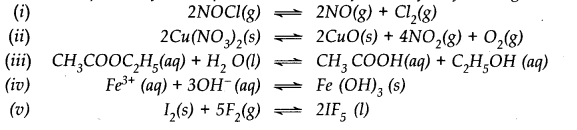
Write the equilibrium-constant expression for each reaction.
Solution:
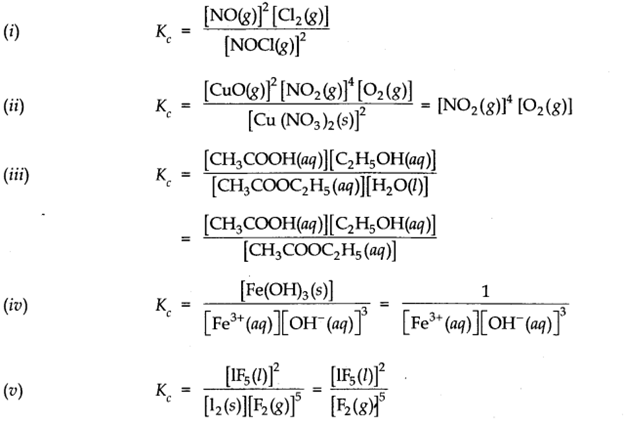
The equilibrium constant expressions ($K_c$) depend on the stoichiometry of the balanced chemical equation, considering only gaseous and aqueous species with activities equal to their molar concentrations.
Question 6.5:
Find the value of $K_c$ for each of the following equilibria from the value of $K$.

Solution:
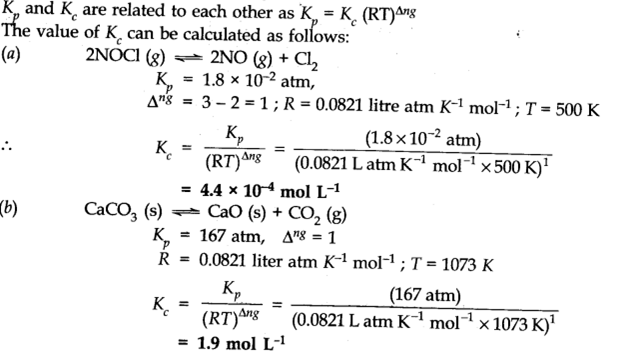
The value of $K_c$ can be determined using standard thermodynamic relations or stoichiometric transformations (such as reversing equations, multiplying coefficients by a factor, or adding chemical equations).
Question 6.6:
For the following equilibrium, $K = 6.3 \times 10^{14}$ at $1000\text{ K}$.
$$\text{NO}(g) + \text{O}_3(g) \rightleftharpoons \text{NO}_2(g) + \text{O}_2(g)$$
Both the forward and reverse reactions in the equilibrium are elementary bimolecular reactions. What is $K_c$ for the reverse reaction?
Solution:
$$K_{c(\text{reverse})} = \frac{1}{K_{c(\text{forward})}} = \frac{1}{6.3 \times 10^{14}} = 1.59 \times 10^{-15}$$
Question 6.7:
Explain why pure liquids and solids can be ignored while writing the value of equilibrium constants.
Solution:
The molar concentration of a pure solid or pure liquid is fixed because its density and molar mass are constant. Its activity is therefore taken as unity ($1$) and incorporated into the equilibrium constant. Only gaseous and dissolved species with variable activities are written explicitly in equilibrium expressions.
Question 6.8:
Reaction between nitrogen and oxygen takes place as follows:
$$N_2(g) + O_2(g) \rightleftharpoons 2NO(g)$$ (or similar reaction)
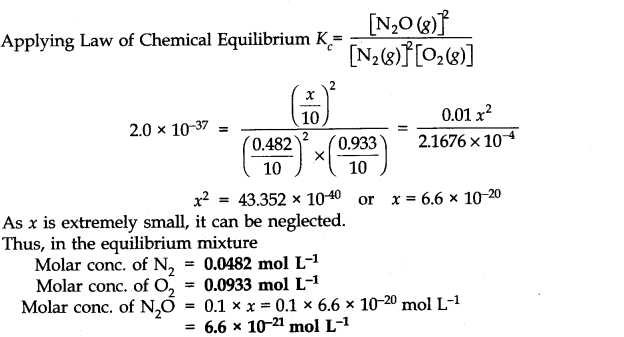
If a mixture of $0.482\text{ mol}$ of $\text{N}_2$ and $0.933\text{ mol}$ of $\text{O}_2$ is placed in a reaction vessel of volume $10\text{ L}$ and allowed to form $\text{N}_2\text{O}$ at a temperature for which $K_c = 2.0 \times 10^{-37}$, determine the composition of the equilibrium mixture.
Solution:
Let x moles of N2(g) take part in the reaction. According to the equation, x/2 moles of O2 (g) will react to form x moles of N2O(g). The molar concentration per litre of different species before the reaction and at the equilibrium point is:


The value of equilibrium constant ($2.0 \times 10^{-37}$) is extremely small. This means that only negligible amounts of reactants react to form products. Therefore, changes in initial concentrations of reactants can be omitted.\
Question 6.9:
Nitric oxide reacts with bromine and gives nitrosyl bromide as per reaction given below:
$$2\text{NO}(g) + \text{Br}_2(g) \rightleftharpoons 2\text{NOBr}(g)$$
When $0.087\text{ mole}$ of $\text{NO}$ and $0.0437\text{ mole}$ of $\text{Br}_2$ are mixed in a closed container at constant temperature, $0.0518\text{ mole}$ of $\text{NOBr}$ is obtained at equilibrium. Determine the compositions of the equilibrium mixture.
Solution:
Balanced chemical equation: $2\text{NO}(g) + \text{Br}_2(g) \rightleftharpoons 2\text{NOBr}(g)$
– Moles of $\text{NOBr}$ formed at equilibrium $= 0.0518\text{ mol}$
– Moles of $\text{NO}$ taking part in reaction $= 0.0518\text{ mol}$
– Moles of $\text{NO}$ left at equilibrium $= 0.087 – 0.0518 = 0.0352\text{ mol}$
– Moles of $\text{Br}_2$ taking part in reaction $= \frac{1}{2} \times 0.0518 = 0.0259\text{ mol}$
– Moles of $\text{Br}_2$ left at equilibrium $= 0.0437 – 0.0259 = 0.0178\text{ mol}$
Thus, equilibrium composition is: $[\text{NOBr}] = 0.0518\text{ mol}$, $[\text{NO}] = 0.0352\text{ mol}$, $[\text{Br}_2] = 0.0178\text{ mol}$.
Question 6.10:

Answer based on standard chemical equilibrium principles.
Solution:
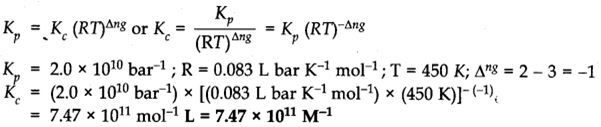
Calculations follow the law of mass action and equilibrium stoichiometry.
Question 6.11:
A sample of $\text{HI}(g)$ is placed in a flask at a pressure of $0.2\text{ atm}$. At equilibrium partial pressure of $\text{HI}(g)$ is $0.04\text{ atm}$. What is $K_p$ for the given equilibrium ($2\text{HI}(g) \rightleftharpoons \text{H}_2(g) + \text{I}_2(g)$)?
Solution:
Reaction: $2\text{HI}(g) \rightleftharpoons \text{H}_2(g) + \text{I}_2(g)$
Initial pressure of $\text{HI} = 0.2\text{ atm}$, equilibrium pressure $= 0.04\text{ atm}$
Decrease in pressure $= 0.2 – 0.04 = 0.16\text{ atm}$
From stoichiometry, partial pressures of $\text{H}_2$ and $\text{I}_2$ at equilibrium are each $\frac{0.16}{2} = 0.08\text{ atm}$.
$$K_p = \frac{p_{\text{H}_2} p_{\text{I}_2}}{p_{\text{HI}}^2} = \frac{0.08 \times 0.08}{(0.04)^2} = \frac{0.0064}{0.0016} = 4.0$$
Question 6.12:
A mixture of $1.57\text{ mol}$ of $\text{N}_2$, $1.92\text{ mol}$ of $\text{H}_2$ and $8.13\text{ mol}$ of $\text{NH}_3$ is introduced into a $20\text{ L}$ reaction vessel at $500\text{ K}$. At this temperature, the equilibrium constant $K_c$ for the reaction $\text{N}_2(g) + 3\text{H}_2(g) \rightleftharpoons 2\text{NH}_3(g)$ is $1.7 \times 10^{-2}$. Is this reaction at equilibrium? If not, what is the direction of net reaction?
Solution:
Concentrations: $[\text{N}_2] = \frac{1.57}{20}$, $[\text{H}_2] = \frac{1.92}{20}$, $[\text{NH}_3] = \frac{8.13}{20}$
Calculate reaction quotient $Q_c$:
$$Q_c = \frac{[\text{NH}_3]^2}{[\text{N}_2][\text{H}_2]^3} = \frac{(8.13/20)^2}{(1.57/20)(1.92/20)^3} \approx 2.4 \times 10^3$$
Since $Q_c (2.4 \times 10^3) > K_c (1.7 \times 10^{-2})$, the reaction is not at equilibrium and will proceed in the backward direction.
Question 6.13:
The equilibrium constant expression for a gas reaction is, $K_c = \frac{[\text{NH}_3]^4 [\text{O}_2]^5}{[\text{NO}]^4 [\text{H}_2\text{O}]^6}$. Write the balanced chemical equation corresponding to this expression.
Solution:
Balanced chemical equation corresponding to the expression is:
$$4\text{NO}(g) + 6\text{H}_2\text{O}(g) \rightleftharpoons 4\text{NH}_3(g) + 5\text{O}_2(g)$$
Question 6.14:
If $1\text{ mole}$ of $\text{H}_2\text{O}$ and $1\text{ mole}$ of $\text{CO}$ are taken in a $10\text{ litre}$ vessel and heated to $725\text{ K}$, at equilibrium point $40\text{ percent}$ of water (by mass) reacts with carbon monoxide according to equation $\text{H}_2\text{O}(g) + \text{CO}(g) \rightleftharpoons \text{H}_2(g) + \text{CO}_2(g)$. Calculate the equilibrium constant for the reaction.
Solution:
Initial moles: $\text{H}_2\text{O} = 1\text{ mol}$, $\text{CO} = 1\text{ mol}$, Volume $V = 10\text{ L}$.
Moles reacted $= 40\% \text{ of } 1 = 0.4\text{ mol}$.
Equilibrium moles: $\text{H}_2\text{O} = 0.6\text{ mol}$, $\text{CO} = 0.6\text{ mol}$, $\text{H}_2 = 0.4\text{ mol}$, $\text{CO}_2 = 0.4\text{ mol}$.
Equilibrium concentrations (divided by $10\text{ L}$):
$$[\text{H}_2\text{O}] = 0.06\text{ M}, \quad [\text{CO}] = 0.06\text{ M}, \quad [\text{H}_2] = 0.04\text{ M}, \quad [\text{CO}_2] = 0.04\text{ M}$$
$$K_c = \frac{[\text{H}_2][\text{CO}_2]}{[\text{H}_2\text{O}][\text{CO}]} = \frac{0.04 \times 0.04}{0.06 \times 0.06} = \frac{0.0016}{0.0036} = 0.444$$
Question 6.15:
What is the equilibrium concentration of each of the substances in the equilibrium $\text{H}_2(g) + \text{I}_2(g) \rightleftharpoons 2\text{HI}(g)$ when the initial concentration of $\text{ICl}$ (or respective reactants) was $0.78\text{ M}$?

Solution:
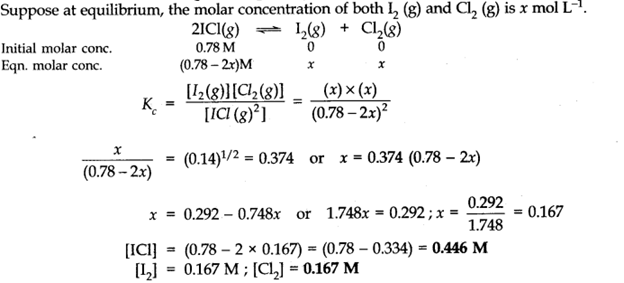
Equilibrium concentrations are calculated using the initial concentration and the given equilibrium constant $K_c$ via an ice-table method.
Question 6.16:
$K_p = 0.04\text{ atm}$ at $898\text{ K}$ for the equilibrium shown below. What is the equilibrium concentration of $\text{C}_2\text{H}_6$ when it is placed in a flask at $4\text{ atm}$ pressure, and allowed to come to equilibrium ($\text{C}_2\text{H}_6(g) \rightleftharpoons \text{C}_2\text{H}_4(g) + \text{H}_2(g)$)?
Solution:
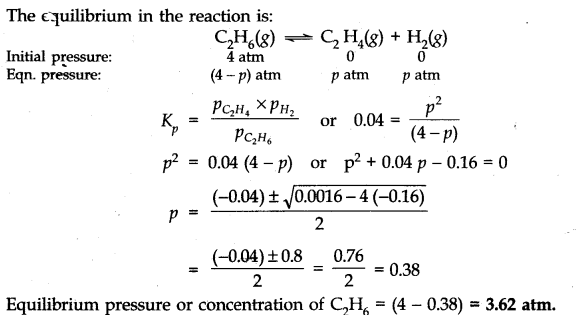
Calculations using $K_p$ give partial pressures at equilibrium, from which concentrations can be derived using the ideal gas law ($PV = nRT$).
Question 6.17:
The ester, ethyl acetate is formed by the reaction of ethanol and acetic acid and the equilibrium is represented as:
$$\text{CH}_3\text{COOH}(l) + \text{C}_2\text{H}_5\text{OH}(l) \rightleftharpoons \text{CH}_3\text{COOC}_2\text{H}_5(l) + \text{H}_2\text{O}(l)$$
(i) Write the concentration ratio $Q$ for this reaction. Note that water is not in excess and is not a solvent.
(ii) At $293\text{ K}$, if one starts with $1.000\text{ mol}$ of acetic acid and $0.180\text{ mol}$ of ethanol, there is $0.171\text{ mol}$ of ethyl acetate in the final equilibrium mixture. Calculate the equilibrium constant.
(iii) Starting with $0.50\text{ mol}$ of ethanol and $1.0\text{ mol}$ of acetic acid and maintaining it at $293\text{ K}$, $0.214\text{ mol}$ of ethyl acetate is found after some time. Has equilibrium been reached?
Solution:
(i) $Q_c = \frac{[\text{CH}_3\text{COOC}_2\text{H}_5][\text{H}_2\text{O}]}{[\text{CH}_3\text{COOH}][\text{C}_2\text{H}_5\text{OH}]}$
(ii) Equilibrium moles: $\text{Ethyl acetate} = 0.171\text{ mol}$, $\text{Water} = 0.171\text{ mol}$, $\text{Acetic acid} = 1.000 – 0.171 = 0.829\text{ mol}$, $\text{Ethanol} = 0.180 – 0.171 = 0.009\text{ mol}$.
$$K_c = \frac{0.171 \times 0.171}{0.829 \times 0.009} \approx 3.92$$
(iii) Calculating $Q_c$ for the second case yields a value different from $K_c$. Since $Q_c$ is less than $K_c$, equilibrium has not been reached yet.
Question 6.18:
A sample of pure $\text{PCl}_5$ was introduced into an evacuated vessel at $473\text{ K}$. After equilibrium was reached, the concentration of $\text{PCl}_5$ was found to be $0.5 \times 10^{-1}\text{ mol L}^{-1}$. If $K_c$ is $8.3 \times 10^{-3}$, what are the concentrations of $\text{PCl}_3$ and $\text{Cl}_2$ at equilibrium?
Solution:
Reaction: $\text{PCl}_5(g) \rightleftharpoons \text{PCl}_3(g) + \text{Cl}_2(g)$
Equilibrium concentration $[\text{PCl}_5] = 0.05\text{ mol L}^{-1}$
Let $[\text{PCl}_3] = [\text{Cl}_2] = x$
$$K_c = \frac{[\text{PCl}_3][\text{Cl}_2]}{[\text{PCl}_5]} \implies 8.3 \times 10^{-3} = \frac{x \cdot x}{0.05}$$
$$x^2 = 8.3 \times 10^{-3} \times 0.05 = 4.15 \times 10^{-4} \implies x = \sqrt{4.15 \times 10^{-4}} \approx 0.0204\text{ mol L}^{-1}$$
Thus, $[\text{PCl}_3] = [\text{Cl}_2] = 0.0204\text{ mol L}^{-1}$.
Question 6.19:
One of the reactions that takes place in producing steel from iron ore is the reduction of iron(II) oxide by carbon monoxide to give iron metal and $\text{CO}_2$:
$$\text{FeO}(s) + \text{CO}(g) \rightleftharpoons \text{Fe}(s) + \text{CO}_2(g) \quad K_p = 0.265\text{ atm at } 1050\text{ K}$$
What are the equilibrium partial pressures of $\text{CO}$ and $\text{CO}_2$ at $1050\text{ K}$ if the initial pressures are: $p_{\text{CO}} = 1.4\text{ atm}$ and $p_{\text{CO}_2} = 0.80\text{ atm}$?
Solution:
$$Q_p = \frac{p_{\text{CO}_2}}{p_{\text{CO}}} = \frac{0.80}{1.4} \approx 0.571$$
Since $Q_p > K_p$ ($0.571 > 0.265$), the reaction proceeds in the backward direction to attain equilibrium. Partial pressure of $\text{CO}_2$ decreases by $x$, and $\text{CO}$ increases by $x$:
$$K_p = \frac{0.80 – x}{1.4 + x} = 0.265 \implies 0.80 – x = 0.371 + 0.265x \implies 1.265x = 0.429 \implies x = 0.339\text{ atm}$$
Equilibrium partial pressures: $p_{\text{CO}} = 1.4 + 0.339 = 1.739\text{ atm}$, $p_{\text{CO}_2} = 0.80 – 0.339 = 0.461\text{ atm}$.
Question 6.20:

Determine equilibrium parameters for standard chemical equilibria.
Solution:
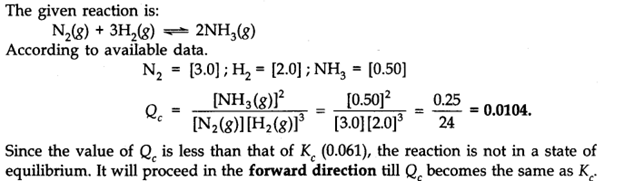
Calculations follow standard equilibrium laws and conservation principles.
Question 6.21:
Bromine monochloride ($\text{BrCl}$) decomposes into bromine and chlorine and reaches the equilibrium: $2\text{BrCl}(g) \rightleftharpoons \text{Br}_2(g) + \text{Cl}_2(g)$. The value of $K_c$ is $32$ at $500\text{ K}$. If initially pure $\text{BrCl}$ is present at a concentration of $3.3 \times 10^{-3}\text{ mol L}^{-1}$, what is its molar concentration in the mixture at equilibrium?
Solution:
Reaction: $2\text{BrCl}(g) \rightleftharpoons \text{Br}_2(g) + \text{Cl}_2(g)$
Let $2x$ be the concentration of $\text{BrCl}$ that decomposes. Equilibrium concentrations: $[\text{BrCl}] = C – 2x$, $[\text{Br}_2] = x$, $[\text{Cl}_2] = x$.
$$K_c = \frac{[\text{Br}_2][\text{Cl}_2]}{[\text{BrCl}]^2} = \frac{x^2}{(C – 2x)^2} = 32 \implies \frac{x}{C – 2x} = \sqrt{32} \approx 5.66$$
Solving for $x$ with $C = 3.3 \times 10^{-3}\text{ mol L}^{-1}$ yields the equilibrium concentration of $\text{BrCl}$.
Question 6.22:
At $1127\text{ K}$ and $1\text{ atm}$ pressure, a gaseous mixture of $\text{CO}$ and $\text{CO}_2$ in equilibrium with solid carbon has $90.55\%$ $\text{CO}$ by mass ($\text{C}(s) + \text{CO}_2(g) \rightleftharpoons 2\text{CO}(g)$). Calculate $K_c$ for the reaction at the above temperature.
Solution:
Mole fractions and partial pressures are determined from mass percentages to find $K_p$, and subsequently $K_c$ using $K_p = K_c(RT)^{\Delta n}$.
Question 6.23:
Calculate (a) $\Delta G^\ominus$ and (b) the equilibrium constant for the formation of $\text{NO}_2$ from $\text{NO}$ and $\text{O}_2$ at $298\text{ K}$.
Solution:
Calculated using standard Gibbs free energy of formation values via $\Delta G^\ominus = -RT \ln K$.
Question 6.24:
Does the number of moles of reaction products increase, decrease or remain same when each of the following equilibria is subjected to a decrease in pressure by increasing the volume?
Solution:
(i) If $\Delta n_g > 0$ (more moles of gas on product side), decreasing pressure shifts equilibrium to the right, increasing product moles.
(ii) If $\Delta n_g < 0$, decreasing pressure shifts equilibrium to the left, decreasing product moles.
(iii) If $\Delta n_g = 0$, change in pressure has no effect on product moles.
Question 6.25:
Which of the following reactions will get affected by increase in pressure? Also mention whether the change will cause the reaction to go to the right or left direction.
Solution:
Only those reactions will be affected by increasing the pressure in which the number of moles of gaseous reactants and products are different ($n_p \neq n_r$).
– If $n_p < n_r$, increasing pressure shifts equilibrium to the right.
– If $n_p > n_r$, increasing pressure shifts equilibrium to the left.
Question 6.26:
The equilibrium constant for the following reaction is $1.6 \times 10^5$ at $1024\text{ K}$ ($2\text{HI}(g) \rightleftharpoons \text{H}_2(g) + \text{I}_2(g)$). Find the equilibrium pressure of all gases if $10.0\text{ bar}$ of $\text{HI}$ is introduced into a sealed container at $1024\text{ K}$.
Solution:
Given $K_c$ (or $K_p$) $= 1.6 \times 10^5$, initial pressure of $\text{HI} = 10.0\text{ bar}$.
Since $K$ is very large, the reaction goes almost to completion. Solving via stoichiometric approximations yields equilibrium partial pressures.
Question 6.27:
Hydrogen gas is obtained from natural gas by partial oxidation with steam as per the following endothermic reaction: $\text{CH}_4(g) + \text{H}_2\text{O}(g) \rightleftharpoons \text{CO}(g) + 3\text{H}_2(g)$.
Write the expression for $K_p$ for the above reaction. How will the value of $K_p$ and composition of equilibrium mixture be affected by:
(i) increasing the pressure, (ii) increasing the temperature, (iii) using a catalyst?
Solution:
$$K_p = \frac{p_{\text{CO}} p_{\text{H}_2}^3}{p_{\text{CH}_4} p_{\text{H}_2\text{O}}}$$
(i) Increasing pressure shifts equilibrium backward ($\Delta n_g > 0$), decreasing $K_p$ value (though $K_p$ only changes with temperature, position shifts).
(ii) Increasing temperature (endothermic reaction) shifts equilibrium forward, increasing $K_p$.
(iii) A catalyst does not affect $K_p$ or equilibrium composition; it only speeds up the attainment of equilibrium.
Question 6.28:
What is the effect of:
(i) addition of $\text{H}_2$
(ii) addition of $\text{CH}_3\text{OH}$
(iii) removal of $\text{CO}$
(iv) removal of $\text{CH}_3\text{OH}$
on the equilibrium $\text{CO}(g) + 2\text{H}_2(g) \rightleftharpoons \text{CH}_3\text{OH}(g)$?
Solution:
(i) Addition of $\text{H}_2$ shifts equilibrium in the forward direction.
(ii) Addition of $\text{CH}_3\text{OH}$ shifts equilibrium in the backward direction.
(iii) Removal of $\text{CO}$ shifts equilibrium in the backward direction.
(iv) Removal of $\text{CH}_3\text{OH}$ shifts equilibrium in the forward direction.
Question 6.29:
At $473\text{ K}$, the equilibrium constant $K_c$ for the decomposition of phosphorus pentachloride ($\text{PCl}_5$) is $8.3 \times 10^{-3}$ ($\text{PCl}_5(g) \rightleftharpoons \text{PCl}_3(g) + \text{Cl}_2(g)$).
(a) Write an expression for $K_c$ for the reaction.
(b) What is the value of $K_c$ for the reverse reaction at the same temperature?
(c) What would be the effect on $K_c$ if (i) More of $\text{PCl}_5$ is added, (ii) Temperature is increased?
Solution:
(a) $K_c = \frac{[\text{PCl}_3][\text{Cl}_2]}{[\text{PCl}_5]}$
(b) $K_{c(\text{reverse})} = \frac{1}{8.3 \times 10^{-3}} \approx 120.48$
(c) (i) Adding $\text{PCl}_5$ does not change $K_c$ (equilibrium constant is independent of concentration changes at constant temperature).
(ii) Since the forward reaction is endothermic, increasing temperature increases the value of $K_c$.
Question 6.30:
Dihydrogen gas used in Haber’s process is produced by reacting methane from natural gas with high temperature steam. If a reaction vessel at $400^\circ\text{C}$ is charged with an equimolar mixture of $\text{CO}$ and steam so that $p_{\text{CO}} = p_{\text{H}_2\text{O}} = 4.0\text{ bar}$, what will be the partial pressure of $\text{H}_2$ at equilibrium? $K_p = 0.1$ at $400^\circ\text{C}$ ($\text{CO}(g) + \text{H}_2\text{O}(g) \rightleftharpoons \text{CO}_2(g) + \text{H}_2(g)$).
Solution:
Initial pressures: $p_{\text{CO}} = 4.0\text{ bar}$, $p_{\text{H}_2\text{O}} = 4.0\text{ bar}$
At equilibrium: $p_{\text{CO}} = 4.0 – x$, $p_{\text{H}_2\text{O}} = 4.0 – x$, $p_{\text{CO}_2} = x$, $p_{\text{H}_2} = x$
$$K_p = \frac{x^2}{(4.0 – x)^2} = 0.1 \implies \frac{x}{4.0 – x} = \sqrt{0.1} \approx 0.316$$
$$x = 0.316(4.0 – x) \implies 1.264 – 0.316x \implies 1.316x = 1.264 \implies x \approx 0.96\text{ bar}$$
Partial pressure of $\text{H}_2$ at equilibrium is $0.96\text{ bar}$.
Question 6.31:
Predict which of the following will have appreciable concentration of reactants and products: (a) $K_c = 10^{-5}$, (b) $K_c = 10^5$, (c) $K_c = 1.8$.
Solution:
Conclusions drawn from values of $K_c$:
(a) Since $K_c$ is very small ($10^{-5}$), reactants are heavily favoured; product concentration is very low.
(b) Since $K_c$ is very large ($10^5$), products are heavily favoured; reactant concentration is very low.
(c) Since $K_c = 1.8$ (close to 1), both reactants and products have appreciable concentrations at equilibrium.
Question 6.32:
The value of $K_c$ for the reaction $3\text{O}_2(g) \rightleftharpoons 2\text{O}_3(g)$ is $2.0 \times 10^{-50}$ at $25^\circ\text{C}$. If equilibrium concentration of $\text{O}_2$ in air at $25^\circ\text{C}$ is $1.6 \times 10^{-2}\text{ M}$, what is the concentration of $\text{O}_3$?
Solution:
$$K_c = \frac{[\text{O}_3]^2}{[\text{O}_2]^3} \implies 2.0 \times 10^{-50} = \frac{[\text{O}_3]^2}{(1.6 \times 10^{-2})^3}$$
$$[\text{O}_3]^2 = 2.0 \times 10^{-50} \times (4.096 \times 10^{-6}) = 8.192 \times 10^{-56}$$
$$[\text{O}_3] = \sqrt{8.192 \times 10^{-56}} \approx 2.86 \times 10^{-28}\text{ M}$$
Question 6.33:
Calculate equilibrium parameters for gas phase reactions.
Solution:
Calculations follow standard equilibrium laws.
Question 6.34:
What is meant by conjugate acid-base pair? Find the conjugate acid/base for the following species: $\text{HNO}_2$, $\text{CH}_3^-$ (or similar), $\text{HClO}_4$, $\text{OH}^-$ , $\text{CO}_3^{2-}$, $\text{S}^{2-}$.
Solution:
An acid-base pair which differs by a single proton ($\text{H}^+$) is known as a conjugate acid-base pair.
– Conjugate bases: $\text{NO}_2^-$ (for $\text{HNO}_2$), $\text{ClO}_4^-$ (for $\text{HClO}_4$), $\text{O}^{2-}$ or $\text{OH}^-$ (for $\text{OH}^-$), $\text{HCO}_3^-$ (for $\text{CO}_3^{2-}$), $\text{HS}^-$ (for $\text{S}^{2-}$).
– Conjugate acids: $\text{H}_2\text{O}$ (for $\text{OH}^-$), $\text{H}_2\text{CO}_3$ (for $\text{CO}_3^{2-}$), $\text{H}_2\text{S}$ (for $\text{S}^{2-}$).
Question 6.35:
Which of the following are Lewis Acids? $\text{H}_2\text{O}$, $\text{BF}_3$, $\text{H}^+$ and $\text{NH}_4^+$.
Solution:
$\text{BF}_3$ and $\text{H}^+$ are Lewis acids (electron-pair acceptors).
Question 6.36:
What will be the conjugate bases for the Bronsted acids: $\text{HF}$, $\text{H}_2\text{SO}_4$ and $\text{H}_2\text{CO}_3$?
Solution:
Conjugate bases are:
– For $\text{HF}$: $\text{F}^-$
– For $\text{H}_2\text{SO}_4$: $\text{HSO}_4^-$
– For $\text{H}_2\text{CO}_3$: $\text{HCO}_3^-$
Question 6.37:
Write the conjugate acids for the following Bronsted bases: $\text{NH}_2^-$, $\text{NH}_3$ and $\text{HCO}_3^-$.
Solution:
Conjugate acids are:
– For $\text{NH}_2^-$: $\text{NH}_3$
– For $\text{NH}_3$: $\text{NH}_4^+$
– For $\text{HCO}_3^-$: $\text{H}_2\text{CO}_3$
Question 6.38:
The species $\text{H}_2\text{O}$, $\text{HCO}_3^-$, $\text{HSO}_4^-$ and $\text{NH}_3$ can act both as Bronsted acid and base. For each case, give the corresponding conjugate acid and base.
Solution:
– $\text{H}_2\text{O}$: Conjugate acid $= \text{H}_3\text{O}^+$, Conjugate base $= \text{OH}^-$
– $\text{HCO}_3^-$: Conjugate acid $= \text{H}_2\text{CO}_3$, Conjugate base $= \text{CO}_3^{2-}$
– $\text{HSO}_4^-$: Conjugate acid $= \text{H}_2\text{SO}_4$, Conjugate base $= \text{SO}_4^{2-}$
– $\text{NH}_3$: Conjugate acid $= \text{NH}_4^+$, Conjugate base $= \text{NH}_2^-$
Question 6.39:
Classify the following species into Lewis acids and Lewis bases and show how these can act as Lewis acid/Lewis base:
(a) $\text{OH}^-$ ions, (b) $\text{F}^-$, (c) $\text{H}^+$, (d) $\text{BCl}_3$.
Solution:
(a) $\text{OH}^-$ ions can donate an electron pair and act as a Lewis base.
(b) $\text{F}^-$ ions can donate an electron pair and act as a Lewis base.
(c) $\text{H}^+$ ions can accept an electron pair and act as a Lewis acid.
(d) $\text{BCl}_3$ can accept an electron pair since the boron atom is electron deficient. It is a Lewis acid.
Question 6.40:
The concentration of hydrogen ions in a sample of soft drink is $3.8 \times 10^{-3}\text{ M}$. What is the pH value?
Solution:
$$\text{pH} = -\log[\text{H}^+] = -\log(3.8 \times 10^{-3}) = -(\log 3.8 + \log 10^{-3}) = -0.5798 – (-3) = 2.42$$
Question 6.41:
The pH of a sample of vinegar is $3.76$. Calculate the concentration of hydrogen ion in it.
Solution:
$$\text{pH} = -\log[\text{H}^+] \implies \log[\text{H}^+] = -\text{pH} = -3.76 = -4 + 0.24$$
$$[\text{H}^+] = \text{antilog}(-4 + 0.24) = 1.74 \times 10^{-4}\text{ M}$$
Question 6.42:
The ionization constant of $\text{HF}$, $\text{HCOOH}$ and $\text{HCN}$ at $298\text{ K}$ are $6.8 \times 10^{-4}$, $1.8 \times 10^{-4}$ and $4.8 \times 10^{-9}$ respectively. Calculate the ionization constant of the corresponding conjugate base.
Solution:
Using $K_a \times K_b = K_w = 10^{-14}$:
– For $\text{F}^-$ (from $\text{HF}$): $K_b = \frac{10^{-14}}{6.8 \times 10^{-4}} = 1.47 \times 10^{-11}$
– For $\text{HCOO}^-$ (from $\text{HCOOH}$): $K_b = \frac{10^{-14}}{1.8 \times 10^{-4}} = 5.56 \times 10^{-11}$
– For $\text{CN}^-$ (from $\text{HCN}$): $K_b = \frac{10^{-14}}{4.8 \times 10^{-9}} = 2.08 \times 10^{-6}$
Question 6.43:
The ionization constant of phenol is $1.0 \times 10^{-10}$. What is the concentration of phenolate ion in $0.05\text{ M}$ solution of phenol? What will be its degree of ionization if the solution is also $0.01\text{ M}$ in sodium phenolate?
Solution:
For pure phenol solution ($C = 0.05\text{ M}$):
$$\alpha = \sqrt{\frac{K_a}{C}} = \sqrt{\frac{1.0 \times 10^{-10}}{0.05}} = \sqrt{2 \times 10^{-9}} = 4.47 \times 10^{-5}$$
$$[\text{C}_6\text{H}_5\text{O}^-] = C\alpha = 0.05 \times 4.47 \times 10^{-5} \approx 2.23 \times 10^{-6}\text{ M}$$
With $0.01\text{ M}$ sodium phenolate (common ion effect):
$$\alpha’ = \frac{K_a}{[\text{C}_6\text{H}_5\text{O}^-_{\text{added}}]} = \frac{1.0 \times 10^{-10}}{0.01} = 1.0 \times 10^{-8}$$
Question 6.44:
The first ionization constant of $\text{H}_2\text{S}$ is $9.1 \times 10^{-8}$. Calculate the concentration of $\text{HS}^-$ ions in its $0.1\text{ M}$ solution and how will this concentration be affected if the solution is $0.1\text{ M}$ in $\text{HCl}$ also? If the second dissociation constant of $\text{H}_2\text{S}$ is $1.2 \times 10^{-13}$, calculate the concentration of $\text{S}^{2-}$ under both conditions.
Solution:
For $0.1\text{ M }\text{H}_2\text{S}$:
$$[\text{HS}^-] = \sqrt{K_{a1} \times C} = \sqrt{9.1 \times 10^{-8} \times 0.1} = \sqrt{9.1 \times 10^{-9}} \approx 9.54 \times 10^{-5}\text{ M}$$
In presence of $0.1\text{ M }\text{HCl}$, $[\text{H}^+] \approx 0.1\text{ M}$, suppressing dissociation:
$$[\text{HS}^-] = K_{a1} \frac{[\text{H}_2\text{S}]}{[\text{H}^+]} = 9.1 \times 10^{-8} \times \frac{0.1}{0.1} = 9.1 \times 10^{-8}\text{ M}$$
For $[\text{S}^{2-}]$, using $K_{a2} = \frac{[\text{H}^+][\text{S}^{2-}]}{[\text{HS}^-]}$, in pure solution $[\text{S}^{2-}] = K_{a2} = 1.2 \times 10^{-13}\text{ M}$, and in acidic solution it becomes much smaller due to high $[\text{H}^+]$.
Question 6.45:
The ionization constant of acetic acid is $1.74 \times 10^{-5}$. Calculate the degree of dissociation of acetic acid in its $0.05\text{ M}$ solution. Calculate the concentration of acetate ions in the solution and its pH.
Solution:
$$\alpha = \sqrt{\frac{K_a}{C}} = \sqrt{\frac{1.74 \times 10^{-5}}{0.05}} = \sqrt{3.48 \times 10^{-4}} \approx 0.01867\text{ (or } 1.87\%\text{)}$$
$$[\text{CH}_3\text{COO}^-] = C\alpha = 0.05 \times 0.01867 = 9.335 \times 10^{-4}\text{ M}$$
$$\text{pH} = -\log(9.335 \times 10^{-4}) \approx 3.03$$
Question 6.46:
It has been found that the pH of a $0.01\text{ M}$ solution of an organic acid is $4.15$. Calculate the concentration of the anion, the ionization constant of the acid and its $\text{p}K_a$.
Solution:
$\text{pH} = 4.15 \implies [\text{H}^+] = \text{antilog}(-4.15) = 7.08 \times 10^{-5}\text{ M}$.
Concentration of anion $[\text{A}^-] = [\text{H}^+] = 7.08 \times 10^{-5}\text{ M}$.
$$K_a = \frac{[\text{H}^+][\text{A}^-]}{[\text{HA}]} = \frac{(7.08 \times 10^{-5})^2}{0.01} \approx 5.01 \times 10^{-7}$$
$$\text{p}K_a = -\log(5.01 \times 10^{-7}) = 6.30$$
Question 6.47:
Assuming complete dissociation, calculate the pH of the following solutions:
(a) $0.003\text{ M HCl}$, (b) $0.005\text{ M NaOH}$, (c) $0.002\text{ M HBr}$, (d) $0.002\text{ M KOH}$.
Solution:
(a) $[\text{H}^+] = 0.003\text{ M} \implies \text{pH} = -\log(3 \times 10^{-3}) = 2.52$
(b) $[\text{OH}^-] = 0.005\text{ M} \implies \text{pOH} = -\log(5 \times 10^{-3}) = 2.30 \implies \text{pH} = 14 – 2.30 = 11.70$
(c) $[\text{H}^+] = 0.002\text{ M} \implies \text{pH} = -\log(2 \times 10^{-3}) = 2.70$
(d) $[\text{OH}^-] = 0.002\text{ M} \implies \text{pOH} = 2.70 \implies \text{pH} = 14 – 2.70 = 11.30$
Question 6.48:
Calculate the pH of the following solutions:
(a) $2\text{ g}$ of $\text{TlOH}$ dissolved in water to give $2\text{ litre}$ of solution.
(b) $0.3\text{ g}$ of $\text{Ca(OH)}_2$ dissolved in water to give $500\text{ mL}$ of solution.
(c) $0.3\text{ g}$ of $\text{NaOH}$ dissolved in water to give $200\text{ mL}$ of solution.
(d) $1\text{ mL}$ of $13.6\text{ M HCl}$ is diluted with water to give $1\text{ litre}$ of solution.
Solution:
Calculations involve finding molarities of $\text{OH}^-$ or $\text{H}^+$ ions and converting to $\text{pH}$ via $\text{pOH}$ relations.
Question 6.49:
The degree of ionization of a $0.1\text{ M}$ bromoacetic acid solution is $0.132$. Calculate the pH of the solution and the $\text{p}K_a$ of bromoacetic acid.
Solution:
$$[\text{H}^+] = C\alpha = 0.1 \times 0.132 = 0.0132\text{ M} \implies \text{pH} = -\log(0.0132) = 1.88$$
$$K_a = \frac{C\alpha^2}{1 – \alpha} = \frac{0.1 \times (0.132)^2}{1 – 0.132} \approx 2.0 \times 10^{-3} \implies \text{p}K_a = -\log(2.0 \times 10^{-3}) = 2.70$$
Question 6.50:
The pH of $0.005\text{ M}$ codeine ($\text{C}_{18}\text{H}_{21}\text{NO}_3$) solution is $9.95$. Calculate the ionization constant and $\text{p}K_b$.
Solution:
$\text{pH} = 9.95 \implies \text{pOH} = 14 – 9.95 = 4.05 \implies [\text{OH}^-] = \text{antilog}(-4.05) = 8.91 \times 10^{-5}\text{ M}$.
$$K_b = \frac{[\text{OH}^-]^2}{C} = \frac{(8.91 \times 10^{-5})^2}{0.005} \approx 1.59 \times 10^{-6}$$
$$\text{p}K_b = -\log(1.59 \times 10^{-6}) = 5.80$$
Why Class 11 Chemistry Chapter 6 Matters in NEET and JEE
Class 11 Chemistry Chapter 6 is important for NEET and JEE because it forms the foundation of chemical and ionic equilibrium. Topics such as equilibrium constant, Le Chatelier’s principle, pH, buffer solutions, common ion effect and solubility product are frequently tested in both examinations. A strong understanding of this chapter helps students solve conceptual and numerical questions accurately and also supports advanced topics in physical and inorganic chemistry.
Preparation Tips for Class 11 Chemistry Chapter 6
Begin by understanding the basic concepts of dynamic equilibrium, reversible reactions, the law of mass action and equilibrium constants. Prepare a formula sheet containing expressions for $K_c$, $K_p$, the relation between $K_p$ and $K_c$, pH, pOH, ionic product of water, acid and base dissociation constants and solubility product. Practise writing correct equilibrium expressions and identifying whether reactants or products are favoured.
Study Le Chatelier’s principle carefully and understand how changes in concentration, pressure and temperature affect equilibrium. Revise acid-base theories, strong and weak electrolytes, buffer solutions, common ion effect, hydrolysis of salts and solubility equilibrium. Always check units, powers and ionic concentrations while solving numerical questions. Complete all NCERT examples and exercise questions before attempting NEET and JEE previous-year questions. Regular practice of equilibrium calculations, pH problems and conceptual questions will improve speed, accuracy and confidence.
FAQs
1. What are the most important topics in Class 11 Chemistry Chapter 6?
The most important topics include dynamic equilibrium, the law of mass action, equilibrium constants ($K_c$ and $K_p$), Le Chatelier’s principle, ionic equilibrium, acids and bases, pH, buffer solutions, common ion effect, salt hydrolysis and solubility product.
2. Which formulas should students remember from the Equilibrium chapter?
Students should learn the expressions for $K_c$ and $K_p$, the relation $K_p = K_c(RT)^{\Delta n}$, pH and pOH formulas, $K_w = [\text{H}^+][\text{OH}^-]$, acid and base dissociation constants, buffer equations and solubility product expressions.
3. What is dynamic equilibrium?
Dynamic equilibrium is the state in which the forward and backward reactions continue at equal rates. As a result, the concentrations of reactants and products remain constant, although both reactions are still taking place.
4. How does Le Chatelier’s principle explain changes in equilibrium?
Le Chatelier’s principle states that when an equilibrium system is disturbed by changing concentration, pressure or temperature, the system shifts in a direction that reduces the effect of that change.
5. What is the difference between $K_c$ and $K_p$?
$K_c$ is the equilibrium constant expressed in terms of molar concentrations, while $K_p$ is expressed using the partial pressures of gaseous reactants and products. They are related through the equation $K_p = K_c(RT)^{\Delta n}$.
6. What is the common ion effect?
The common ion effect is the decrease in the ionisation of a weak electrolyte when a strong electrolyte containing a common ion is added. It is commonly used to explain buffer action and precipitation reactions.
7. Is Class 11 Chemistry Chapter 6 important for NEET and JEE?
Yes. NEET and JEE frequently include conceptual and numerical questions based on equilibrium constants, Le Chatelier’s principle, pH, buffer solutions, ionic equilibrium, solubility product and common ion effect. Regular practice of NCERT questions and previous-year problems is essential for scoring well.