
Physics is a fundamental subject in the CBSE Class 11 Physics syllabus that lays the foundation for higher studies in engineering and science.
Class 11 Physics Chapter 1 NCERT Solutions Chapter 1 Units and Measurements introduces students to the importance of measurement in physics, different unit systems, errors, significant figures, and dimensional analysis.
Having strong conceptual clarity in this chapter helps students not only in board exams but also in competitive exams like JEE and NEET. Referring to NCERT Solutions for Class 11 makes revision easier and improves accuracy in solving numerical problems.
Class 11 Physics Chapter 1 Overview
The Units and Measurements chapter explains the basic principles of measuring physical quantities accurately. Students learn about fundamental and derived quantities, SI units, dimensions and dimensional analysis. The chapter covers significant figures, errors in measurement, accuracy, precision and the use of different measuring instruments. It also explains how dimensional equations are used to check the correctness of physical formulas and convert quantities from one system of units to another.
NCERT Solutions for Class 11 Physics
Chapter 1: Units and Measurements
Question 1.1
Fill in the blanks:
(a) The volume of a cube of side $1\text{ cm}$ is equal to $\dots\dots \text{m}^3$
(b) The surface area of a solid cylinder of radius $2.0\text{ cm}$ and height $10.0\text{ cm}$ is equal to $\dots\dots (\text{mm})^2$
(c) A vehicle moving with a speed of $18\text{ km h}^{-1}$ covers $\dots\dots \text{m}$ in $1\text{ s}$
(d) The relative density of lead is $11.3$. Its density is $\dots\dots \text{g cm}^{-3}$ or $\dots\dots \text{kg m}^{-3}$.
Solution:
| Part | Calculation | Answer |
|---|---|---|
| a | $(1\text{ cm})^3 = (10^{-2}\text{ m})^3$ | $1.0 \times 10^{-6}\text{ m}^3$ |
| b | $2\pi r(r+h) = 2\pi(20)(20+100)\text{ mm}^2$ | $1.5 \times 10^4\text{ mm}^2$ |
| c | $18\text{ km h}^{-1} = \frac{18 \times 1000}{3600} = 5\text{ m s}^{-1}$ | $5\text{ m}$ |
| d | $\rho = 11.3 \times 1\text{ g cm}^{-3}$ | $11.3\text{ g cm}^{-3} = 1.13 \times 10^4\text{ kg m}^{-3}$ |
Question 1.2
Fill in the blanks by suitable conversion of units:
(a) $1\text{ kg m}^2\text{ s}^{-2} = \dots\dots \text{g cm}^2\text{ s}^{-2}$
(b) $1\text{ m} = \dots\dots \text{ly}$
(c) $3.0\text{ m s}^{-2} = \dots\dots \text{km h}^{-2}$
(d) $G = 6.67 \times 10^{-11}\text{ N m}^2\text{ (kg)}^{-2} = \dots\dots \text{(cm)}^3\text{ s}^{-2}\text{ g}^{-1}$.
Solution:
| Part | Conversion | Result |
|---|---|---|
| a | $1\text{ kg} = 10^3\text{ g}$ and $1\text{ m}^2 = 10^4\text{ cm}^2$ | $1\text{ kg m}^2\text{ s}^{-2} = 10^7\text{ g cm}^2\text{ s}^{-2}$ |
| b | $1\text{ ly} = 9.46 \times 10^{15}\text{ m}$ | $1\text{ m} = 1.06 \times 10^{-16}\text{ ly}$ |
| c | $3.0\text{ m s}^{-2} \times 10^{-3}\text{ km m}^{-1} \times (3600\text{ s h}^{-1})^2$ | $3.89 \times 10^4\text{ km h}^{-2}$ |
| d | $G = 6.67 \times 10^{-11}\text{ m}^3\text{ kg}^{-1}\text{ s}^{-2}$ | $6.67 \times 10^{-8}\text{ cm}^3\text{ g}^{-1}\text{ s}^{-2}$ |
Question 1.3
A calorie is a unit of heat (energy in transit) and it equals about $4.2\text{ J}$ where $1\text{ J} = 1\text{ kg m}^2\text{ s}^{-2}$. Suppose we employ a system of units in which the unit of mass equals $\alpha\text{ kg}$, the unit of length equals $\beta\text{ m}$, the unit of time is $\gamma\text{ s}$. Show that a calorie has a magnitude $4.2\alpha^{-1}\beta^{-2}\gamma^2$ in terms of the new units.
Solution:
$$1\text{ cal} = 4.2\text{ kg m}^2\text{ s}^{-2}$$
Since $1\text{ kg} = \alpha^{-1}\text{ new mass unit}$, $1\text{ m} = \beta^{-1}\text{ new length unit}$, and $1\text{ s} = \gamma^{-1}\text{ new time unit}$:
$$1\text{ cal} = 4.2(\alpha^{-1})(\beta^{-1})^2(\gamma^{-1})^{-2} = 4.2\alpha^{-1}\beta^{-2}\gamma^2\text{ new energy units}.$$
Question 1.4
Explain this statement clearly: “To call a dimensional quantity ‘large’ or ‘small’ is meaningless without specifying a standard for comparison”. In view of this, reframe the following statements wherever necessary:
(a) atoms are very small objects
(b) a jet plane moves with great speed
(c) the mass of Jupiter is very large
(d) the air inside this room contains a large number of molecules
(e) a proton is much more massive than an electron
(f) the speed of sound is much smaller than the speed of light.
Solution:
A dimensional quantity becomes meaningfully “large” or “small” only when it is compared with another quantity of the same dimensions. Suitable statements are:
– An atom is very small compared with a football or another macroscopic object.
– A jet plane moves much faster than a bicycle.
– The mass of Jupiter is very large compared with the mass of the Earth or a laboratory object.
– The room contains many more air molecules than a small closed box.
– A proton is about $1836$ times as massive as an electron.
– The speed of sound in air is much smaller than the speed of light in vacuum.
Question 1.5
A new unit of length is chosen such that the speed of light in vacuum is unity. What is the distance between the Sun and the Earth in terms of the new unit if light takes $8\text{ min}$ and $20\text{ s}$ to cover this distance?
Solution:
$$t = 8\text{ min } 20\text{ s} = 8 \times 60 + 20 = 500\text{ s}$$
$$\text{Distance} = \text{speed} \times \text{time} = 1 \times 500 = 500\text{ new length units}.$$
Question 1.6
Which of the following is the most precise device for measuring length:
(a) a vernier callipers with $20$ divisions on the sliding scale
(b) a screw gauge of pitch $1\text{ mm}$ and $100$ divisions on the circular scale
(c) an optical instrument that can measure length to within a wavelength of light?
Solution:
| Instrument | Least count |
|---|---|
| Vernier callipers | $1\text{ mm} / 20 = 0.05\text{ mm} = 5 \times 10^{-3}\text{ cm}$ |
| Screw gauge | $1\text{ mm} / 100 = 0.01\text{ mm} = 1 \times 10^{-3}\text{ cm}$ |
| Optical instrument | $\approx \text{wavelength of light} \approx 10^{-5}\text{ cm}$ |
The optical instrument has the smallest least count and is therefore the most precise.
Question 1.7
A student measures the thickness of a human hair by looking at it through a microscope of magnification $100$. He makes $20$ observations and finds that the average width of the hair in the field of view of the microscope is $3.5\text{ mm}$. What is the estimate on the thickness of hair?
Solution:
$$\text{Actual thickness} = \frac{\text{apparent width}}{\text{magnification}} = \frac{3.5}{100} = 0.035\text{ mm} = 3.5 \times 10^{-5}\text{ m}.$$
Question 1.8
Answer the following:
(a) You are given a thread and a metre scale. How will you estimate the diameter of the thread?
(b) A screw gauge has a pitch of $1.0\text{ mm}$ and $200$ divisions on the circular scale. Do you think it is possible to increase the accuracy of the screw gauge arbitrarily by increasing the number of divisions on the circular scale?
(c) The mean diameter of a thin brass rod is to be measured by vernier callipers. Why is a set of $100$ measurements of the diameter expected to yield a more reliable estimate than a set of $5$ measurements only?
Solution:
(a) Wind the thread tightly in $N$ adjacent turns around a smooth cylindrical rod. Measure the total length $L$ occupied by the turns. The mean thread diameter is $d = L/N$. Repeating the measurement at several places improves reliability.
(b) No. Increasing the number of divisions reduces the nominal least count only up to the limit set by the screw quality, backlash, zero error, surface irregularities and the observer’s ability to read the scale.
(c) Random errors fluctuate in sign and magnitude. Taking the mean of a larger number of observations reduces their effect, so $100$ observations generally give a more reliable estimate than $5$ observations.
Question 1.9
The photograph of a house occupies an area of $1.75\text{ cm}^2$ on a $35\text{ mm}$ slide. The slide is projected on to a screen, and the area of the house on the screen is $1.55\text{ m}^2$. What is the linear magnification of the projector-screen arrangement.
Solution:
$$\text{Area on slide} = 1.75\text{ cm}^2 = 1.75 \times 10^{-4}\text{ m}^2$$
$$\text{Areal magnification} = \frac{1.55}{1.75 \times 10^{-4}} = 8.857 \times 10^3$$
$$\text{Linear magnification} = \sqrt{\text{areal magnification}} = \sqrt{8.857 \times 10^3} \approx 94.1.$$
Question 1.10
State the number of significant figures in the following:
(a) $0.007\text{ m}^2$
(b) $2.64 \times 10^{24}\text{ kg}$
(c) $0.2370\text{ g cm}^{-3}$
(d) $6.320\text{ J}$
(e) $6.032\text{ N m}^{-2}$
(f) $0.0006032\text{ m}^2$
Solution:
| Quantity | Significant figures | Reason |
|---|---|---|
| $0.007\text{ m}^2$ | $1$ | Leading zeros are not significant. |
| $2.64 \times 10^{24}\text{ kg}$ | $3$ | The exponent does not affect the count. |
| $0.2370\text{ g cm}^{-3}$ | $4$ | A trailing zero after a decimal is significant. |
| $6.320\text{ J}$ | $4$ | The trailing decimal zero is significant. |
| $6.032\text{ N m}^{-2}$ | $4$ | A zero between non-zero digits is significant. |
| $0.0006032\text{ m}^2$ | $4$ | Leading zeros are ignored; the internal zero is significant. |
Question 1.11
The length, breadth and thickness of a rectangular sheet of metal are $4.234\text{ m}$, $1.005\text{ m}$, and $2.01\text{ cm}$ respectively. Give the area and volume of the sheet to correct significant figures.
Solution:
Length $l = 4.234\text{ m}$ ($4\text{ sig figs}$), Breadth $b = 1.005\text{ m}$ ($4\text{ sig figs}$), Thickness $t = 0.0201\text{ m}$ ($3\text{ sig figs}$).
$$\text{Area} = lb = 4.234 \times 1.005 = 4.25517\text{ m}^2 \approx 4.255\text{ m}^2\text{ ($4$ significant figures)}.$$
$$\text{Volume} = lbt = 4.234 \times 1.005 \times 0.0201 = 0.0855289\text{ m}^3 \approx 0.0855\text{ m}^3\text{ ($3$ significant figures)}.$$
Question 1.12
The mass of a box measured by a grocer’s balance is $2.30\text{ kg}$. Two gold pieces of masses $20.15\text{ g}$ and $20.17\text{ g}$ are added to the box. What is (a) the total mass of the box, (b) the difference in the masses of the pieces to correct significant figures?
Solution:
$$\text{Total mass} = 2.300\text{ kg} + 0.02015\text{ kg} + 0.02017\text{ kg} = 2.34032\text{ kg} \approx 2.340\text{ kg}.$$
$$\text{Difference} = 20.17\text{ g} – 20.15\text{ g} = 0.02\text{ g}.$$
For addition or subtraction, the result is rounded to the least number of decimal places among the measured quantities expressed in the same unit.
Question 1.13
A famous relation in physics relates ‘moving mass’ $m$ to the ‘rest mass’ $m_0$ of a particle in terms of its speed $v$ and the speed of light, $c$. (This relation first arose as a consequence of special relativity due to Albert Einstein). A boy recalls the relation almost correctly but forgets where to put the constant $c$. He writes: $m = \frac{m_0}{\sqrt{1 – v^2}}$. Guess where to put the missing $c$.
Solution:
The quantity subtracted from $1$ must be dimensionless. Since $v$ and $c$ both have dimensions of speed ($\text{LT}^{-1}$), $v^2$ must be divided by $c^2$ to make the ratio dimensionless.
Thus, the correct relation is:
$$m = \frac{m_0}{\sqrt{1 – \frac{v^2}{c^2}}}.$$
Question 1.14
The unit of length convenient on the atomic scale is known as an angstrom and is denoted by $\text{\AA}$: $1\text{ \AA} = 10^{-10}\text{ m}$. The size of a hydrogen atom is about $0.5\text{ \AA}$. What is the total atomic volume in $\text{m}^3$ of a mole of hydrogen atoms?
Solution:
$$r = 0.5\text{ \AA} = 0.5 \times 10^{-10}\text{ m}$$
$$\text{Volume of one atom} = \frac{4}{3}\pi r^3 = 5.24 \times 10^{-31}\text{ m}^3$$
$$\text{Volume of one mole} = N_A \times \text{volume of one atom} = 6.022 \times 10^{23} \times 5.24 \times 10^{-31} \approx 3.16 \times 10^{-7}\text{ m}^3.$$
Question 1.15
One mole of an ideal gas at standard temperature and pressure occupies $22.4\text{ L}$ (molar volume). What is the ratio of molar volume to the atomic volume of a mole of hydrogen? (Take the size of hydrogen molecule to be about $1\text{ \AA}$). Why is this ratio so large?
Solution:
$$V_m = 22.4\text{ L} = 2.24 \times 10^{-2}\text{ m}^3$$
$$\text{Approximate material volume of one mole} \approx 3.16 \times 10^{-7}\text{ m}^3$$
$$\frac{V_m}{V_a} \approx \frac{2.24 \times 10^{-2}}{3.16 \times 10^{-7}} \approx 7.1 \times 10^4.$$
The ratio is very large because gas molecules are separated by distances much greater than their own size; most of a gas volume is empty space.
Question 1.16
Explain this common observation clearly: If you look out of the window of a fast moving train, the nearby trees, houses etc. seem to move rapidly in a direction opposite to the train’s motion, but the distant objects (hill tops, the Moon, the stars etc.) seem to be stationary. (In fact, since you are aware that you are moving, these distant objects seem to move with you).
Solution:
The apparent motion depends on the rate of change of the line of sight. For nearby objects, a small displacement of the observer produces a large angular change, so they appear to sweep backward rapidly. For very distant objects, the same displacement causes an extremely small angular change, so they appear almost stationary.
Question 1.17
The Sun is a hot plasma (ionized matter) with its inner core at a temperature exceeding $10^7\text{ K}$, and its outer surface at a temperature of about $6000\text{ K}$. At these high temperatures, no substance remains in a solid or liquid phase. In what range do you expect the mass density of the Sun to be, in the range of densities of solids and liquids or gases? Check if your guess is correct from the following data: mass of the Sun $= 2.0 \times 10^{30}\text{ kg}$, radius of the Sun $= 7.0 \times 10^8\text{ m}$.
Solution:
$$V = \frac{4}{3}\pi R^3 = \frac{4}{3}\pi (7.0 \times 10^8)^3 \approx 1.44 \times 10^{27}\text{ m}^3$$
$$\rho = \frac{M}{V} = \frac{2.0 \times 10^{30}}{1.44 \times 10^{27}} \approx 1.4 \times 10^3\text{ kg m}^{-3}.$$
The Sun is plasma, yet its mean density is comparable to that of liquids and some solids because its enormous self-gravity compresses the material strongly.
Additional Question 1
A parsec is the distance at which one astronomical unit subtends an angle of $1\text{ arcsecond}$. Express one parsec in metres.
Solution:
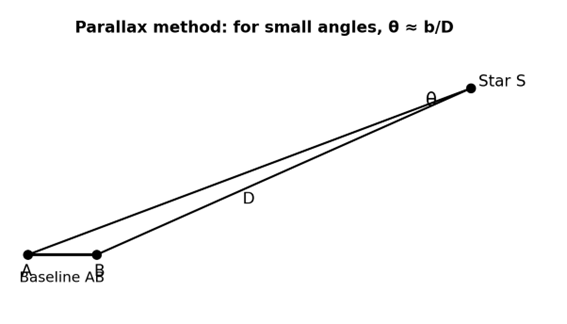
$$1\text{ arcsecond} = \frac{\pi / 180}{3600}\text{ rad} = 4.848 \times 10^{-6}\text{ rad}$$
$$1\text{ pc} = \frac{1\text{ AU}}{1\text{ arcsecond in radians}} = \frac{1.496 \times 10^{11}\text{ m}}{4.848 \times 10^{-6}\text{ rad}} \approx 3.09 \times 10^{16}\text{ m}.$$
Additional Question 2
Alpha Centauri is $4.29\text{ light-years}$ away. Express this distance in parsecs and find the total angular shift when observed from Earth positions six months apart.
Solution:
Since $1\text{ pc} = 3.26\text{ ly}$:
$$D = \frac{4.29}{3.26} \approx 1.32\text{ pc}$$
The annual parallax angle is $p = \frac{1}{D} \approx 0.758\text{ arcsecond}$. Observations six months apart use opposite ends of Earth’s orbital diameter, so the total angular shift is approximately $2p \approx 1.52\text{ arcseconds}$.
Additional Question 3
Give examples from modern science where very precise measurements of length, time or mass are required.
Solution:
– Ultrashort laser pulses measure processes occurring over intervals near $10^{-15}\text{ s}$.
– Atomic clocks measure time with fractional uncertainties far below one part in $10^{12}$.
– X-ray diffraction determines interatomic and interplanar distances of order $10^{-10}\text{ m}$.
– Mass spectrometers distinguish atomic and molecular masses with very high precision.
– Radar and satellite navigation require precise position and time measurements to determine speed and distance.
Additional Question 4
Suggest methods for making rough estimates of the following quantities:
(a) Mass of monsoon rain over India
(b) Mass of an elephant
(c) Wind speed during a storm
(d) Number of hairs on a head
(e) Air molecules in a room
Solution:
| Quantity | Estimation method / expression |
|---|---|
| Mass of monsoon rain over India | Use $m = \rho A h$. With $A \approx 3.3 \times 10^{12}\text{ m}^2$, rainfall $h \approx 2.15\text{ m}$ and $\rho \approx 10^3\text{ kg m}^{-3}$, $m \approx 7.1 \times 10^{15}\text{ kg}$. |
| Mass of an elephant | Place it on a floating platform of area $A$. If the additional immersion is $\Delta d$, mass $\approx \rho_{\text{water}} A \Delta d$. |
| Wind speed during a storm | Use an anemometer, or estimate distance travelled by a light object divided by travel time. |
| Number of hairs on a head | Estimate scalp area $A$ and average area allotted per hair; $N \approx A / (\text{mean spacing area})$. |
| Air molecules in a room | For room volume $V$, $N \approx \left(\frac{V}{22.4 \times 10^{-3}}\right) N_A$ at STP, approximately $2.69 \times 10^{25} V$ molecules when $V$ is in $\text{m}^3$. |
Additional Question 5
A book gives four formulas for the displacement $y$ in periodic motion. Rule out the dimensionally wrong formulas:
(a) $y = a \sin\left(\frac{2\pi t}{T}\right)$
(b) $y = a \sin(vt)$
(c) $y = \frac{a}{T} \sin\left(\frac{t}{a}\right)$
(d) $y = \frac{a}{\sqrt{2}} \left[\sin\left(\frac{2\pi t}{T}\right) + \cos\left(\frac{2\pi t}{T}\right)\right]$.
Solution:
| Formula | Dimensional check | Conclusion |
|---|---|---|
| (a) $y = a \sin\left(\frac{2\pi t}{T}\right)$ | $\frac{t}{T}$ is dimensionless and prefactor $a$ has dimension $L$. | Correct |
| (b) $y = a \sin(vt)$ | $vt$ has dimension $L$, not dimensionless. | Incorrect |
| (c) $y = \frac{a}{T} \sin\left(\frac{t}{a}\right)$ | Prefactor has dimension $LT^{-1}$ and $\frac{t}{a}$ is not dimensionless. | Incorrect |
| (d) $y = \frac{a}{\sqrt{2}} \left[\sin\left(\frac{2\pi t}{T}\right) + \cos\left(\frac{2\pi t}{T}\right)\right]$ | Arguments are dimensionless and prefactor has dimension $L$. | Correct |
Additional Question 6
A student remembers the relativistic mass formula as $m = \frac{m_0}{\sqrt{1 – v^2}}$ but has omitted $c$. Restore $c$ using dimensional analysis.
Solution:
The quantity subtracted from $1$ must be dimensionless. Since $v$ and $c$ both have dimensions $LT^{-1}$, $\frac{v^2}{c^2}$ is dimensionless.
$$m = \frac{m_0}{\sqrt{1 – \frac{v^2}{c^2}}}.$$
Additional Question 7
Jupiter is $824.7\text{ million kilometres}$ from Earth and has angular diameter $35.72\text{ arcseconds}$. Calculate its diameter.
Solution:
$$D = 824.7 \times 10^6\text{ km}; \quad \theta = 35.72 \times 4.848 \times 10^{-6}\text{ rad} = 1.732 \times 10^{-4}\text{ rad}$$
$$\text{Diameter } d = \theta D \approx 1.732 \times 10^{-4} \times 824.7 \times 10^6\text{ km} \approx 1.43 \times 10^5\text{ km}.$$
Additional Question 8
A person walking in vertical rain with speed $v$ slants an umbrella by angle $\theta$ from the vertical. Can $\tan\theta = v$ be correct? Suggest a correct relation.
Solution:
No. $\tan\theta$ is dimensionless but $v$ has dimensions of speed. If $u$ is the vertical speed of rain relative to the ground, the horizontal relative speed is $v$ and the vertical relative speed is $u$. Therefore,
$$\tan\theta = \frac{v}{u}.$$
Additional Question 9
Two caesium clocks may differ by only $0.02\text{ s}$ after $100\text{ years}$. What accuracy does this imply for measuring a $1\text{ s}$ interval?
Solution:
$$100\text{ years} \approx 100 \times 365.25 \times 24 \times 3600 = 3.156 \times 10^9\text{ s}$$
$$\text{Fractional error} = \frac{0.02}{3.156 \times 10^9} \approx 6.3 \times 10^{-12}.$$
Thus, a $1\text{ s}$ interval is measured with an uncertainty of order $10^{-11}\text{ to } 10^{-12}\text{ s}$.
Additional Question 10
Estimate the average mass density of a sodium atom, assuming its diameter is $2.5\text{ \AA}$. Compare it with crystalline sodium, whose density is $970\text{ kg m}^{-3}$.
Solution:
$$r = 1.25 \times 10^{-10}\text{ m}; \quad V = \frac{4}{3}\pi r^3 \approx 8.18 \times 10^{-30}\text{ m}^3$$
$$\text{Mass of one Na atom} = \frac{23 \times 10^{-3}}{6.022 \times 10^{23}} \approx 3.82 \times 10^{-26}\text{ kg}$$
$$\rho_{\text{atom}} \approx \frac{3.82 \times 10^{-26}}{8.18 \times 10^{-30}} \approx 4.7 \times 10^3\text{ kg m}^{-3}.$$
This is the same order of magnitude as $970\text{ kg m}^{-3}$. The estimate treats the atom as a hard sphere; real crystals contain packing gaps and the quoted atomic “size” is only approximate.
Additional Question 11
Nuclear radius follows $r = r_0 A^{1/3}$ with $r_0 \approx 1.2\text{ fm}$. Show that nuclear density is nearly constant and estimate it for sodium.
Solution:
$$V = \frac{4}{3}\pi r^3 = \frac{4}{3}\pi r_0^3 A; \quad \text{mass} \approx A \times 1.66 \times 10^{-27}\text{ kg}$$
$$\rho = \frac{A(1.66 \times 10^{-27})}{\frac{4}{3}\pi r_0^3 A} = \frac{3(1.66 \times 10^{-27})}{4\pi r_0^3}.$$
The factor $A$ cancels, so the density is approximately independent of the nucleus.
For $r_0 = 1.2 \times 10^{-15}\text{ m}$, $\rho \approx 2.3 \times 10^{17}\text{ kg m}^{-3}$.
This is about $10^{14}$ times the estimated average density of a sodium atom, showing that almost all atomic mass is concentrated in the tiny nucleus.
Additional Question 12
A laser pulse sent to the Moon returns in $2.56\text{ s}$. Find the radius of the lunar orbit.
Solution:
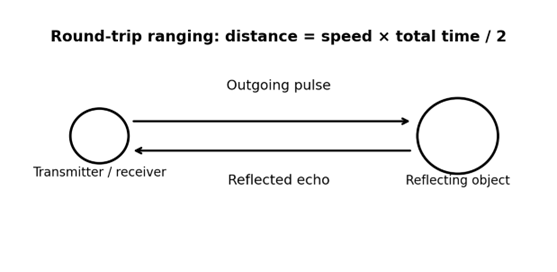
$$\text{One-way time} = \frac{2.56}{2} = 1.28\text{ s}$$
$$\text{Earth-Moon distance} = c \times 1.28 = 3.0 \times 10^8 \times 1.28 = 3.84 \times 10^8\text{ m} = 3.84 \times 10^5\text{ km}.$$
Additional Question 13
A SONAR echo returns after $77.0\text{ s}$. If the speed of sound in water is $1450\text{ m s}^{-1}$, find the distance of the reflecting submarine.
Solution:
$$\text{Distance} = \frac{vt}{2} = \frac{1450 \times 77.0}{2} = 5.5825 \times 10^4\text{ m} \approx 55.8\text{ km}.$$
Additional Question 14
How far away is a quasar whose light takes $3.0\text{ billion years}$ to reach Earth? Express the answer in kilometres.
Solution:
$$t = 3.0 \times 10^9 \times 365.25 \times 24 \times 3600 \approx 9.47 \times 10^{16}\text{ s}$$
$$D = ct = 3.0 \times 10^8 \times 9.47 \times 10^{16} \approx 2.84 \times 10^{25}\text{ m} = 2.84 \times 10^{22}\text{ km}.$$
Additional Question 15
During a total solar eclipse, the Moon and Sun have nearly equal angular diameters. Using Earth-Moon distance $3.84 \times 10^8\text{ m}$, Earth-Sun distance $1.496 \times 10^{11}\text{ m}$ and Sun diameter $1.39 \times 10^9\text{ m}$, estimate the Moon’s diameter.
Solution:
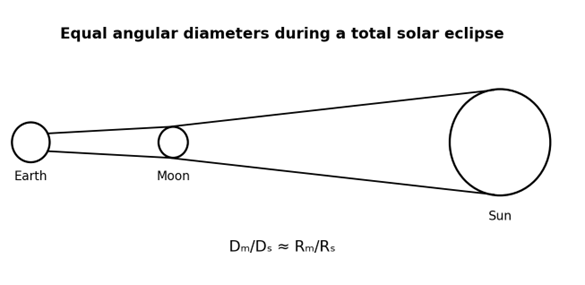
$$\frac{D_{\text{moon}}}{D_{\text{sun}}} \approx \frac{R_{\text{moon}}}{R_{\text{sun}}}$$
$$D_{\text{moon}} = 1.39 \times 10^9 \times \frac{3.84 \times 10^8}{1.496 \times 10^{11}} \approx 3.57 \times 10^6\text{ m} \approx 3570\text{ km}.$$
Additional Question 16
Construct a combination of fundamental constants having the dimensions of time, of very large magnitude, as discussed by P. A. M. Dirac. What would a significant coincidence with the age of the universe imply?
Solution:
| Constant | Symbol | Approximate SI value |
|---|---|---|
| Elementary charge | $e$ | $1.60 \times 10^{-19}\text{ C}$ |
| Electron mass | $m_e$ | $9.11 \times 10^{-31}\text{ kg}$ |
| Proton mass | $m_p$ | $1.67 \times 10^{-27}\text{ kg}$ |
| Speed of light | $c$ | $3.00 \times 10^8\text{ m s}^{-1}$ |
| Gravitational constant | $G$ | $6.67 \times 10^{-11}\text{ m}^3\text{ kg}^{-1}\text{ s}^{-2}$ |
| Coulomb constant | $k = \frac{1}{4\pi\varepsilon_0}$ | $8.99 \times 10^9\text{ N m}^2\text{ C}^{-2}$ |
One possible time-like combination is:
$$t = \frac{(ke^2)^2}{m_p m_e^2 c^3 G}$$
Dimensional analysis gives $[t] = T$. Substitution gives a very large timescale, of order $10^{16}\text{ s}$ (roughly $10^9\text{ years}$). The question is intended as an exploration of large-number coincidences rather than a precise determination of the universe’s age.
If such a coincidence were fundamental rather than accidental, it could suggest that at least one supposedly constant dimensionless combination of physical constants changes over cosmological time. Any meaningful test must ultimately be framed in terms of dimensionless ratios.
Why Class 11 Physics Chapter 1 Matters in NEET and JEE
Class 11 Physics Chapter 1, Units and Measurements, is important for NEET and JEE because it forms the foundation for solving numerical problems throughout physics. The chapter explains how physical quantities are measured, represented and expressed using standard units. Students learn about fundamental and derived quantities, the International System of Units, significant figures, dimensions and different types of measurement errors.
NEET frequently includes direct and calculation-based questions on significant figures, percentage errors, dimensional formulas and the least count of measuring instruments. JEE commonly tests dimensional analysis, propagation of errors, unit conversion and the limitations of dimensional equations. The concepts covered in this chapter are also used in mechanics, thermodynamics, electricity, magnetism and modern physics. A strong understanding of units, dimensions and errors helps students perform calculations accurately and avoid mistakes in later chapters.
Preparation Tips for Class 11 Physics Chapter 1
Begin by learning the seven fundamental physical quantities and their SI units. Understand the difference between fundamental quantities and derived quantities, and practise expressing commonly used physical quantities such as velocity, acceleration, force, pressure, energy and power in SI units.
Prepare a table containing important physical quantities, their SI units and dimensional formulas. Memorise the dimensions of frequently used quantities such as momentum, force, work, power, pressure, gravitational constant and Planck’s constant. Practise using the principle of dimensional homogeneity to check whether a physical equation is dimensionally correct.
Study significant figures and the rules for rounding off carefully. Practise identifying the number of significant figures in different measurements and applying the correct rules during addition, subtraction, multiplication and division. Understand the difference between accuracy and precision, as well as systematic, random and least-count errors.
Learn the formulas for absolute error, mean absolute error, relative error and percentage error. Practise the propagation of errors in sums, differences, products, quotients and powers of measured quantities. Also revise the least count and working principles of instruments such as the vernier callipers and screw gauge. Complete NCERT examples and exercises before solving NEET and JEE previous-year questions.
FAQs
1. What are the most important topics in Class 11 Physics Chapter 1?
The most important topics include SI units, fundamental and derived quantities, significant figures, dimensional formulas, dimensional analysis, accuracy, precision, errors in measurement, vernier callipers and screw gauge.
2. What is a physical quantity?
A physical quantity is a measurable property that can be expressed using a numerical value and a unit. Examples include length, mass, time, temperature, force and energy.
3. What are fundamental and derived quantities?
Fundamental quantities are independent physical quantities that cannot be expressed in terms of other quantities. Derived quantities are obtained by combining fundamental quantities through mathematical relationships.
4. What are the seven fundamental SI quantities?
The seven fundamental SI quantities are length, mass, time, electric current, thermodynamic temperature, amount of substance and luminous intensity. Their SI units are metre, kilogram, second, ampere, kelvin, mole and candela, respectively.
5. What are significant figures?
Significant figures are the meaningful digits in a measured quantity, including all certain digits and the first uncertain digit. They indicate the precision of a measurement.
6. What is dimensional analysis?
Dimensional analysis is a method of representing physical quantities in terms of fundamental dimensions such as mass, length and time. It is used to check equations, derive relationships and convert units.
7. What is the principle of dimensional homogeneity?
The principle of dimensional homogeneity states that all terms in a physically correct equation must have the same dimensions. The dimensions on the left-hand side and right-hand side of an equation must be equal.
8. What are the limitations of dimensional analysis?
Dimensional analysis cannot determine numerical constants, distinguish between quantities having the same dimensions or derive equations involving trigonometric, exponential and logarithmic functions. It also cannot confirm whether an equation is completely correct.
9. What is the difference between accuracy and precision?
Accuracy refers to how close a measured value is to the true value, while precision refers to how close repeated measurements are to one another. A measurement may be precise without being accurate.
10. What are the main types of errors in measurement?
The main types of errors are systematic errors, random errors and least-count errors. Systematic errors occur consistently, random errors vary unpredictably and least-count errors arise because of the limited resolution of a measuring instrument.
11. How is percentage error calculated?
Percentage error is calculated by dividing the absolute error by the measured or mean value and multiplying the result by 100.
$$\text{Percentage Error} = \left(\frac{\text{Absolute Error}}{\text{Mean Value}}\right) \times 100$$
12. What is the least count of a measuring instrument?
The least count is the smallest value that can be measured accurately by an instrument. A smaller least count generally allows more precise measurements.
13. What is a vernier calliper used for?
What is a vernier calliper used for? A vernier calliper is used to measure external dimensions, internal dimensions and the depth of an object more accurately than an ordinary metre scale.
14. What is a screw gauge used for?
A screw gauge is used to measure very small dimensions, such as the diameter of a thin wire or the thickness of a sheet, with high precision.