
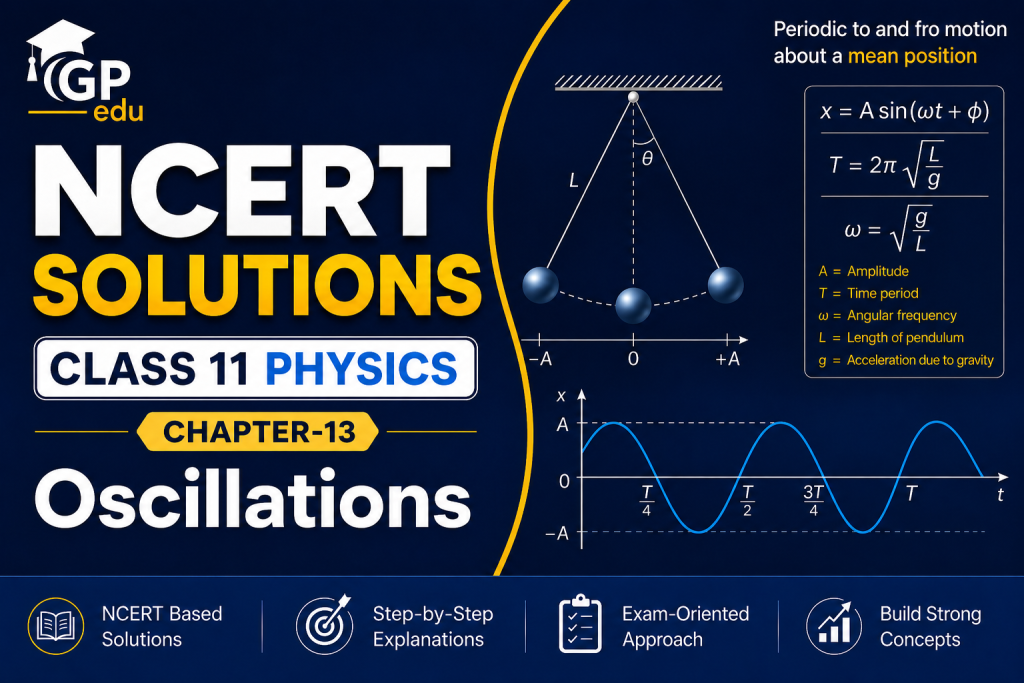
NCERT Solutions for Class 11 Physics Chapter 13, “Oscillations,” have been carefully prepared by experienced physics teachers to help students understand every concept clearly. Before attempting the NCERT questions, students should study the chapter theory thoroughly, including simple harmonic motion (SHM), displacement, velocity, acceleration, time period, frequency, and energy in oscillatory motion. These step-by-step solutions simplify both conceptual and numerical problems and are useful for school exams, NEET and JEE preparation.
Class 11 Physics Chapter 13 Overview
The Oscillations chapter explains the periodic to-and-fro motion of objects about their equilibrium position. Students learn about simple harmonic motion (SHM), displacement, velocity, acceleration, amplitude, time period, and frequency. The chapter also covers the equations of SHM, energy in oscillatory motion, and examples such as the spring-mass system and simple pendulum, providing a strong foundation for understanding waves and vibrations.
NCERT Solutions for Class 11 Physics
Chapter 13: Oscillations
Question 13.1.
Which of the following examples represent periodic motion?
a. A swimmer completing one (return) trip from one bank of a river to the other and back.
b. A freely suspended bar magnet displaced from its N-S direction and released.
c. A hydrogen molecule rotating about its center of mass.
d. An arrow released from a bow.
Solution :
a. The swimmer’s motion is not periodic. Though the motion of a swimmer is to and fro but will not have a definite period.
b. The motion of a freely-suspended magnet, if displaced from its N-S direction and released, is periodic because the magnet oscillates about its position with a definite period of time.
c. When a hydrogen molecule rotates about its centre of mass, it comes to the same position again and again after an equal interval of time. Such a motion is periodic.
d. An arrow released from a bow moves only in the forward direction. It does not come backward. Hence, this motion is not periodic.
Question 13.2.
Which of the following examples represent (nearly) simple harmonic motion and which represent periodic but not simple harmonic motion?
a. the rotation of earth about its axis.
b. motion of an oscillating mercury column in a U-tube.
c. motion of a ball bearing inside a smooth curved bowl, when released from a point slightly above the lower most point.
d. general vibrations of a polyatomic molecule about its equilibrium position.
Solution :
a. It is periodic but not simple harmonic motion because it is not to and fro about a fixed point.
b. It is a simple harmonic motion because the mercury moves to and fro on the same path, about the fixed position, with a certain period of time.
c. It is simple harmonic motion because the ball moves to and fro about the lowermost point of the bowl when released. Also, the ball comes back to its initial position in the same period of time, again and again.
d. A polyatomic molecule has many natural frequencies of oscillation. Its vibration is the superposition of individual simple harmonic motions of a number of different molecules. Hence, it is not simple harmonic, but periodic.
Question 13.3.
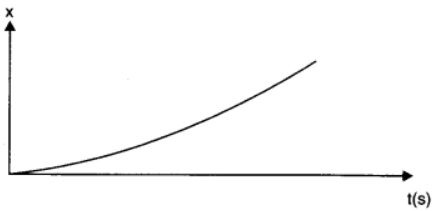
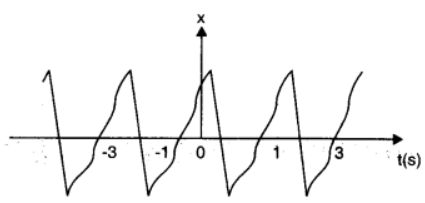
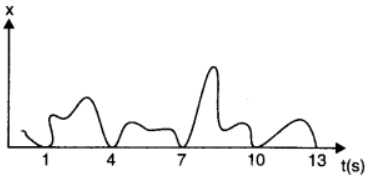
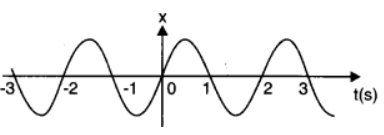
Figure 13.27 depicts four $x\text{-}t$ plots for linear motion of a particle. Which of the plots represent periodic motion? What is the period of motion (in case of periodic motion)?
a.
b.
c.
d.
Solution :
a. It is not a periodic motion. This represents a unidirectional, linear uniform motion. There is no repetition of motion in this case.
b. In this case, the motion of the particle repeats itself after $2\text{ s}$. Hence, it is a periodic motion, having a period of $2\text{ s}$.
c. It is not a periodic motion. This is because the particle repeats the motion in one position only. For a periodic motion, the entire motion of the particle must be repeated in equal intervals of time.
d. In this case, the motion of the particle repeats itself after $2\text{ s}$. Hence, it is a periodic motion, having a period of $2\text{ s}$.
Question 13.4.
Which of the following functions of time represent (a) simple harmonic, (b) periodic but not simple harmonic, and (c) non-periodic motion? Give period for each case of periodic motion ($\omega$ is any positive constant):
a. $\sin\omega t – \cos\omega t$
b. $\sin^3\omega t$
c. $3 \cos\left(\frac{\pi}{4} – 2\omega t\right)$
d. $\cos\omega t + \cos 3\omega t + \cos 5\omega t$
e. $\exp(-\omega^2 t^2)$
f. $1 + \omega t + \omega^2 t^2$
Solution :
a. **SHM**
The given function is $\sin\omega t – \cos\omega t = \sqrt{2}\left(\frac{1}{\sqrt{2}}\sin\omega t – \frac{1}{\sqrt{2}}\cos\omega t\right) = \sqrt{2}\sin\left(\omega t – \frac{\pi}{4}\right)$.
Its period is $\frac{2\pi}{\omega}$.
b. **Periodic but not SHM**
The given function is $\sin^3\omega t = \frac{1}{4}(3\sin\omega t – \sin 3\omega t)$.
The terms $\sin\omega t$ and $\sin 3\omega t$ individually represent simple harmonic motion (SHM). However, the superposition of two SHMs is periodic and not simple harmonic.
Its period is $\frac{2\pi}{\omega}$.
c. **SHM**
The given function is $3\cos\left(\frac{\pi}{4} – 2\omega t\right) = 3\cos\left(2\omega t – \frac{\pi}{4}\right)$.
This function represents simple harmonic motion because it can be written in the form $A\cos(\omega’ t + \Phi)$.
Its period is $\frac{2\pi}{2\omega} = \frac{\pi}{\omega}$.
d. **Periodic, but not SHM**
The given function is $\cos\omega t + \cos 3\omega t + \cos 5\omega t$. Each individual cosine function represents SHM. However, the superposition of three simple harmonic motions is periodic, but not simple harmonic.
e. **Non-periodic motion**
The given function $\exp(-\omega^2 t^2)$ is an exponential function. Exponential functions do not repeat themselves. Therefore, it is a non-periodic motion.
f. The given function $1 + \omega t + \omega^2 t^2$ is non-periodic.
Question 13.5.
A particle is in linear simple harmonic motion between two points, A and B, $10\text{ cm}$ apart. Take the direction from A to B as the positive direction and give the signs of velocity, acceleration and force on the particle when it is
a. at the end A,
b. at the end B,
c. at the mid-point of AB going towards A,
d. at $2\text{ cm}$ away from B going towards A,
e. at $3\text{ cm}$ away from A going towards B, and
f. at $4\text{ cm}$ away from B going towards A.
Solution :
From the figure, where A and B represent the two extreme positions of SHM. For velocity, the direction from A to B is taken to be positive. The acceleration and the force, along AP are taken as positive and along BP are taken as negative.
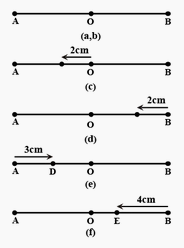
a. At the end A, the particle executing SHM is momentarily at rest being its extreme position of motion. Therefore, its velocity is zero. Acceleration is positive because it is directed along AP. Force is also positive since the force is directed along AP.
b. At the end B, velocity is zero. Here, acceleration and force are negative as they are directed along BP.
c. At the mid-point of AB going towards A, the particle is at its mean position P, with a tendency to move along PA. Hence, velocity is negative (towards A). Both acceleration and force are zero.
d. At $2\text{ cm}$ away from B going towards A, the particle is at Q, with a tendency to move along QP, which is negative direction. Therefore, velocity is negative. Acceleration and force are also negative as they are directed towards the mean position (along BP).
e. At $3\text{ cm}$ away from A going towards B, the particle is at R, with a tendency to move along RP, which is positive direction. Here, velocity, acceleration, and force all are positive.
f. At $4\text{ cm}$ away from B going towards A, the particle is at S, with a tendency to move along SA, which is negative direction. Therefore, velocity is negative, but acceleration is directed towards mean position, along SP. Hence it is positive and also force is positive similarly.
Question 13.6.
Which of the following relationships between the acceleration $a$ and the displacement $x$ of a particle involve simple harmonic motion?
a. $a = 0.7x$
b. $a = -200x^2$
c. $a = -10x$
d. $a = 100x^3$
Solution :
In SHM, acceleration $a$ is related to displacement by the relation of the form $a = -\omega^2 x$ (i.e. $a = -kx$), which is true for relation **(c)** ($a = -10x$).
Question 13.7.
The motion of a particle executing simple harmonic motion is described by the displacement function,
$$x(t) = A \cos(\omega t + \phi)$$
If the initial ($t = 0$) position of the particle is $1\text{ cm}$ and its initial velocity is $\omega\text{ cm/s}$, what are its amplitude and initial phase angle? The angular frequency of the particle is $\pi\text{ s}^{-1}$. If instead of the cosine function, we choose the sine function to describe the SHM: $x = B \sin(\omega t + \alpha)$, what are the amplitude and initial phase of the particle with the above initial conditions.
Solution :
Initially, at $t = 0$:
Displacement, $x = 1\text{ cm}$
Initial velocity, $v = \omega\text{ cm/sec}$
Angular frequency, $\omega = \pi\text{ rad/s}$
Given $x(t) = A \cos(\omega t + \phi)$:
$$1 = A \cos(\omega \times 0 + \phi) = A \cos\phi \implies A \cos\phi = 1 \quad \dots\text{(i)}$$
Velocity, $v = \frac{dx}{dt} = -A\omega \sin(\omega t + \phi)$
$$\omega = -A\omega \sin(\omega \times 0 + \phi) \implies A \sin\phi = -1 \quad \dots\text{(ii)}$$
Squaring and adding equations (i) and (ii):
$$A^2(\sin^2\phi + \cos^2\phi) = 1 + 1 \implies A^2 = 2 \implies A = \sqrt{2}\text{ cm}$$
Dividing equation (ii) by equation (i):
$$\tan\phi = -1 \implies \phi = \frac{3\pi}{4}, \frac{7\pi}{4}, \dots$$
For SHM given as $x = B \sin(\omega t + \alpha)$:
$$1 = B \sin(\omega \times 0 + \alpha) \implies B \sin\alpha = 1 \quad \dots\text{(iii)}$$
Velocity, $v = \omega B \cos(\omega t + \alpha)$:
$$\omega = \omega B \cos(\omega \times 0 + \alpha) \implies B \cos\alpha = 1 \quad \dots\text{(iv)}$$
Squaring and adding equations (iii) and (iv):
$$B^2(\sin^2\alpha + \cos^2\alpha) = 1 + 1 \implies B^2 = 2 \implies B = \sqrt{2}\text{ cm}$$
Dividing equation (iii) by equation (iv):
$$\tan\alpha = 1 \implies \alpha = \frac{\pi}{4}, \frac{5\pi}{4}, \dots$$
Question 13.8.
A spring balance has a scale that reads from $0$ to $50\text{ kg}$. The length of the scale is $20\text{ cm}$. A body suspended from this balance, when displaced and released, oscillates with a period of $0.6\text{ s}$. What is the weight of the body?
Solution :
Maximum mass that the scale can read, $M = 50\text{ kg}$
Maximum displacement of the spring = Length of the scale, $l = 20\text{ cm} = 0.2\text{ m}$
Time period, $T = 0.6\text{ s}$
Maximum force exerted on the spring, $F = Mg = 50 \times 9.8 = 490\text{ N}$
$$\therefore \text{Spring constant, } k = \frac{F}{l} = \frac{490}{0.2} = 2450\text{ N m}^{-1}$$
Mass $m$ is suspended from the balance:
$$T = 2\pi \sqrt{\frac{m}{k}} \implies m = \frac{T^2 k}{4\pi^2} = \frac{(0.6)^2 \times 2450}{4 \times (3.14)^2} \approx 22.36\text{ kg}$$
$$\therefore \text{Weight of the body} = mg = 22.36 \times 9.8 \approx 219.17\text{ N}$$
Hence, the weight of the body is about $219\text{ N}$.
Question 13.9.
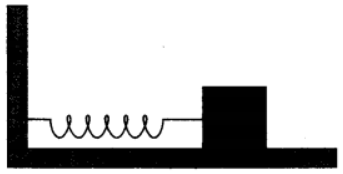
A spring having with a spring constant $1200\text{ N m}^{-1}$ is mounted on a horizontal table as shown in Fig. A mass of $3\text{ kg}$ is attached to the free end of the spring. The mass is then pulled sideways to a distance of $2.0\text{ cm}$ and released. Determine (i) the frequency of oscillations, (ii) maximum acceleration of the mass, and (iii) the maximum speed of the mass.
Solution :
Spring constant, $k = 1200\text{ N m}^{-1}$
Mass, $m = 3\text{ kg}$
Amplitude, $A = 2.0\text{ cm} = 0.02\text{ m}$
(i) Frequency of oscillation $\nu$, is given by the relation:
$$\nu = \frac{1}{2\pi}\sqrt{\frac{k}{m}} = \frac{1}{2 \times 3.14}\sqrt{\frac{1200}{3}} = \frac{1}{6.28} \times \sqrt{400} = \frac{20}{6.28} \approx 3.18\text{ Hz}$$
(ii) Maximum acceleration $a_{\text{max}} = \omega^2 A = \left(\frac{k}{m}\right)A = \left(\frac{1200}{3}\right) \times 0.02 = 400 \times 0.02 = 8\text{ m s}^{-2}$
(iii) Maximum speed $v_{\text{max}} = A\omega = A\sqrt{\frac{k}{m}} = 0.02 \times \sqrt{\frac{1200}{3}} = 0.02 \times 20 = 0.4\text{ m/s}$
Hence, the maximum velocity of the mass is $0.4\text{ m/s}$.
Question 13.10.
In Exercise 13.9, let us take the position of mass when the spring is unstreched as $x = 0$, and the direction from left to right as the positive direction of $x$-axis. Give $x$ as a function of time $t$ for the oscillating mass if at the moment we start the stopwatch ($t = 0$), the mass is
a. at the mean position,
b. at the maximum stretched position, and
c. at the maximum compressed position.
In what way do these functions for SHM differ from each other, in frequency, in amplitude or the initial phase?
Solution :
Amplitude $A = 2.0\text{ cm} = 0.02\text{ m}$
Angular frequency $\omega = \sqrt{\frac{k}{m}} = \sqrt{\frac{1200}{3}} = 20\text{ rad/s}$
a. At the mean position ($t = 0$, $x = 0$ moving in positive direction): $x = A \sin(\omega t) = 0.02 \sin(20t)$
b. At the maximum stretched position ($t = 0$, $x = +A$): $x = A \cos(\omega t) = 0.02 \cos(20t)$
c. At the maximum compressed position ($t = 0$, $x = -A$): $x = -A \cos(\omega t) = -0.02 \cos(20t)$
The functions **neither differ in amplitude nor in frequency**. They differ in **initial phase**.
Question 13.11.
Figures 13.29 correspond to two circular motions. The radius of the circle, the period of revolution, the initial position, and the sense of revolution (i.e. clockwise or anti-clockwise) are indicated on each figure.
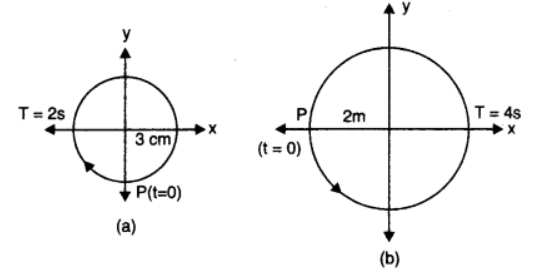
Obtain the corresponding simple harmonic motions of the $x$-projection of the radius vector of the revolving particle P, in each case.
Solution :
(a) Time period $T = 2\text{ s}$, Amplitude $A = 3\text{ cm}$
At time $t = 0$, the radius vector OP makes an angle $\pi/2$ with the positive $x$-axis, i.e., phase angle $\phi = +\pi/2$.
Therefore, the equation of simple harmonic motion for the $x$-projection of OP at time $t$ is:
$$x(t) = 3 \cos\left(\frac{2\pi}{2}t + \frac{\pi}{2}\right) = 3 \cos\left(\pi t + \frac{\pi}{2}\right) = -3 \sin(\pi t)$$
(b) Time Period $T = 4\text{ s}$, Amplitude $a = 2\text{ m}$
At time $t = 0$, OP makes an angle $\pi$ with the $x$-axis in the anticlockwise direction. Hence, phase angle $\phi = \pi$.
Therefore, the equation of simple harmonic motion is:
$$x(t) = 2 \cos\left(\frac{2\pi}{4}t + \pi\right) = 2 \cos\left(\frac{\pi}{2}t + \pi\right) = -2 \cos\left(\frac{\pi}{2}t\right)$$
Question 13.12.
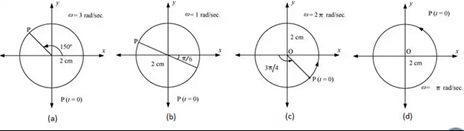
Plot the corresponding reference circle for each of the following simple harmonic motions. Indicate the initial ($t = 0$) position of the particle, the radius of the circle, and the angular speed of the rotating particle. For simplicity, the sense of rotation may be fixed to be anticlockwise in every case: ($x$ is in cm and $t$ is in s).
a. $x = -2 \sin(3t + \pi/3)$
b. $x = \cos(\pi/6 – t)$
c. $x = 3 \sin(2\pi t + \pi/4)$
d. $x = 2 \cos(\pi t)$
Solution :
a. $x = -2 \sin(3t + \pi/3) = 2 \cos(3t + \pi/3 + \pi/2) = 2 \cos(3t + 5\pi/6)$
Amplitude $A = 2\text{ cm}$, Phase angle $\phi = 5\pi/6 = 150^\circ$, Angular velocity $\omega = 3\text{ rad/s}$.
b. $x = \cos(\pi/6 – t) = \cos(t – \pi/6)$
Amplitude $A = 1\text{ cm}$, Phase angle $\phi = -\pi/6 = -30^\circ$, Angular velocity $\omega = 1\text{ rad/s}$.
c. $x = 3 \sin(2\pi t + \pi/4) = 3 \cos(2\pi t + \pi/4 – \pi/2) = 3 \cos(2\pi t – \pi/4)$
Amplitude $A = 3\text{ cm}$, Phase angle $\phi = -\pi/4 = -45^\circ$, Angular velocity $\omega = 2\pi\text{ rad/s}$.
d. $x = 2 \cos(\pi t)$
Amplitude $A = 2\text{ cm}$, Phase angle $\phi = 0$, Angular velocity $\omega = \pi\text{ rad/s}$.
The motion of the particle can be plotted as shown in fig. 10(d).
Question 13.13.
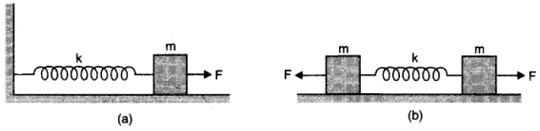
Figure 13.30 (a) shows a spring of force constant $k$ clamped rigidly at one end and a mass $m$ attached to its free end. A force $F$ applied at the free end stretches the spring. Figure 14.30 (b) shows the same spring with both ends free and attached to a mass $m$ at either end. Each end of the spring in Fig. 14.30(b) is stretched by the same force $F$.
a. What is the maximum extension of the spring in the two cases?
b. If the mass in Fig. (a) and the two masses in Fig. (b) are released, what is the period of oscillation in each case?
Solution :
a. The maximum extension of the spring in both cases will be $\frac{F}{k}$, where $k$ is the spring constant of the spring.
b. In Fig. (a), the inertia factor is $m$ and spring factor is $k$:
$$T_a = 2\pi\sqrt{\frac{m}{k}}$$
In Fig. (b), we have a two-body system of spring constant $k$ and reduced mass $\mu = \frac{m \times m}{m + m} = \frac{m}{2}$.
$$\text{Inertia factor} = \frac{m}{2}, \quad \text{Spring factor} = k \implies T_b = 2\pi\sqrt{\frac{m}{2k}}.$$
Question 13.14.
The piston in the cylinder head of a locomotive has a stroke (twice the amplitude) of $1.0\text{ m}$. If the piston moves with simple harmonic motion with an angular frequency of $200\text{ rad/min}$, what is its maximum speed?
Solution :
$$\text{Angular frequency, } \omega = 200\text{ rad/min}$$
$$\text{Stroke} = 1.0\text{ m} \implies \text{Amplitude, } A = \frac{1.0}{2} = 0.5\text{ m}$$
The maximum speed ($v_{\text{max}}$) of piston is given by the relation:
$$v_{\text{max}} = A\omega = 0.5 \times 200 = 100\text{ m/min} = \frac{100}{60}\text{ m/s} \approx 1.67\text{ m/s}.$$
Question 13.15.
The acceleration due to gravity on the surface of moon is $1.7\text{ ms}^{-2}$. What is the time period of a simple pendulum on the surface of moon if its time period on the surface of earth is $3.5\text{ s}$? ($g$ on the surface of earth is $9.8\text{ ms}^{-2}$)
Solution :
$$\text{Acceleration due to gravity on moon, } g’ = 1.7\text{ m s}^{-2}$$
$$\text{Acceleration due to gravity on earth, } g = 9.8\text{ m s}^{-2}$$
$$\text{Time period on earth, } T = 3.5\text{ s}$$
$$T = 2\pi\sqrt{\frac{l}{g}} \implies T’ = 2\pi\sqrt{\frac{l}{g’}} \implies \frac{T’}{T} = \sqrt{\frac{g}{g’}}$$
$$T’ = 3.5 \times \sqrt{\frac{9.8}{1.7}} \approx 3.5 \times 2.402 \approx 8.4\text{ s}$$
Hence, the time period of the simple pendulum on the surface of the moon is $8.4\text{ s}$.
Question 13.16.
A simple pendulum of length $l$ and having a bob of mass $M$ is suspended in a car. The car is moving on a circular track of radius $R$ with a uniform speed $v$. If the pendulum makes small oscillations in a radial direction about its equilibrium position, what will be its time period?
Solution :
The bob of the simple pendulum will experience acceleration due to gravity ($g$) vertically and centripetal acceleration $\left(\frac{v^2}{R}\right)$ horizontally.
Effective acceleration ($g’$) is given as:
$$g’ = \sqrt{g^2 + \left(\frac{v^2}{R}\right)^2}$$
$$\text{Time period } T = 2\pi\sqrt{\frac{l}{g’}} = 2\pi\sqrt{\frac{l}{\sqrt{g^2 + (v^2/R)^2}}}.$$
Question 13.17.
Cylindrical piece of cork of density $\rho$, base area $A$ and height $h$ floats in a liquid of density $\rho_1$. The cork is depressed slightly and then released. Show that the cork oscillates up and down simple harmonically with a period
$$T = 2\pi\sqrt{\frac{h\rho}{\rho_1 g}}$$
where $\rho$ is the density of cork. (Ignore damping due to viscosity of the liquid).
Solution :
Base area of the cork $= A$, Height $= h$, Density of liquid $= \rho_1$, Density of cork $= \rho$
In equilibrium: Weight of the cork $=$ Weight of the liquid displaced.
Let the cork be depressed slightly by $x$. Extra up-thrust acting upward provides restoring force:
$$F = -(Ax\rho_1 g) = -k x \implies k = A\rho_1 g$$
Mass of the cork $m = Ah\rho$.
$$\text{Time period } T = 2\pi\sqrt{\frac{m}{k}} = 2\pi\sqrt{\frac{Ah\rho}{A\rho_1 g}} = 2\pi\sqrt{\frac{h\rho}{\rho_1 g}}.$$
Question 13.18.
One end of a U-tube containing mercury is connected to a suction pump and the other end to atmosphere. A small pressure difference is maintained between the two columns. Show that, when the suction pump is removed, the column of mercury in the U-tube executes simple harmonic motion.
Solution :
Area of cross-section of the U-tube $= A$
Density of mercury $= \rho$, Acceleration due to gravity $= g$
Restoring force $F = -(A \times 2h \times \rho \times g) = -2A\rho g h = -kh$
Where $k = 2A\rho g$.
Mass of mercury column $m = Al\rho$ (where $l$ is total length of mercury column).
$$\text{Time period } T = 2\pi\sqrt{\frac{m}{k}} = 2\pi\sqrt{\frac{Al\rho}{2A\rho g}} = 2\pi\sqrt{\frac{l}{2g}}.$$
Additional Question 1
Answer the following questions:
a. Time period of a particle in SHM depends on the force constant $k$ and mass $m$ of the particle: $T = 2\pi\sqrt{\frac{m}{k}}$. A simple pendulum executes SHM approximately. Why then is the time period of a pendulum independent of the mass of the pendulum?
b. The motion of a simple pendulum is approximately simple harmonic for small angle oscillations. For larger angles of oscillation, a more involved analysis shows that $T$ is greater than $2\text{}\pi\sqrt{\frac{l}{g}}$. Think of a qualitative argument to appreciate this result.
c. A man with a wristwatch on his hand falls from the top of a tower. Does the watch give correct time during the free fall?
d. What is the frequency of oscillation of a simple pendulum mounted in a cabin that is freely falling under gravity?
Solution :
a. For a simple pendulum, force constant $k$ is proportional to mass $m$, so $m$ cancels out in both numerator and denominator.
b. For larger angles, restoring force $F = -mg\sin\theta$ deviates from $-mg\theta$, reducing effective acceleration and increasing the time period.
c. **Yes**, because wristwatch operation depends on spring action, not gravity.
d. **Zero**, because effective gravity inside a freely falling cabin is zero.
Additional Question 2
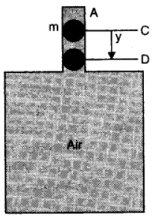
An air chamber of volume $V$ has a neck area of cross section $a$ into which a ball of mass $m$ just fits and can move up and down without any friction (Fig.14.33). Show that when the ball is pressed down a little and released, it executes SHM. Obtain an expression for the time period of oscillations assuming pressure-volume variations of air to be isothermal.
Solution :
Using bulk modulus of air under isothermal conditions ($B = P$), pressing the ball by $x$ creates restoring force $F = -\frac{Pa^2}{V}x$.
$$\text{Time period } T = 2\pi\sqrt{\frac{mV}{Pa^2}}.$$
Additional Question 3
You are riding in an automobile of mass $3000\text{ kg}$. Assuming that you are examining the oscillation characteristics of its suspension system. The suspension sags $15\text{ cm}$ when the entire automobile is placed on it. Also, the amplitude of oscillation decreases by $50\%$ during one complete oscillation. Estimate the values of
a. the spring constant $k$ and
b. the damping constant $b$ for the spring and shock absorber system of one wheel, assuming that each wheel supports $750\text{ kg}$.
Solution :
a. Total spring constant $K = \frac{mg}{x} = \frac{3000 \times 9.8}{0.15} = 1.96 \times 10^5\text{ N/m} \implies k \approx 5 \times 10^4\text{ N/m}$ per wheel.
b. Using damping equation $x = x_0 e^{-bt/2M}$, with $x = 0.5x_0$, damping constant $b \approx 1350\text{ kg/s}$.
Additional Question 4
Show that for a particle in linear SHM the average kinetic energy over a period of oscillation equals the average potential energy over the same period.
Solution :
$$\langle K \rangle = \frac{1}{T}\int_0^T \frac{1}{2}m A^2\omega^2 \cos^2(\omega t) dt = \frac{1}{4}m A^2\omega^2$$
$$\langle U \rangle = \frac{1}{T}\int_0^T \frac{1}{2}k A^2\sin^2(\omega t) dt = \frac{1}{4}k A^2 = \frac{1}{4}m A^2\omega^2$$
Thus, average kinetic energy equals average potential energy over a complete cycle.
Additional Question 5
A circular disc of mass $10\text{ kg}$ is suspended by a wire attached to its centre. The wire is twisted by rotating the disc and released. The period of torsional oscillations is found to be $1.5\text{ s}$. The radius of the disc is $15\text{ cm}$. Determine the torsional spring constant of the wire. ($J = -\alpha\theta$).
Solution :
$$\text{Moment of inertia } I = \frac{1}{2}mr^2 = 0.5 \times 10 \times (0.15)^2 = 0.1125\text{ kg m}^2$$
$$\alpha = \frac{4\pi^2 I}{T^2} = \frac{4 \times (3.14)^2 \times 0.1125}{(1.5)^2} \approx 1.97\text{ N m rad}^{-1}.$$
Additional Question 6
A body describes simple harmonic motion with amplitude of $5\text{ cm}$ and a period of $0.2\text{ s}$. Find the acceleration and velocity of the body when the displacement is (a) $5\text{ cm}$, (b) $3\text{ cm}$, (c) $0\text{ cm}$.
Solution :
$$A = 0.05\text{ m}, \quad T = 0.2\text{ s} \implies \omega = \frac{2\pi}{0.2} = 10\pi\text{ rad/s}$$
a. At $y = 5\text{ cm}$ ($0.05\text{ m}$): $v = 0$, $a = -\omega^2 y \approx -49.3\text{ m/s}^2$.
b. At $y = 3\text{ cm}$ ($0.03\text{ m}$): $v = \omega\sqrt{A^2 – y^2} \approx 1.25\text{ m/s}$, $a \approx -29.6\text{ m/s}^2$.
c. At $y = 0$: $v = A\omega \approx 1.57\text{ m/s}$, $a = 0$.
Additional Question 7
A mass attached to a spring is free to oscillate, with angular velocity $\omega$, in a horizontal plane without friction or damping. It is pulled to a distance $x_0$ and pushed towards the centre with a velocity $v_0$ at time $t = 0$. Determine the amplitude of the resulting oscillations in terms of the parameters $\omega$, $x_0$ and $v_0$.
Solution :
Using $x(t) = A \cos(\omega t + \theta)$, at $t = 0$, $x_0 = A \cos\theta$ and $v_0 = -A\omega \sin\theta$:
$$A = \sqrt{x_0^2 + \left(\frac{v_0}{\omega}\right)^2}.$$
Why Class 11 Physics Chapter 13 Matters in NEET and JEE
Oscillations, is important for NEET and JEE because it introduces the concept of periodic motion and Simple Harmonic Motion (SHM). Students learn key topics such as displacement, amplitude, time period, frequency, velocity, acceleration, and energy in SHM. These concepts form the foundation for understanding waves and many advanced topics in physics.
NEET often includes direct conceptual and formula-based questions on SHM, time period, frequency, and energy. JEE frequently tests numerical and conceptual understanding of spring-mass systems, simple pendulums, and the equations of SHM. A clear understanding of these concepts helps students solve oscillation and wave-related problems accurately.
Preparation Tips for Class 11 Physics Chapter 13
Begin by understanding the basic concepts of oscillatory motion and Simple Harmonic Motion (SHM). Learn the meaning of displacement, amplitude, time period, frequency, phase, velocity, and acceleration, and understand how these quantities are related in SHM.
Memorize the important formulas:
$$T = 2\pi\sqrt{\frac{m}{k}}$$
$$T = 2\pi\sqrt{\frac{l}{g}}$$
$$v = \omega\sqrt{A^2 – x^2}$$
$$a = -\omega^2 x$$
Focus on concepts such as energy in SHM, spring-mass systems, and the simple pendulum. Complete all NCERT examples and exercises first, then practice NEET and JEE previous-year questions to strengthen your conceptual understanding and numerical problem-solving skills.
FAQs
1. What are the most important topics in Class 11 Physics Chapter 13?
The most important topics include oscillatory motion, Simple Harmonic Motion (SHM), amplitude, time period, frequency, phase, velocity, acceleration, energy in SHM, spring-mass systems, and the simple pendulum.
2. What is oscillatory motion?
Oscillatory motion is the repeated to-and-fro motion of an object about its mean (equilibrium) position at regular intervals of time.
3. What is Simple Harmonic Motion (SHM)?
Simple Harmonic Motion (SHM) is a special type of oscillatory motion in which the restoring force is directly proportional to the displacement from the mean position and always acts toward it:
$$F = -kx$$
4. What is the time period of an oscillation?
The time period is the time taken by an object to complete one full oscillation. It is denoted by $T$ and is measured in seconds.
5. What is frequency?
Frequency is the number of complete oscillations made in one second. It is measured in hertz ($\text{Hz}$) and is related to the time period by:
$$f = \frac{1}{T}$$
6. What is amplitude in SHM?
Amplitude is the maximum displacement of an oscillating object from its mean position. It remains constant for ideal SHM.
7. What is the restoring force in SHM?
The restoring force is the force that always acts toward the equilibrium position and is responsible for bringing the object back to its mean position, causing continuous oscillations.
8. What forms of energy are involved in SHM?
In SHM, the object continuously exchanges kinetic energy and potential energy, while the total mechanical energy remains constant (ignoring damping):
$$E = \frac{1}{2}kA^2$$
9. What is a simple pendulum?
A simple pendulum consists of a small bob suspended by a light, inextensible string. For small oscillations, it performs Simple Harmonic Motion.
10. Is Class 11 Physics Chapter 13 important for NEET and JEE?
Yes. Oscillations is an important chapter for NEET and JEE. Questions are commonly asked on SHM, time period, frequency, spring-mass systems, simple pendulums, and energy in oscillatory motion. Regular conceptual study and numerical practice are essential for scoring well.