
NCERT Solution for class 11 Physics Chapter 6 System of Particles and Rotational Motion is prepared by our senior and renowned teachers of Physics Wallah primary focus while solving these questions of class-11 in NCERT textbook, also do read theory of this Chapter 6 System of Particles and Rotational Motion while going before solving the NCERT questions.
Class 11 Physics Chapter 6 Overview
The System of Particles and Rotational Motion chapter explains the motion of a system containing several particles and the rotation of rigid bodies. Students learn about the centre of mass, linear momentum, torque, angular momentum and equilibrium of bodies. The chapter covers moment of inertia, radius of gyration, rotational kinetic energy and the conservation of angular momentum. It also discusses rolling motion and the relationship between linear and rotational quantities.
NCERT CLASS 11 PHYSICS
CHAPTER 6: SYSTEM OF PARTICLES AND ROTATIONAL MOTION
Question 6.1.
Give the location of the centre of mass of a (i) sphere, (ii) cylinder, (iii) ring, and (iv) cube, each of uniform mass density. Does the centre of mass of a body necessarily lie inside the body?
Solution :
In all the four cases, as the mass density is uniform, centreof mass is located at their respective geometrical centres.
No, it is not necessary that the centre of mass of a body should lie on the body. For example, in case of a circular ring, centre of mass is at the centre of the ring, where there is no mass.
Question 6.2.
In the $\text{HCl}$ molecule, the separation between the nuclei of the two atoms is about $1.27\text{ \AA}$ ($1\text{ \AA} = 10^{-10}\text{ m}$). Find the approximate location of the CM of the molecule, given that a chlorine atom is about $35.5$ times as massive as a hydrogen atom and nearly all the mass of an atom is concentrated in its nucleus.
Solution :
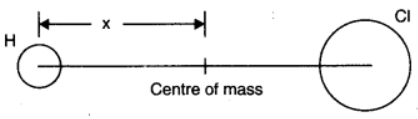
$$\text{Mass of H atom} = m$$
$$\text{Mass of Cl atom} = 35.5m$$
Let the centre of mass of the system lie at a distance $x$ from the Cl atom.
Distance of the centre of mass from the H atom $= (1.27 – x)$
Let us assume that the centre of mass of the given molecule lies at the origin. Therefore, we can have:
$$\frac{m(1.27 – x) + 35.5mx}{m + 35.5m} = 0$$
$$m(1.27 – x) + 35.5mx = 0$$
$$1.27 – x = -35.5x$$
$$\therefore x = \frac{-1.27}{35.5 – 1} = -0.037\text{ \AA}$$
Here, the negative sign indicates that the centre of mass lies at the left of the molecule. Hence, the centre of mass of the $\text{HCl}$ molecule lies $0.037\text{ \AA}$ from the Cl atom.
Question 6.3.
A child sits stationary at one end of a long trolley moving uniformly with a speed $V$ on a smooth horizontal floor. If the child gets up and runs about on the trolley in any manner, what is the speed of the CM of the (trolley + child) system?
Solution :
The child is running arbitrarily on a trolley moving with velocity $v$. However, the running of the child will produce no effect on the velocity of the centre of mass of the trolley. This is because the force due to the boy’s motion is purely internal. Internal forces produce no effect on the motion of the bodies on which they act. Since no external force is involved in the boy–trolley system, the boy’s motion will produce no change in the velocity of the centre of mass of the trolley.
Question 6.4.
Show that the area of the triangle contained between the vectors $a$ and $b$ is one half of the magnitude of $a \times b$.
Solution :
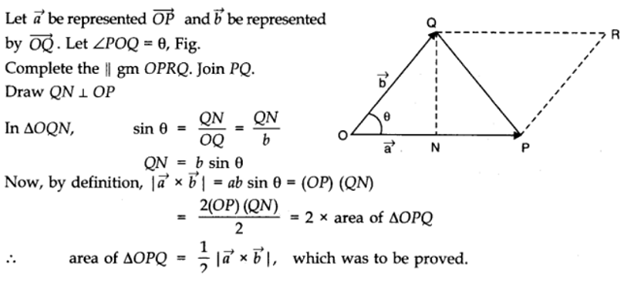
Consider two vectors $\vec{OK} = \vec{a}$ and $\vec{OM} = \vec{b}$, inclined at an angle $\theta$, as shown in the following figure.
Question 6.5.
Show that $a \cdot (b \times c)$ is equal in magnitude to the volume of the parallelepiped formed on the three vectors, $a$, $b$ and $c$.
Solution :
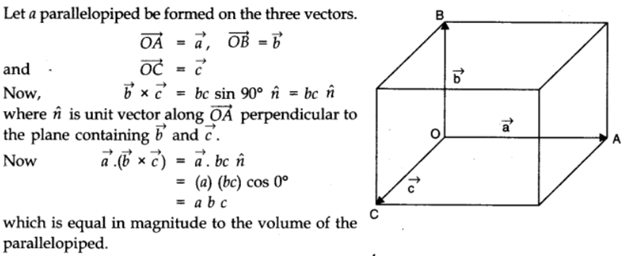
A parallelepiped with origin $O$ and sides $a$, $b$, and $c$ is shown in the following figure.
Question 6.6.
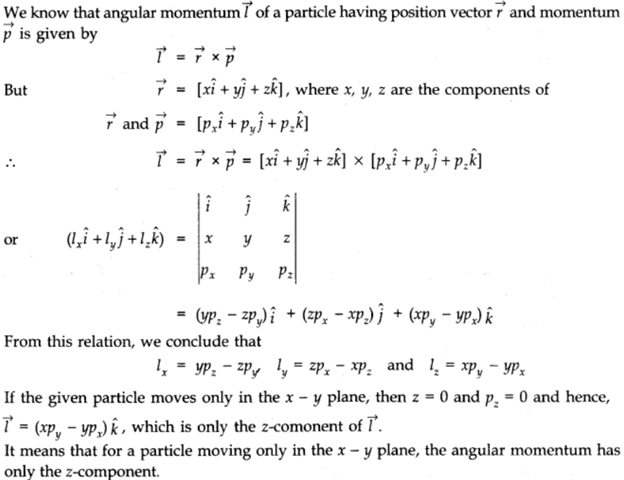
Find the components along the $x, y, z$ axes of the angular momentum $l$ of a particle, whose position vector is $r$ with components $x, y, z$ and momentum is $p$ with components $p_x, p_y$ and $p_z$. Show that if the particle moves only in the $x\text{-}y$ plane the angular momentum has only a $z$-component.
Solution :
$$\vec{l} = \vec{r} \times \vec{p} = (y p_z – z p_y)\hat{i} + (z p_x – x p_z)\hat{j} + (x p_y – y p_x)\hat{k}$$
Components along axes:
$$l_x = y p_z – z p_y, \quad l_y = z p_x – x p_z, \quad l_z = x p_y – y p_x$$
If the particle moves only in the $x\text{-}y$ plane, then $z = 0$ and $p_z = 0$. Consequently, $l_x = 0$ and $l_y = 0$, leaving only the $z$-component ($l_z = x p_y – y p_x$).
Question 6.7.
Two particles, each of mass $m$ and speed $v$, travel in opposite directions along parallel lines separated by a distance $d$. Show that the vector angular momentum of the two particle system is the same whatever be the point about which the angular momentum is taken.
Solution :
Let at a certain instant two particles be at points P and Q, as shown in the following figure.
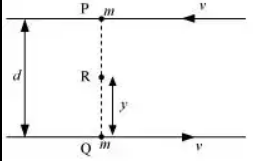
Angular momentum of the system about point P:
$$L_P = mv \times 0 + mv \times d = mvd \quad \dots\text{(i)}$$
Angular momentum of the system about point Q:
$$L_Q = mv \times d + mv \times 0 = mvd \quad \dots\text{(ii)}$$
Consider a point R, which is at a distance $y$ from point Q, i.e.,
$$\text{QR} = y$$
$$\therefore \text{PR} = d – y$$
Angular momentum of the system about point R:
$$L_R = mv \times (d – y) + mv \times y = mvd – mvy + mvy = mvd \quad \dots\text{(iii)}$$
Comparing equations (i), (ii), and (iii), we get:
$$L_P = L_Q = L_R \quad \dots\text{(iv)}$$
We infer from equation (iv) that the angular momentum of a system does not depend on the point about which it is taken.
Question 6.8.
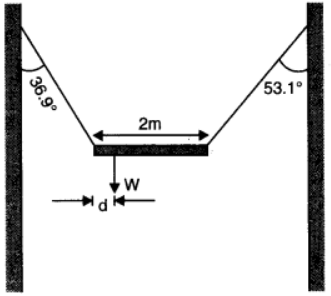
A non-uniform bar of weight $W$ is suspended at rest by two strings of negligible weight as shown in Fig.7.39. The angles made by the strings with the vertical are $36.9^\circ$ and $53.1^\circ$ respectively. The bar is $2\text{ m}$ long. Calculate the distance $d$ of the centre of gravity of the bar from its left end.
Solution :
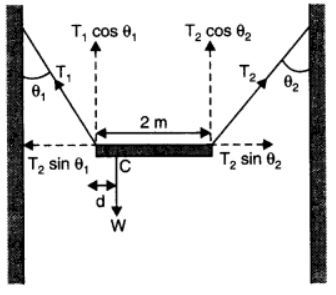
The free body diagram of the bar is shown in the following figure.
Length of the bar, $l = 2\text{ m}$
$T_1$ and $T_2$ are the tensions produced in the left and right strings respectively.
At translational equilibrium, we have:
$$T_1 \sin(36.9^\circ) = T_2 \sin(53.1^\circ)$$
$$\frac{T_1}{T_2} = \frac{4}{3} \implies T_1 = \left(\frac{4}{3}\right)T_2$$
For rotational equilibrium, on taking the torque about the centre of gravity, we have:
$$T_1 \cos(36.9^\circ) \times d = T_2 \cos(53.1^\circ) (2 – d)$$
$$T_1 \times 0.800d = T_2 \times 0.600(2 – d)$$
$$\left(\frac{4}{3}\right) \times T_2 \times 0.800d = T_2 (0.600 \times 2 – 0.600d)$$
$$1.067d + 0.6d = 1.2$$
$$\therefore d = \frac{1.2}{1.67} = 0.72\text{ m}$$
Hence, the C.G. (centre of gravity) of the given bar lies $0.72\text{ m}$ from its left end.
Question 6.9.
A car weighs $1800\text{ kg}$. The distance between its front and back axles is $1.8\text{ m}$. Its centre of gravity is $1.05\text{ m}$ behind the front axle. Determine the force exerted by the level ground on each front wheel and each back wheel.
Solution :
Mass of the car, $m = 1800\text{ kg}$
Distance between the front and back axles, $d = 1.8\text{ m}$
Distance between the C.G. (centre of gravity) and the back axle $= 1.05\text{ m}$
The various forces acting on the car are shown in the following figure.
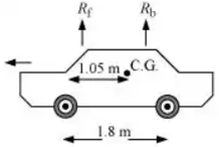
$R_f$ and $R_b$ are the forces exerted by the level ground on the front and back wheels respectively.
At translational equilibrium:
$$R_f + R_b = mg = 1800 \times 9.8 = 17640\text{ N} \quad \dots\text{(i)}$$
For rotational equilibrium, on taking the torque about the C.G., we have:
$$R_f(1.05) = R_b(1.8 – 1.05)$$
$$\frac{R_b}{R_f} = \frac{7}{5} \implies R_b = 1.4R_f \quad \dots\text{(ii)}$$
Solving equations (i) and (ii), we get:
$$1.4R_f + R_f = 17640 \implies R_f = 7350\text{ N}$$
$$\therefore R_b = 17640 – 7350 = 10290\text{ N}$$
Therefore, the force exerted on each front wheel $= \frac{7350}{2} = 3675\text{ N}$, and
The force exerted on each back wheel $= \frac{10290}{2} = 5145\text{ N}$.
Question 6.10.
Torques of equal magnitude are applied to a hollow cylinder and a solid sphere, both having the same mass and radius. The cylinder is free to rotate about its standard axis of symmetry, and the sphere is free to rotate about an axis passing through its centre. Which of the two will acquire a greater angular speed after a given time?
Solution :
Let $m$ and $r$ be the respective masses of the hollow cylinder and the solid sphere.
The moment of inertia of the hollow cylinder about its standard axis, $I_1 = mr^2$
The moment of inertia of the solid sphere about an axis passing through its centre, $I_2 = \left(\frac{2}{5}\right)mr^2$
We have the relation:
$$\tau = I\alpha$$
Where,
$\alpha = \text{Angular acceleration}$
$\tau = \text{Torque}$
$I = \text{Moment of inertia}$
For the hollow cylinder, $\tau_1 = I_1 \alpha_1$
For the solid sphere, $\tau_2 = I_2 \alpha_2$
As an equal torque is applied to both the bodies, $\tau_1 = \tau_2$
$$\therefore \frac{\alpha_2}{\alpha_1} = \frac{I_1}{I_2} = \frac{mr^2}{\left(\frac{2}{5}\right)mr^2}$$
$$\alpha_2 > \alpha_1 \quad \dots\text{(i)}$$
Now, using the relation:
$$\omega = \omega_0 + \alpha t$$
Where,
$\omega_0 = \text{Initial angular velocity}$
$t = \text{Time of rotation}$
$\omega = \text{Final angular velocity}$
For equal $\omega_0$ and $t$, we have:
$$\omega \propto \alpha \quad \dots\text{(ii)}$$
From equations (i) and (ii), we can write:
$$\omega_2 > \omega_1$$
Hence, the angular velocity of the solid sphere will be greater than that of the hollow cylinder.
Question 6.11.
A solid cylinder of mass $20\text{ kg}$ rotates about its axis with angular speed $100\text{ rad s}^{-1}$. The radius of the cylinder is $0.25\text{ m}$. What is the kinetic energy associated with the rotation of the cylinder? What is the magnitude of angular momentum of the cylinder about its axis?
Solution :
Mass of the cylinder, $m = 20\text{ kg}$
Angular speed, $\omega = 100\text{ rad s}^{-1}$
Radius of the cylinder, $r = 0.25\text{ m}$
The moment of inertia of the solid cylinder:
$$I = \frac{mr^2}{2} = \left(\frac{1}{2}\right) \times 20 \times (0.25)^2 = 0.625\text{ kg m}^2$$
$$\therefore \text{Kinetic energy} = \left(\frac{1}{2}\right)I\omega^2 = \left(\frac{1}{2}\right) \times 6.25 \times (100)^2 = 3125\text{ J}$$
$$\therefore \text{Angular momentum, } L = I\omega = 6.25 \times 100 = 62.5\text{ Js}$$
Question 6.12.
a. A child stands at the centre of a turntable with his two arms outstretched. The turntable is set rotating with an angular speed of $40\text{ rev/min}$. How much is the angular speed of the child if he folds his hands back and thereby reduces his moment of inertia to $2/5$ times the initial value? Assume that the turntable rotates without friction.
b. Show that the child’s new kinetic energy of rotation is more than the initial kinetic energy of rotation. How do you account for this increase in kinetic energy?
Solution :
a. $100\text{ rev/min}$
Initial angular velocity, $\omega_1 = 40\text{ rev/min}$
Final angular velocity $= \omega_2$
The moment of inertia of the boy with stretched hands $= I_1$
The moment of inertia of the boy with folded hands $= I_2$
The two moments of inertia are related as:
$$I_2 = \left(\frac{2}{5}\right)I_1$$
Since no external force acts on the boy, the angular momentum $L$ is a constant. Hence, for the two situations, we can write:
$$I_2 \omega_2 = I_1 \omega_1$$
$$\omega_2 = \left(\frac{I_1}{I_2}\right)\omega_1 = \left[\frac{I_1}{\left(\frac{2}{5}\right)I_1}\right] \times 40 = \left(\frac{5}{2}\right) \times 40 = 100\text{ rev/min}$$
b. Final K.E. $= 2.5\text{ Initial K.E.}$
Final kinetic rotation, $E_F = \left(\frac{1}{2}\right)I_2 \omega_2^2$
Initial kinetic rotation, $E_I = \left(\frac{1}{2}\right)I_1 \omega_1^2$
$$\frac{E_F}{E_I} = \frac{\left(\frac{1}{2}\right)I_2 \omega_2^2}{\left(\frac{1}{2}\right)I_1 \omega_1^2} = \frac{\left(\frac{2}{5}\right)I_1 (100)^2}{I_1 (40)^2} = 2.5$$
$$\therefore E_F = 2.5 E_1$$
The increase in the rotational kinetic energy is attributed to the internal energy of the boy.
Question 6.13.
A rope of negligible mass is wound round a hollow cylinder of mass $3\text{ kg}$ and radius $40\text{ cm}$. What is the angular acceleration of the cylinder if the rope is pulled with a force of $30\text{ N}$? What is the linear acceleration of the rope? Assume that there is no slipping.
Solution :
Mass of the hollow cylinder, $m = 3\text{ kg}$
Radius of the hollow cylinder, $r = 40\text{ cm} = 0.4\text{ m}$
Applied force, $F = 30\text{ N}$
The moment of inertia of the hollow cylinder about its geometric axis:
$$I = mr^2 = 3 \times (0.4)^2 = 0.48\text{ kg m}^2$$
Torque, $\tau = F \times r = 30 \times 0.4 = 12\text{ Nm}$
For angular acceleration $\alpha$, torque is also given by the relation:
$$\tau = I\alpha$$
$$\alpha = \frac{\tau}{I} = \frac{12}{0.48} = 25\text{ rad s}^{-2}$$
$$\text{Linear acceleration} = r\alpha = 0.4 \times 25 = 10\text{ m s}^{-2}$$
Question 6.14.
To maintain a rotor at a uniform angular speed of $200\text{ rad s}^{-1}$, an engine needs to transmit a torque of $180\text{ Nm}$. What is the power required by the engine?
(Note: uniform angular velocity in the absence of friction implies zero torque. In practice, applied torque is needed to counter frictional torque). Assume that the engine is $100\%$ efficient.
Solution :
Angular speed of the rotor, $\omega = 200\text{ rad/s}$
Torque required, $\tau = 180\text{ Nm}$
The power of the rotor ($P$) is related to torque and angular speed by the relation:
$$P = \tau\omega = 180 \times 200 = 36 \times 10^3 = 36\text{ kW}$$
Hence, the power required by the engine is $36\text{ kW}$.
Question 6.15.
From a uniform disk of radius $R$, a circular hole of radius $R/2$ is cut out. The centre of the hole is at $R/2$ from the centre of the original disc. Locate the centre of gravity of the resulting flat body.
Solution :
$R/6$; from the original centre of the body and opposite to the centre of the cut portion.
Mass per unit area of the original disc $= \sigma$
Radius of the original disc $= R$
Mass of the original disc, $M = \pi R^2 \sigma$
The disc with the cut portion is shown in the following figure:
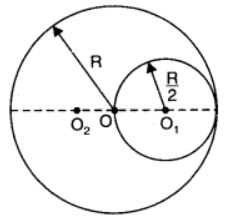
Radius of the smaller disc $= R/2$
Mass of the smaller disc, $M’ = \pi (R/2)^2 \sigma = \frac{\pi R^2 \sigma}{4} = \frac{M}{4}$
Let $O$ and $O’$ be the respective centres of the original disc and the disc cut off from the original. As per the definition of the centre of mass, the centre of mass of the original disc is supposed to be concentrated at $O$, while that of the smaller disc is supposed to be concentrated at $O’$.
It is given that:
$$OO’ = \frac{R}{2}$$
After the smaller disc has been cut from the original, the remaining portion is considered to be a system of two masses. The two masses are:
$M$ (concentrated at $O$), and $-M’ \left(= -\frac{M}{4}\right)$ concentrated at $O’$
(The negative sign indicates that this portion has been removed from the original disc.)
Let $x$ be the distance through which the centre of mass of the remaining portion shifts from point $O$.
The relation between the centres of masses of two masses is given as:
$$x = \frac{m_1 r_1 + m_2 r_2}{m_1 + m_2}$$
For the given system, we can write:
$$x = \frac{M \times 0 – M’ \times \left(\frac{R}{2}\right)}{M + (-M’)} = -\frac{R}{6}$$
(The negative sign indicates that the centre of mass gets shifted toward the left of point $O$.)
Question 6.16.
A metre stick is balanced on a knife edge at its centre. When two coins, each of mass $5\text{ g}$ are put one on top of the other at the $12.0\text{ cm}$ mark, the stick is found to be balanced at $45.0\text{ cm}$. What is the mass of the metre stick?
Solution :
Let $W$ and $W’$ be the respective weights of the metre stick and the coin.
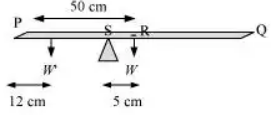
The mass of the metre stick is concentrated at its mid-point, i.e., at the $50\text{ cm}$ mark. Mass of the meter stick $= m’$
Mass of each coin, $m = 5\text{ g}$
When the coins are placed $12\text{ cm}$ away from the end P, the centre of mass gets shifted by $5\text{ cm}$ from point R toward the end P. The centre of mass is located at a distance of $45\text{ cm}$ from point P.
The net torque will be conserved for rotational equilibrium about point R:
$$10 \times g(45 – 12) – m’g(50 – 45) = 0$$
$$\therefore m’ = 66\text{ g}$$
Hence, the mass of the metre stick is $66\text{ g}$.
Question 6.17.
The oxygen molecule has a mass of $5.30 \times 10^{-26}\text{ kg}$ and a moment of inertia of $1.94 \times 10^{-46}\text{ kg m}^2$ about an axis through its centre perpendicular to the lines joining the two atoms. Suppose the mean speed of such a molecule in a gas is $500\text{ m/s}$ and that its kinetic energy of rotation is two thirds of its kinetic energy of translation. Find the average angular velocity of the molecule.
Solution :
Mass of an oxygen molecule, $m = 5.30 \times 10^{-26}\text{ kg}$
Moment of inertia, $I = 1.94 \times 10^{-46}\text{ kg m}^2$
Velocity of the oxygen molecule, $v = 500\text{ m/s}$
The separation between the two atoms of the oxygen molecule $= 2r$
Mass of each oxygen atom $= m/2$
Hence, moment of inertia $I$, is calculated as:
$$\left(\frac{m}{2}\right)r^2 + \left(\frac{m}{2}\right)r^2 = mr^2$$
$$r = \left(\frac{I}{m}\right)^{1/2} = \left(\frac{1.94 \times 10^{-46}}{5.30 \times 10^{-26}}\right)^{1/2} \approx 6.05 \times 10^{-11}\text{ m}$$
It is given that:
$$KE_{\text{rot}} = \left(\frac{2}{3}\right)KE_{\text{trans}}$$
$$\left(\frac{1}{2}\right)I\omega^2 = \left(\frac{2}{3}\right) \times \left(\frac{1}{2}\right)mv^2$$
$$mr^2 \omega^2 = \left(\frac{2}{3}\right)mv^2$$
$$\omega = \left(\frac{2}{3}\right)^{1/2} \left(\frac{v}{r}\right) = \left(\frac{2}{3}\right)^{1/2} \left(\frac{500}{6.05 \times 10^{-11}}\right) \approx 6.75 \times 10^{12}\text{ rad/s}$$
Additional Question 1
A solid sphere rolls down two different inclined planes of the same heights but different angles of inclination.
(a) Will it reach the bottom with the same speed in each case?
(b) Will it take longer to roll down one plane than the other?
(c) If so, which one and why?
Solution :
(a) Mass of the sphere $= m$
Height of the plane $= h$
Velocity of the sphere at the bottom of the plane $= v$
At the top of the plane, the total energy of the sphere = Potential energy $= mgh$
At the bottom of the plane, the sphere has both translational and rotational kinetic energies.
Hence, total energy $= \left(\frac{1}{2}\right)mv^2 + \left(\frac{1}{2}\right)I\omega^2$
Using the law of conservation of energy, we can write:
$$\left(\frac{1}{2}\right)mv^2 + \left(\frac{1}{2}\right)I\omega^2 = mgh \quad \dots\text{(i)}$$
For a solid sphere, the moment of inertia about its centre, $I = \left(\frac{2}{5}\right)mr^2$
Hence, equation (i) becomes:
$$\left(\frac{1}{2}\right)mv^2 + \left(\frac{1}{2}\right)\left[\left(\frac{2}{5}\right)mr^2\right]\omega^2 = mgh$$
$$\left(\frac{1}{2}\right)v^2 + \left(\frac{1}{5}\right)r^2\omega^2 = gh$$
But we have the relation, $v = r\omega$:
$$\therefore \left(\frac{1}{2}\right)v^2 + \left(\frac{1}{5}\right)v^2 = gh \implies v^2\left(\frac{7}{10}\right) = gh \implies v = \sqrt{\frac{10}{7}gh}$$
Hence, the velocity of the sphere at the bottom depends only on height ($h$) and acceleration due to gravity ($g$). Both these values are constants. Therefore, the velocity at the bottom remains the same from whichever inclined plane the sphere is rolled.
(b) Consider two inclined planes with inclinations $\theta_1$ and $\theta_2$, related as:
$$\theta_1 < \theta_2$$
The acceleration produced in the sphere when it rolls down the plane inclined at $\theta_1$ is:
$$g \sin\theta_1$$
The various forces acting on the sphere are shown in the following figure.
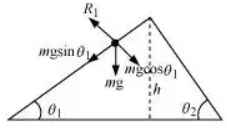
$R_1$ is the normal reaction to the sphere. Similarly, the acceleration produced in the sphere when it rolls down the plane inclined at $\theta_2$ is:
$$g \sin\theta_2$$
$R_2$ is the normal reaction to the sphere.
$$\theta_2 > \theta_1 \implies \sin\theta_2 > \sin\theta_1 \quad \dots\text{(i)}$$
$$\therefore a_2 > a_1 \quad \dots\text{(ii)}$$
Initial velocity, $u = 0$
Final velocity, $v = \text{Constant}$
Using the first equation of motion, we can obtain the time of roll as:
$$v = u + at \implies t \propto \left(\frac{1}{a}\right)$$
For inclination $\theta_1$: $t_1 \propto \left(\frac{1}{a_1}\right)$
For inclination $\theta_2$: $t_2 \propto \left(\frac{1}{a_2}\right)$
From above equations, we get:
$$t_2 < t_1$$
Hence, the sphere will take a longer time to reach the bottom of the inclined plane having the smaller inclination.
Additional Question 2
A hoop of radius $2\text{ m}$ weighs $100\text{ kg}$. It rolls along a horizontal floor so that its centre of mass has a speed of $20\text{ cm/s}$. How much work has to be done to stop it?
Solution :
Radius of the hoop, $r = 2\text{ m}$
Mass of the hoop, $m = 100\text{ kg}$
Velocity of the hoop, $v = 20\text{ cm/s} = 0.2\text{ m/s}$
Total energy of the hoop $=$ Translational K.E. + Rotational K.E.
$$E_T = \left(\frac{1}{2}\right)mv^2 + \left(\frac{1}{2}\right)I\omega^2$$
Moment of inertia of the hoop about its centre, $I = mr^2$:
$$E_T = \left(\frac{1}{2}\right)mv^2 + \left(\frac{1}{2}\right)(mr^2)\omega^2$$
But we have the relation, $v = r\omega$:
$$\therefore E_T = \left(\frac{1}{2}\right)mv^2 + \left(\frac{1}{2}\right)mv^2 = mv^2$$
The work required to be done for stopping the hoop is equal to the total energy of the hoop.
$$\therefore \text{Required work to be done, } W = mv^2 = 100 \times (0.2)^2 = 4\text{ J}.$$
Additional Question 3
a. Find the moment of inertia of a sphere about a tangent to the sphere, given the moment of inertia of the sphere about any of its diameters to be $2MR^2/5$, where $M$ is the mass of the sphere and $R$ is the radius of the sphere.
b. Given the moment of inertia of a disc of mass $M$ and radius $R$ about any of its diameters to be $MR^2/4$, find its moment of inertia about an axis normal to the disc and passing through a point on its edge.
Solution :
a. The moment of inertia (M.I.) of a sphere about its diameter $= \frac{2MR^2}{5}$
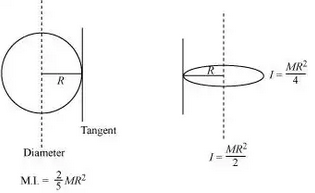
According to the theorem of parallel axes, the moment of inertia of a body about any axis is equal to the sum of the moment of inertia of the body about a parallel axis passing through its centre of mass and the product of its mass and the square of the distance between the two parallel axes.
The M.I. about a tangent of the sphere:
$$= \frac{2MR^2}{5} + MR^2 = \frac{7MR^2}{5}$$
b. The moment of inertia of a disc about its diameter $= \frac{MR^2}{4}$
According to the theorem of perpendicular axes, the moment of inertia of a planar body (lamina) about an axis perpendicular to its plane is equal to the sum of its moments of inertia about two perpendicular axes concurrent with perpendicular axis and lying in the plane of the body.
The M.I. of the disc about its centre $= \frac{MR^2}{4} + \frac{MR^2}{4} = \frac{MR^2}{2}$
Applying the theorem of parallel axes:
The moment of inertia about an axis normal to the disc and passing through a point on its edge:
$$= \frac{MR^2}{2} + MR^2 = \frac{3MR^2}{2}$$
Additional Question 4
A solid cylinder rolls up an inclined plane of angle of inclination $30^\circ$. At the bottom of the inclined plane the centre of mass of the cylinder has a speed of $5\text{ m/s}$.
a. How far will the cylinder go up the plane?
b. How long will it take to return to the bottom?
Solution :
Given,
initial velocity of the solid cylinder, $v = 5\text{ m/s}$
Angle of inclination, $\theta = 30^\circ$
Assuming that the cylinder goes up to a height of $h$. We get:
$$\left(\frac{1}{2}\right)mv^2 + \left(\frac{1}{2}\right)I\omega^2 = mgh$$
$$\left(\frac{1}{2}\right)mv^2 + \left(\frac{1}{2}\right)\left(\frac{1}{2}mr^2\right)\omega^2 = mgh$$
$$\frac{3}{4}mv^2 = mgh \quad (\text{since } v = r\omega)$$
$$h = \frac{3v^2}{4g} = \frac{3 \times 5^2}{4 \times 9.8} = \frac{75}{39.2} \approx 1.913\text{ m}$$
Let $d$ be the distance the cylinder covers up the plane, this means:
$$\sin\theta = \frac{h}{d}$$
$$d = \frac{h}{\sin\theta} = \frac{1.913}{\sin(30^\circ)} \approx 3.826\text{ m}$$
Now, the time required to return back:
$$t = \sqrt{\frac{2d}{a_{\text{down}}}}$$
Thus, the cylinder takes $1.53\text{ s}$ to return to the bottom.
Additional Question 5
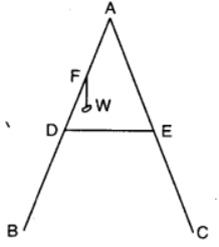
As shown in Fig.7.40, the two sides of a step ladder BA and CA are $1.6\text{ m}$ long and hinged at A. A rope DE, $0.5\text{ m}$ is tied half way up. A weight $40\text{ kg}$ is suspended from a point F, $1.2\text{ m}$ from B along the ladder BA. Assuming the floor to be frictionless and neglecting the weight of the ladder, find the tension in the rope and forces exerted by the floor on the ladder. (Take $g = 9.8\text{ m/s}^2$) (Hint: Consider the equilibrium of each side of the ladder separately.)
Solution :
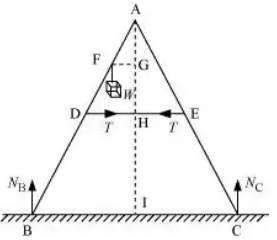
$N_B = \text{Force exerted on the ladder by the floor point B}$
$N_C = \text{Force exerted on the ladder by the floor point C}$
$T = \text{Tension in the rope}$
$\text{BA} = \text{CA} = 1.6\text{ m}, \quad \text{DE} = 0.5\text{ m}, \quad \text{BF} = 1.2\text{ m}$
Mass of the weight, $m = 40\text{ kg}$
Draw a perpendicular from A on the floor BC. This intersects DE at mid-point H.
$\Delta ABI$ and $\Delta AIC$ are similar $\implies \text{BI} = \text{IC}$. Hence, I is the mid-point of BC.
$\text{DE} \parallel \text{BC} \implies \text{BC} = 2 \times \text{DE} = 1\text{ m}$
$$\text{AF} = \text{BA} – \text{BF} = 0.4\text{ m} \quad \dots\text{(i)}$$
D is the mid-point of AB. Hence, we can write:
$$\text{AD} = \left(\frac{1}{2}\right) \times \text{BA} = 0.8\text{ m} \quad \dots\text{(ii)}$$
Using equations (i) and (ii), we get:
$$\text{FE} = 0.4\text{ m}$$
Hence, F is the mid-point of AD.
$\text{FG} \parallel \text{DH}$ and F is the mid-point of AD. Hence, G will also be the mid-point of AH.
$\Delta AFG$ and $\Delta ADH$ are similar:
$$\frac{\text{FG}}{\text{DH}} = \frac{\text{AF}}{\text{AD}} = \frac{0.4}{0.8} = \frac{1}{2} \implies \text{FG} = \left(\frac{1}{2}\right)\text{DH} = \left(\frac{1}{2}\right) \times 0.25 = 0.125\text{ m}$$
In $\Delta ADH$:
$$\text{AH} = (\text{AD}^2 – \text{DH}^2)^{1/2} = (0.8^2 – 0.25^2)^{1/2} \approx 0.76\text{ m}$$
For translational equilibrium of the ladder, the upward force should be equal to the downward force:
$$N_c + N_B = mg = 392 \quad \dots\text{(iii)}$$
For rotational equilibrium of the ladder, the net moment about A is:
$$-N_B \times \text{BI} + mg \times \text{FG} + N_C \times \text{CI} + T \times \text{AG} – T \times \text{AG} = 0$$
$$-N_B \times 0.5 + 40 \times 9.8 \times 0.125 + N_C \times 0.5 = 0$$
$$(N_C – N_B) \times 0.5 = 49 \implies N_C – N_B = 98 \quad \dots\text{(iv)}$$
Adding equations (iii) and (iv), we get:
$$N_C = 245\text{ N}, \quad N_B = 147\text{ N}$$
For rotational equilibrium of the side AB, consider the moment about A:
$$-N_B \times \text{BI} + mg \times \text{FG} + T \times \text{AG} = 0$$
$$-245 \times 0.5 + 40 \times 9.8 \times 0.125 + T \times 0.76 = 0 \implies T = 96.7\text{ N}.$$
Additional Question 6
A man stands on a rotating platform, with his arms stretched horizontally holding a $5\text{ kg}$ weight in each hand. The angular speed of the platform is $30\text{ revolutions per minute}$. The man then brings his arms close to his body with the distance of each weight from the axis changing from $90\text{ cm}$ to $20\text{ cm}$. The moment of inertia of the man together with the platform may be taken to be constant and equal to $7.6\text{ kg m}^2$.
(a) What is his new angular speed? (Neglect friction.)
(b) Is kinetic energy conserved in the process? If not, from where does the change come about?
Solution :
(a) Moment of inertia of the man-platform system $= 7.6\text{ kg m}^2$
Moment of inertia when the man stretches his hands to a distance of $90\text{ cm}$:
$$2 \times m r^2 = 2 \times 5 \times (0.9)^2 = 8.1\text{ kg m}^2$$
Initial moment of inertia of the system, $I_i = 7.6 + 8.1 = 15.7\text{ kg m}^2$
Angular speed, $\omega_i = 30\text{ rev/min}$
Angular momentum, $L_i = I_i \omega_i = 15.7 \times 30 \quad \dots\text{(i)}$
Moment of inertia when the man folds his hands to a distance of $20\text{ cm}$:
$$2 \times mr^2 = 2 \times 5 \times (0.2)^2 = 0.4\text{ kg m}^2$$
Final moment of inertia, $I_f = 7.6 + 0.4 = 8\text{ kg m}^2$
Final angular speed $= \omega_f$
Final angular momentum, $L_f = I_f \omega_f = 8 \omega_f \quad \dots\text{(ii)}$
From the conservation of angular momentum, we have:
$$I_i \omega_i = I_f \omega_f \implies \omega_f = \frac{15.7 \times 30}{8} \approx 58.88\text{ rev/min}$$
(b) Kinetic energy is not conserved in the given process. In fact, with the decrease in the moment of inertia, kinetic energy increases. The additional kinetic energy comes from the work done by the man to fold his hands toward himself.
Additional Question 7
A bullet of mass $10\text{ g}$ and speed $500\text{ m/s}$ is fired into a door and gets embedded exactly at the centre of the door. The door is $1.0\text{ m}$ wide and weighs $12\text{ kg}$. It is hinged at one end and rotates about a vertical axis practically without friction. Find the angular speed of the door just after the bullet embeds into it.
(Hint: The moment of inertia of the door about the vertical axis at one end is $ML^2/3$.)
Solution :
Mass of the bullet, $m = 10\text{ g} = 10 \times 10^{-3}\text{ kg}$
Velocity of the bullet, $v = 500\text{ m/s}$
Thickness/width of the door, $L = 1\text{ m}$
Radius of impact (centre of door), $r = L/2 = 0.5\text{ m}$
Mass of the door, $M = 12\text{ kg}$
Angular momentum imparted by the bullet on the door:
$$\alpha = mvr = (10 \times 10^{-3}) \times 500 \times 0.5 = 2.5\text{ kg m}^2\text{ s}^{-1} \quad \dots\text{(i)}$$
Moment of inertia of the door:
$$I = \frac{ML^2}{3} = \left(\frac{1}{3}\right) \times 12 \times 1^2 = 4\text{ kg m}^2$$
But $\alpha = I\omega$:
$$\therefore \omega = \frac{\alpha}{I} = \frac{2.5}{4} = 0.625\text{ rad s}^{-1}$$
Additional Question 8
Two discs of moments of inertia $I_1$ and $I_2$ about their respective axes (normal to the disc and passing through the centre), and rotating with angular speeds $\omega_1$ and $\omega_2$ are brought into contact face to face with their axes of rotation coincident.
a. What is the angular speed of the two-disc system?
b. Show that the kinetic energy of the combined system is less than the sum of the initial kinetic energies of the two discs. How do you account for this loss in energy? Take $\omega_1 \neq \omega_2$.
Solution :
a. Moment of inertia of disc I $= I_1$, Angular speed $= \omega_1$
Moment of inertia of disc II $= I_2$, Angular speed $= \omega_2$
Angular momentum of disc I, $L_1 = I_1 \omega_1$
Angular momentum of disc II, $L_2 = I_2 \omega_2$
Total initial angular momentum $L_i = I_1 \omega_1 + I_2 \omega_2$
When the two discs are joined together, their moments of inertia get added up: $I = I_1 + I_2$. Let $\omega$ be the angular speed.
Using the law of conservation of angular momentum:
$$I_1 \omega_1 + I_2 \omega_2 = (I_1 + I_2)\omega \implies \omega = \frac{I_1 \omega_1 + I_2 \omega_2}{I_1 + I_2}$$
b. Total initial kinetic energy $E_i = \frac{1}{2}I_1\omega_1^2 + \frac{1}{2}I_2\omega_2^2$
Final kinetic energy $E_f = \frac{1}{2}(I_1 + I_2)\omega^2 = \frac{1}{2}\frac{(I_1\omega_1 + I_2\omega_2)^2}{I_1 + I_2}$
$$\therefore E_i – E_f = \frac{I_1 I_2 (\omega_1 – \omega_2)^2}{2(I_1 + I_2)} > 0 \implies E_i > E_f$$
The loss of K.E. can be attributed to the frictional force that comes into play when the two discs come in contact with each other.
Additional Question 9
a. Prove the theorem of perpendicular axes.
(Hint: Square of the distance of a point (x, y) in the x–y plane from an axis through the origin perpendicular to the plane is $x^2 + y^2$).
b. Prove the theorem of parallel axes.
(Hint: If the centre of mass is chosen to be the origin $\sum m_i r_i = 0$).
Solution :
a. The theorem of perpendicular axes states that the moment of inertia of a planar body (lamina) about an axis perpendicular to its plane is equal to the sum of its moments of inertia about two perpendicular axes concurrent with perpendicular axis and lying in the plane of the body.
A physical body with centre O and a point mass m,in the x–y plane at (x, y) is shown in the following figure.
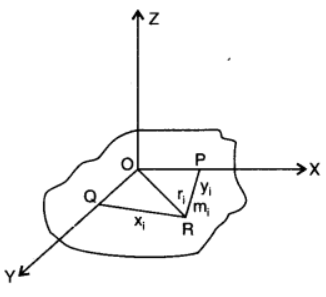
Moment of inertia about $x$-axis, $I_x = mx^2$
Moment of inertia about $y$-axis, $I_y = my^2$
Moment of inertia about $z$-axis, $I_z = m(x^2 + y^2)$
$$I_x + I_y = mx^2 + my^2 = m(x^2 + y^2) = I_z$$
Hence, the theorem is proved.
b. The theorem of parallel axes states that the moment of inertia of a body about any axis is equal to the sum of the moment of inertia of the body about a parallel axis passing through its centre of mass and the product of its mass and the square of the distance between the two parallel axes.
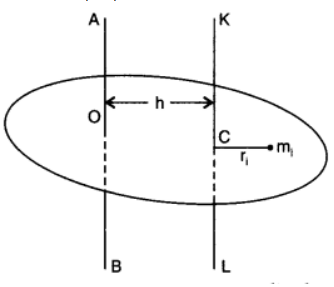
$$I = I_{\text{cm}} + Md^2$$
(Derived by summing moments about the centre of mass where $\sum m_i \vec{r}_i = 0$).
Additional Question 10
Prove the result that the velocity $v$ of translation of a rolling body (like a ring, disc, cylinder or sphere) at the bottom of an inclined plane of a height $h$ is given by $v^2 = \frac{2gh}{1 + (k^2/R^2)}$
Using dynamical consideration (i.e. by consideration of forces and torques). Note $k$ is the radius of gyration of the body about its symmetry axis, and $R$ is the radius of the body. The body starts from rest at the top of the plane.
Solution :
A body rolling on an inclined plane of height h,is shown in the following figure:
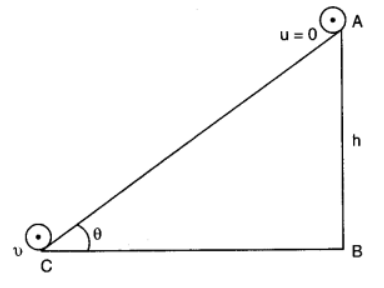
m = Mass of the body
R = Radius of the body
K = Radius of gyration of the body
v = Translational velocity of the body
h =Height of the inclined plane
g = Acceleration due to gravity
Total energy at the top of the plane, $E_1 = mgh$
Total energy at the bottom of the plane, $E_b = KE_{\text{rot}} + KE_{\text{trans}} = \left(\frac{1}{2}\right)I\omega^2 + \left(\frac{1}{2}\right)mv^2$
Since $I = mk^2$ and $\omega = \frac{v}{R}$:
$$E_b = \left(\frac{1}{2}\right)(mk^2)\left(\frac{v^2}{R^2}\right) + \left(\frac{1}{2}\right)mv^2 = \left(\frac{1}{2}\right)mv^2\left(1 + \frac{k^2}{R^2}\right)$$
From the law of conservation of energy ($E_1 = E_b$):
$$mgh = \left(\frac{1}{2}\right)mv^2\left(1 + \frac{k^2}{R^2}\right) \implies v^2 = \frac{2gh}{1 + (k^2/R^2)}$$
Hence, the given result is proved.
Additional Question 11
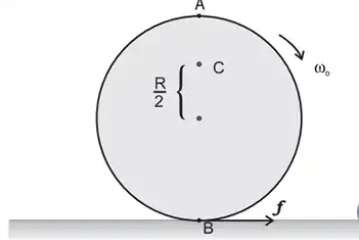
A disc rotating about its axis with angular speed $\omega_0$ is placed lightly (without any translational push) on a perfectly frictionless table. The radius of the disc is $R$. What are the linear velocities of the points A, B and C on the disc shown in Fig. 7.41? Will the disc roll in the direction indicated?
Solution :
$$v_A = R\omega_0; \quad v_B = R\omega_0; \quad v_C = \left(\frac{R}{2}\right)\omega_0$$
The disc will not roll.
Angular speed of the disc $= \omega_0$, Radius $= R$
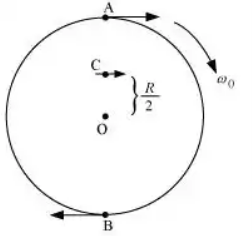
Since the disc is placed on a frictionless table, it will not roll. This is because the presence of friction is essential for the rolling of a body.
Additional Question 12
Explain why friction is necessary to make the disc in Fig. 7.41 roll in the direction indicated.
a. Give the direction of frictional force at B, and the sense of frictional torque, before perfect rolling begins.
b. What is the force of friction after perfect rolling begins?
Solution :
A torque is required to roll the given disc. As per the definition of torque, the rotating force should be tangential to the disc. Since the frictional force at point B is along the tangential force at point A, a frictional force is required for making the disc roll.
a. Force of friction acts opposite to the direction of velocity at point B. The direction of linear velocity at point B is tangentially leftward. Hence, frictional force will act tangentially rightward. The sense of frictional torque before the start of perfect rolling is perpendicular to the plane of the disc in the outward direction.
b. Since frictional force acts opposite to the direction of velocity at point B, perfect rolling will begin when the velocity at that point becomes equal to zero. This will make the frictional force acting on the disc zero.
Additional Question 13
A solid disc and a ring, both of radius $10\text{ cm}$ are placed on a horizontal table simultaneously, with initial angular speed equal to $10\pi\text{ rad s}^{-1}$. Which of the two will start to roll earlier? The co-efficient of kinetic friction is $\mu_k = 0.2$.
Solution :
Radii of the ring and the disc, $r = 10\text{ cm} = 0.1\text{ m}$
Initial angular speed, $\omega_0 = 10\pi\text{ rad s}^{-1}$
Coefficient of kinetic friction, $\mu_k = 0.2$
Initial velocity of both the objects, $u = 0$
For the ring: $t_r = 0.80\text{ s}$
For the disc: $t_d = 0.53\text{ s}$
Since $t_d < t_r$, the disc will start rolling before the ring.
Additional Question 14
A cylinder of mass $10\text{ kg}$ and radius $15\text{ cm}$ is rolling perfectly on a plane of inclination $30^\circ$. The coefficient of static friction $\mu_s = 0.25$.
a. How much is the force of friction acting on the cylinder?
b. What is the work done against friction during rolling?
c. If the inclination $\theta$ of the plane is increased, at what value of $\theta$ does the cylinder begin to skid, and not roll perfectly?
Solution :
Mass of the cylinder, $m = 10\text{ kg}$
Radius of the cylinder, $r = 15\text{ cm} = 0.15\text{ m}$
Co-efficient of kinetic/static friction, $\mu = 0.25$
Angle of inclination, $\theta = 30^\circ$
Moment of inertia of a solid cylinder about its geometric axis, $I = \left(\frac{1}{2}\right)mr^2$
The various forces acting on the cylinder are shown in the following figure:
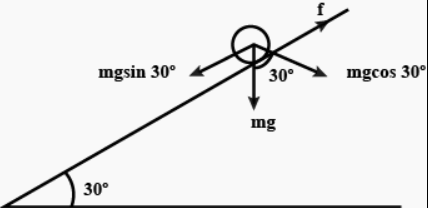
The acceleration of the cylinder is given as:
$$a = \frac{mg \sin\theta}{m + \left(\frac{I}{r^2}\right)} = \frac{mg \sin(30^\circ)}{m + \left(\frac{1}{2}mr^2 / r^2\right)} = \left(\frac{2}{3}\right)g \sin(30^\circ) = \left(\frac{2}{3}\right) \times 9.8 \times 0.5 = 3.27\text{ ms}^{-2}$$
a. Using Newton’s second law of motion, we can write net force as:
$$f_{\text{net}} = ma \implies mg \sin(30^\circ) – f = ma \implies f = mg \sin(30^\circ) – ma$$
$$f = 10 \times 9.8 \times 0.5 – 10 \times 3.27 = 49 – 32.7 = 16.3\text{ N}$$
b. During rolling, the instantaneous point of contact with the plane comes to rest. Hence, the work done against frictional force is zero.
c. For rolling without skid, we have the relation:
$$\mu = \left(\frac{1}{3}\right) \tan\theta \implies \tan\theta = 3\mu = 3 \times 0.25 = 0.75$$
$$\therefore \theta = \tan^{-1}(0.75) = 36.87^\circ.$$
Additional Question 15
Read each statement below carefully, and state, with reasons, if it is true or false;
a. During rolling, the force of friction acts in the same direction as the direction of motion of the CM of the body.
b. The instantaneous speed of the point of contact during rolling is zero.
c. The instantaneous acceleration of the point of contact during rolling is zero.
d. For perfect rolling motion, work done against friction is zero.
e. A wheel moving down a perfectly frictionless inclined plane will undergo slipping (not rolling) motion.
Solution :
a. **False**
Frictional force acts opposite to the direction of motion of the centre of mass of a body. In the case of rolling, the direction of motion of the centre of mass is backward. Hence, frictional force acts in the forward direction.
b. **True**
Rolling can be considered as the rotation of a body about an axis passing through the point of contact of the body with the ground. Hence, its instantaneous speed is zero.
c. **False**
This is because when a body is rolling, its instantaneous acceleration is not equal to zero. It has some value.
d. **True**
This is because once the perfect rolling begins, force of friction becomes zero. Hence work done against friction is zero.
e. **True**
This is because rolling occurs only on account of friction which is a tangential force capable of providing torque. When the inclined plane is perfectly smooth, the wheel will simply slip under the effect of its own weight.
Why Class 11 Physics Chapter 6 Matters in NEET and JEE
Class 11 Physics Chapter 6, System of Particles and Rotational Motion, is important for NEET and JEE because it explains the motion of systems containing multiple particles and the rotational motion of rigid bodies. Students learn about the centre of mass, torque, angular momentum, moment of inertia, equilibrium and rolling motion. These concepts extend the principles of linear motion to rotating objects and form an important part of mechanics.
NEET commonly includes conceptual and formula-based questions involving the centre of mass, torque, angular momentum, moment of inertia and rotational kinetic energy. JEE frequently asks advanced numerical questions based on rigid-body equilibrium, conservation of angular momentum, combined translation and rotation, and rolling without slipping. Students must understand the relationship between linear and angular quantities and learn to select the correct axis of rotation. A strong command of diagrams, formulas and moment-of-inertia calculations helps students solve rotational mechanics problems accurately.
Preparation Tips for Class 11 Physics Chapter 6
Begin by understanding the concept of a system of particles and how its centre of mass represents the average position of its total mass. Practise calculating the centre of mass of two-particle systems, uniform rods and symmetrical bodies.
Learn the relationship between linear and rotational quantities:
$$\tau = \vec{r} \times \vec{F}$$
$$L = I\omega$$
$$\tau = I\alpha$$
Learn the conditions for equilibrium of a rigid body. For complete equilibrium, both the net force and net torque must be zero:
$$\sum \vec{F} = 0, \quad \sum \vec{\tau} = 0$$
Prepare a table of moments of inertia for standard bodies (ring, disc, rod, cylinder, sphere). Understand the parallel-axis theorem ($I = I_{\text{cm}} + Md^2$) and perpendicular-axis theorem ($I_z = I_x + I_y$).
Study rotational kinetic energy ($K_{\text{rot}} = \frac{1}{2}I\omega^2$) and rolling motion ($v = R\omega$). Revise all NCERT derivations, diagrams and solved examples before attempting NEET and JEE questions.
FAQs
1. What are the most important topics in Class 11 Physics Chapter 6?
The most important topics include the centre of mass, motion of a system of particles, torque, angular momentum, equilibrium of rigid bodies, moment of inertia, rotational kinetic energy, conservation of angular momentum and rolling motion.
2. What is the centre of mass?
The centre of mass is the point at which the entire mass of a system may be considered concentrated for studying its translational motion. Its position depends on the masses and locations of all particles in the system.
3. What is torque?
Torque is the turning effect produced by a force about an axis or point:
$$\vec{\tau} = \vec{r} \times \vec{F}$$
4. What is angular momentum?
Angular momentum is the rotational equivalent of linear momentum:
$$\vec{L} = \vec{r} \times \vec{p} \quad \text{or} \quad L = I\omega$$
5. What is moment of inertia?
Moment of inertia is the rotational equivalent of mass. It measures the resistance of a body to a change in its rotational motion. It depends on the mass of the body and the distribution of mass about the axis of rotation.
6. What are the conditions for the equilibrium of a rigid body?
A rigid body is in complete equilibrium when the net external force and net external torque acting on it are both zero:
$$\sum \vec{F} = 0, \quad \sum \vec{\tau} = 0$$
7. What is the parallel-axis theorem?
$$I = I_{\text{cm}} + Md^2$$
8. What is the perpendicular-axis theorem?
$$I_z = I_x + I_y$$
9. What is rolling motion?
Rolling motion is a combination of translational and rotational motion. For pure rolling without slipping, the linear velocity of the centre of mass is related to angular velocity by:
$$v = R\omega$$
10. Is Class 11 Physics Chapter 6 important for NEET and JEE?
Yes. System of Particles and Rotational Motion is one of the most important and challenging mechanics chapters for NEET and JEE. Questions are frequently based on torque, equilibrium, moment of inertia, angular momentum and rolling motion. Regular numerical practice and clear diagrams are essential for scoring well.