
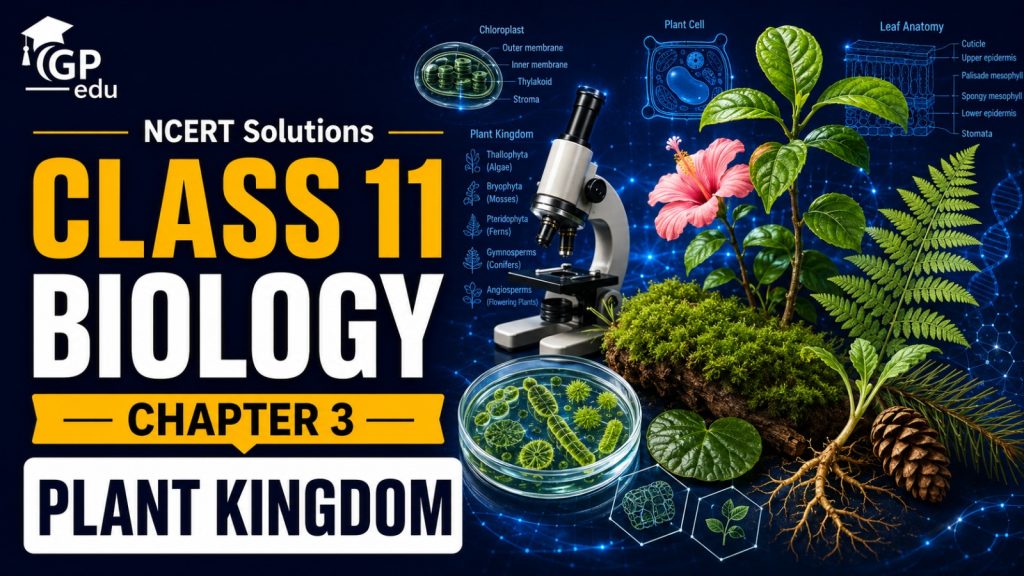
The chapter Plant Kingdom introduces students to the major groups of the plant kingdom and explains their characteristics, classification, structure, reproduction, and life cycles. It explores important plant groups such as algae, bryophytes, pteridophytes, gymnosperms, and angiosperms, highlighting their distinguishing features and evolutionary relationships. Students learn about the alternation of generations, different types of life cycles, reproductive structures, and the transition of plants from aquatic to terrestrial environments. This chapter provides a strong foundation for understanding plant diversity, evolution, reproduction, and morphology, making it an important topic for NEET preparation.
Class 11 Biology Chapter 3 Overview
Chapter 3 of Class 11 Biology, titled Plant Kingdom, introduces students to the diversity and classification of plants based on their structural features, reproductive methods, life cycles, and evolutionary relationships. The chapter explains the major groups of plants and their progression from simple aquatic forms to more complex terrestrial plants.
Students learn about the distinctive features of Algae, Bryophytes, Pteridophytes, Gymnosperms, and Angiosperms, along with important examples and their modes of reproduction. The chapter also covers alternation of generations, haplontic, diplontic and haplo-diplontic life cycles, and the major differences between various plant groups. A clear understanding of Plant Kingdom helps students develop a strong foundation in plant diversity, evolution, reproduction, and other advanced biology concepts, making it an important chapter for NEET preparation.
NCERT Solutions for Class 11 Biology Chapter 3- Plant Kingdom
Question 3.1. What is the basis for classification of algae?
Solution:
The presence of pigments that give the traditional colour on algae is the main basis for the classification of algae.
| Name of the pigment | Colour imparted | Chlorophyll type |
|---|---|---|
| Chlorophyceae | Green | chlorophyll a and chlorophyll b |
| Phaeophyceae | Brown | chlorophyll a, chlorophyll c, fucoxanthin |
| Rhodophyceae | Red | chlorophyll a and chlorophyll d, phycoerythrin |
Now, algae are classified on different criteria such as: (i) Flagellation (ii) Storage products (iii) Cellular organization (iv) Constitution of cell walls
Also Check: Anatomy of Flowering Plants Topics and Solutions
Question 3.2. When and where does reduction division take place in the life cycle of a liverwort, a moss, a fern, a gymnosperm and an angiosperm?
Solution:
The reduction division takes place in the following stages:
(i) Liverworts: meiosis takes place in the spore mother cells of the capsule in sporangium resulting in haploid spore formation.
(ii) Moss: meiosis occurs in spore mother cells of spore sacs in the capsule of sporangium.
(iii) Fern: Sporophylls, or fertile leaves, are the host for fern-sporangia. To create haploid spores, meiosis takes place in the sporangium’s spore mother cells.
(iv) Gymnosperm: When haploid pollen grains are formed in the microsporangia found in the microsporophylls, meiosis takes place in the microspore mother cells, producing male gametophytes.
(v) Angiosperm: Male gametophytes form in the stamen’s anther as a result of pollen grains that are created in microspore mother cells. To create the haploid megaspore that eventually gives rise to the female gametophyte, the megaspore mother cell, which is found in the ovule’s nucellus, goes through meiosis.
Question 3.3. Name three groups of plants that bear archegonia. Briefly describe the life cycle of any one of them.
Solution:
Bryophytes, Pteridophytes, and Gymnosperms are the plants that bear archegonia.
The life cycle of Bryophytes:
(i) Bryophytes are haploid, and produce gametes. The sexual organs in bryophytes are multicellular.
(ii) The male sex organ is the antheridium, which produces biflagellate antherozoids. Female sexual organs are called archegonium, which produces a single egg.
(iii) Antheridium releases antherozoids into the water that come in contact with the archegonium.
(iv) An antherozoid fuses with the egg to produce the zygote.
(v) The zygote divides via mitosis to create a sporophyte, which is a multicellular body.
(vi) To create haploid spores, sporocytes go through reduction division (meiosis).
(vii) The gametophyte is created when these spores germinate.
Question 3.4. Mention the ploidy of the following: protonemal cell of a moss; primary endosperm nucleus in dicot, leaf cell of a moss; prothallus cell of a fern; gemma cell in Marchantia; meristem cell of monocot, ovum of a liverwort, and zygote of a fern.
Solution:
| Cell | Type of Ploidy |
|---|---|
| Protonemal cell of a moss | Haploid ($n$) |
| Primary endosperm nucleus in dicot | Triploid ($3n$) |
| Leaf cell of a moss | Haploid ($n$) |
| Prothallus cell of a fern | Haploid ($n$) |
| Gemma cell in Marchantia | Haploid ($n$) |
| Meristem cell of monocot | Diploid ($2n$) |
| Ovum of a liverwort | Haploid ($n$) |
| Zygote of a fern | Diploid ($2n$) |
Quick Read: Animal Kingdom Topics and Solutions
Question 3.5. Write a note on the economic importance of algae and gymnosperms.
Solution:
Importance of Gymnosperms:
(i) Gymnosperms are utilised as plants for decoration. Some are utilised for bonsai and are found in formal gardens.
(ii) Their fibres are utilised to make paper pulp.
(iii) Conifer resin is the source of turpentine and resins.
(iv) Gymnosperms such as junipers, pines, hemlock, fir, spruces, and arborvitae are used to extract useful oils.
(v) Gymnosperm seeds are utilised to make baked goods and other food products.
(vi) Occasionally used to make fabrics such as silk.
Importance of Algae:
(i) Algae fixes carbon dioxide with the help of photosynthesis.
(ii) It increases the level of dissolved oxygen in their immediate environment.
(iii) They produce rich compounds that serve as food for aquatic animals.
(iv) Marine algae are used as food. For example, Laminaria and Sargassum.
(v) Certain algae are used as hydrocolloids.
(vi) Agar is used in growing microorganisms and in the preparation of jellies.
(vii) Chlorella is used as food by space travellers.
Question 3.6. Both gymnosperms and angiosperms bear seeds, then why are they classified separately?
Solution:
Angiosperms and gymnosperms are distinguished for the following reasons:
(i) In angiosperms, the ovules are encased within the ovary, but in gymnosperms, they are naked.
(ii) While endosperms in angiosperms are triploid and created following double fertilisation, endosperms in gymnosperms are haploid and produced prior to fertilisation.
(iii) Gymnosperms do not undergo double fertilisation, whereas angiosperms do.
(iv) Wood is porous in angiosperms and nonporous in gymnosperms.
Question 3.7. What is heterospory? Briefly comment on its significance. Give two examples.
Solution:
The phenomenon of producing two different types of spores in the same plant is called heterospory. The importance of heterospory is as follows: (i) Heterospory causes the growth of seeds in gymnosperms and angiosperms. (ii) It is required in the differentiation of male and female gametophytes. Examples: Salvinia, Selaginella.
Check This Out: Biodiversity and Conservation Topics and Solutions
Question 3.8. Explain briefly the following terms with suitable examples:
(i) protonema (ii) antheridium (iii) archegonium (iv) diplontic (v) sporophyll (vi) isogamy
Solution:
(i) Protonema: The haploid stage of the bryophyte life cycle, known as the protonema, is where a thread-like chain of cells forms. In mosses, for instance, the protonema grows straight from the spore.
(ii) Antheridium: This is the male sex organ that produces male gametes in pteridophytes and bryophytes. For instance, antheridia are present in the reproductive stages of several fungi and algae.
(iii) Archegonium: The archegonium is a flask-shaped female bryophyte reproductive organ that only produces one egg. They are multicellular, jacketed, and have a neck and enlarged venter. They are found in pteridophytes, gymnosperms, and bryophytes.
(iv) Diplontic: This life cycle produces haploid gametes with a dominating diploid free-living phase. Sargassum, for instance.
(v) Sporophyll: A sporophyll, which can be either microsporophyll or megasporophyll, is a leaf that carries sporangia. Together, these structures create strobili, or cones. Take Pinus, for instance.
(vi) Isogamy: This type of sexual reproduction occurs when two gametes fuse together. The gametes may be flagellated and of comparable size, or they may be non-flagellated (non-motile) but of similar size. This type of reproduction is known as isogamy. As an illustration, Ectocarpus.
Question 3.9. Differentiate between the following:
(i) red algae and brown algae
(ii) liverworts and moss
(iii) homosporous and heterosporous pteridophyte
(iv) syngamy and triple fusion
Solution:
(i) Red algae contain chlorophyll a and chlorophyll d but brown algae contain chlorophyll a and c. In red algae, Phycobilins are present but brown algae do not have phycobilins. If red algae reserve food in the form of floridean starch, it is laminarin in brown algae. Red algae are not flagellated, and brown algae are flagellated.
(ii) There is no protonema phase in the liverworts and the life cycle in the moss begins with the protonema. If the plant body is dorsoventral in liverworts, the moss plant body is separated into a stem-axis.
(iii) Homosporous possesses only one type of spores whereas heterosporous will have morphologically different spores in different sporangia.
(iv) Syngamy is the fusion of the male gamete with the ovum whereas triple fusion is the fusion of another male gamete with two polar nuclei.
Question 3.10. How would you distinguish monocots from dicots?
Solution:
| Monocots | Dicots |
|---|---|
| Have single cotyledon seed | Seeds having two cotyledons |
| Flowers are trimerous | Flowers are tetramerous or pentamerous |
| Venation in leaves is parallel | Have reticulate venations in leaves |
| Vascular bundle is scattered | Vascular bundle are organised in a ring |
| Absence of vascular cambium | Presence of vascular cambium |
| Primary root replaced by adventitious roots and are short-lived | Primary roots occur in a few cases. Primary root is long-lived |
Question 3.11. Match the following (column I with column II)
| Column I | Column II |
|---|---|
| (a) Chlamydomonas | (i) Moss |
| (b) Cycas | (ii) Pteridophyte |
| (c) Selaginella | (iii) Algae |
| (d) Sphagnum | (iv) Gymnosperm |
Solution:
| Column I | Column II |
|---|---|
| (a) Chlamydomonas | (iii) Algae |
| (b) Cycas | (iv) Gymnosperm |
| (c) Selaginella | (ii) Pteridophyte |
| (d) Sphagnum | (i) Moss |
Also Check: Biological Classification Topics and Solutions
Question 3.12. Describe the important characteristics of gymnosperms.
Solution:
The main characteristics of gymnosperms are as follows:
(i) In Gymnosperm the ovules are not enclosed by ovary. They are exposed before and after fertilization.
(ii) The seeds are naked.
(iii) Gymnosperms include medium-sized trees or tall trees and shrubs.
(iv) Taproots make up the roots.
(v) Do the stems have branches or not?
(vi) Simple and complex leaves.
(vii) The plant body is sporophyte and divided into roots, stems, and leaves.
(viii) They are referred to be heterosporous since they generate two types of spores.
(ix) Syphonogamy fertilisation occurs without the use of external water.
Why Class 11 Biology Chapter 3 Matters in NEET
Class 11 Biology Chapter 3: Plant Kingdom is highly important for NEET because it explains the diversity, classification, characteristics, and evolutionary relationships of different groups of plants. Students learn important concepts such as Algae, Bryophytes, Pteridophytes, Gymnosperms, and Angiosperms, along with their distinguishing features, reproductive structures, life cycles, and important examples. NEET frequently includes direct NCERT-based questions on the characteristics of plant groups, reproductive methods, alternation of generations, and differences between various plant divisions. A thorough understanding of this chapter helps students build a strong foundation in plant diversity, evolution, reproduction, and morphology while improving their performance in the examination.
Preparation Tips for Class 11 Biology Chapter 3
Begin by understanding the major groups of the Plant Kingdom and the basis of their classification, including their body structure, vascular tissues, reproductive methods, and life cycles. Study the important characteristics and examples of Algae, Bryophytes, Pteridophytes, Gymnosperms, and Angiosperms carefully.
Pay special attention to the differences between bryophytes and pteridophytes, gymnosperms and angiosperms, as well as the important features of each plant group. Learn the concepts of alternation of generations, haplontic, diplontic, and haplo-diplontic life cycles with the help of NCERT diagrams. Memorise important examples such as Chlamydomonas, Volvox, Spirogyra, Marchantia, Funaria, Selaginella, Equisetum, Cycas, and Pinus. Prepare comparison tables for quick revision and complete all NCERT diagrams, tables, examples, and exercise questions, as NEET asks many direct questions from the NCERT textbook. Finally, practise NEET previous-year questions regularly and revise important characteristics and examples to improve accuracy and confidence.
FAQs
What are the most important topics in Class 11 Biology Chapter 3?
The most important topics include Algae, Bryophytes, Pteridophytes, Gymnosperms, Angiosperms, alternation of generations, life cycles, reproductive structures, and important examples of different plant groups. These topics are frequently tested in NEET.
What are the major groups of the Plant Kingdom?
The major groups discussed in this chapter are Algae, Bryophytes, Pteridophytes, Gymnosperms, and Angiosperms. They show increasing levels of structural complexity and adaptations to terrestrial life.
What is alternation of generations?
Alternation of generations is the occurrence of two distinct phases in the life cycle of a plant: the gametophytic phase, which produces gametes, and the sporophytic phase, which produces spores. These two phases alternate during the life cycle.
What is the difference between gymnosperms and angiosperms?
Gymnosperms are plants with naked seeds, meaning their seeds are not enclosed within fruits. Angiosperms are flowering plants in which the seeds are enclosed within fruits. Angiosperms are further divided into monocotyledons and dicotyledons.
Why are bryophytes called the amphibians of the plant kingdom?
Bryophytes are called the amphibians of the plant kingdom because they generally live on land but depend on water for sexual reproduction. They are non-vascular plants and include organisms such as mosses and liverworts.
What are the main characteristics of pteridophytes?
Pteridophytes are vascular plants that possess well-developed roots, stems, and leaves. They reproduce through spores and do not produce seeds. Examples include Selaginella, Equisetum, and ferns.
Is Class 11 Biology Chapter 3 important for NEET?
Yes. Class 11 Biology Chapter 3: Plant Kingdom is highly important for NEET because it contains many direct NCERT-based questions on plant characteristics, classification, life cycles, reproduction, and important examples. Regular revision of NCERT concepts, diagrams, comparison tables, and previous-year questions is essential for scoring well in the examination.