
The chapter Morphology of Flowering Plants introduces students to the external structure and features of flowering plants and explains the morphology of different plant parts. It covers the structure, modifications, and functions of roots, stems, leaves, inflorescences, flowers, fruits, and seeds, along with their important characteristics and variations.
Students learn about different types of root systems, stem modifications, leaf arrangements, venation, phyllotaxy, inflorescence types, floral parts, aestivation, placentation, and types of fruits and seeds. The chapter also explains the semi-technical description of a typical flowering plant and the floral characteristics of important plant families such as Fabaceae, Solanaceae, and Liliaceae. A clear understanding of this chapter provides a strong foundation for studying plant structure, reproduction, identification, and classification, making it an important topic for NEET preparation.
Class 11 Biology Chapter 5 Overview
Students learn about different types of root systems, stem modifications, leaf arrangements, venation, phyllotaxy, inflorescence, floral parts, aestivation, placentation, fruits, and seeds. The chapter also covers the semi-technical description of a typical flowering plant and the important characteristics of plant families such as Fabaceae, Solanaceae, and Liliaceae. A clear understanding of Morphology of Flowering Plants helps students develop a strong foundation in plant structure, identification, reproduction, and classification, making it an important chapter for NEET preparation.
NCERT Solutions for Class 11 Biology Chapter 5 – Morphology of Flowering Plants
Question 5.1. What is meant by modification of root? What type of modification of root is found in the:
(a) Banyan tree (b) Turnip (c) Mangrove trees
Solution:
Roots can alter their size, shape, or even regular functioning in order to perform certain secondary duties or a particular adaption. The term “root modification” describes this.
(a) The roots of banyan trees grow from the branches and descend far into the ground to provide the tree with mechanical support. Prop root is the term for this type of alteration.
(b) A fleshy taproot is a sort of root alteration found in turnips that is altered to store food.
(c) To supply oxygen to the tree, mangrove trees have changed their roots into a pneumatic structure. Pneumatophores, or respiratory roots, are the term for this kind of alteration.
Also Check: Anatomy of Flowering Plants Topics and Solutions
Question 5.2. Justify the following statements on the basis of external features:
(i) Underground parts of a plant are not always roots.
(ii) The flower is a modified shoot.
Solution:
(i) Stems of certain plants, such as ginger, stay underground for vegetative reproduction and food storage. In a similar vein, potatoes’ modified stems stay underground. The existence of internodes and nodes—in this case, buds and scale leaves—is indicated by potato tubers. The potato tuber is confirmed to be a stem by the presence of an apical bud at its tip. These examples so demonstrate that subterranean components are not necessarily roots.
(ii) The axis of the stem condenses as internodes lay closer to one another, and apical meristems give rise to floral meristems. As a result, stems are replaced with floral appendages. The flower’s status as a modified shoot is thus justified.
Question 5.3. How is a pinnately compound leaf different from a palmately compound leaf?
Solution:
| Feature | Pinnately compound leaf | Palmately compound leaf |
|---|---|---|
| Structure | Many numbers of leaflets are present on a common axis | Several leaflets are attached to a common point. |
| Attachment | Leaflets are attached to a common axis called the rachis | Leaflets are attached to a common point on the leaf stalk. |
| Axis | Leaflet-bearing axis is the continuation of the petiole | Leaflet-bearing axis is very short. |
| Example | Ex: Neem leaves | Ex: Cotton leaves |
Check This Out: Animal Kingdom Topics and Solutions
Question 5.4. Explain with suitable examples the different types of phyllotaxy.
Solution:
The pattern of leaf arrangement on the stem or branch is called phyllotaxy. Phyllotaxy is of three types, namely:
Alternate: The emergence of a single leaf at each node in an alternate manner. Example: Hibiscus, mustard, and sunflower.
Whorled: Whorl is formed when two or more leaves emerge at a node. Example: Alstonia.
Opposite: Emergence of a pair of leaves at every node, facing opposite to each other. Example: Guava.
Question 5.5. Define the following terms:
(a) aestivation (b) placentation (c) actinomorphic (d) zygomorphic (e) superior ovary (f) perigynous flower (g) epipetalous stamen
Solution:
(a) Aestivation: Sepals or petals’ arrangement in a floral bud concerning other members of the same whorl is called aestivation. Types: Twisted (e.g., cotton), Valvate (e.g., Calotropis), Imbricate (e.g., gulmohar), Vexillary (e.g., Bean flower).
(b) Placentation: Arrangement of the ovule within the ovary. Types: Marginal (e.g., Pea), Axile (e.g., lemon), Parietal (e.g., Mustard), Basal (e.g., Marigold), Free central (e.g., Primrose).
(c) Actinomorphic: Flowers which can be divided into two halves by any vertical plane. Example: Chilli.
(d) Zygomorphic: A flower that has bilateral symmetry and can only be split in half in a single plane. Example: Gulmohar.
(e) Superior ovary: The gynoecium is at the top of a hypogynous flower, with the other components remaining below it. Example: Brinjal.
(f) Perigynous flower: A flower that has the gynoecium in the centre and other flower components on the thalamic rim. Half of the ovary is inferior. Example: Rose.
(g) Epipetalous stamen: This type of stamen is carried over a petal rather than directly over the thalamus. Example: Brinjal.
Quick Read: Biological Classification Topics and Solutions
Question 5.6. Differentiate between
(a) Racemose and cymose inflorescence
(b) Fibrous root and adventitious root
(c) Apocarpous and syncarpous ovary
Solution:
| Feature | Differentiation |
|---|---|
| (a) Racemose vs Cymose | Racemose: Young flowers at the tip, older at base; Main axis grows. Cymose: Old flowers at the tip, young at base; Main axis limited. |
| (b) Fibrous vs Adventitious | Fibrous: Primary root short-lived, replaced by many roots (monocots). Adventitious: Roots arise from parts other than the radicle. |
| (c) Apocarpous vs Syncarpous | Apocarpous: Two or more carpels are free (e.g., Lotus). Syncarpous: Two or more carpels are fused (e.g., Mustard). |
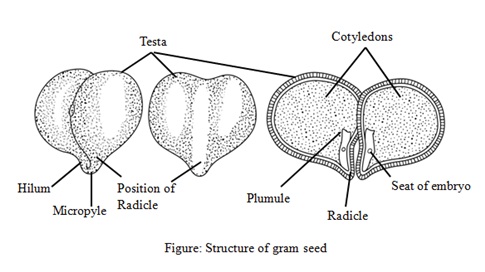
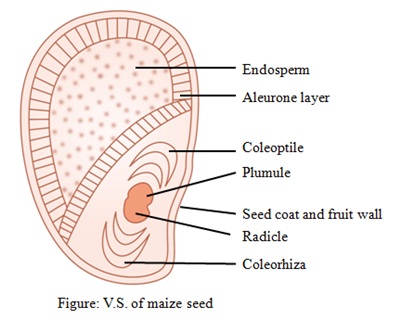
Question 5.7. Draw the labelled diagram of the following: (i) gram seed (ii) V.S. of maize seed.
Solution:
(i) Gram seed
(ii) V.S. of maize seed
Question 5.8. Describe modifications of the stem with suitable examples.
Solution:
Food storage: Underground stems of potato, ginger, and turmeric are modified to store food in them. They act as organs of perennation to tide over conditions unfavourable for growth.
Tendrils: Tendrils are slender and spirally coiled and develop from axillary buds. These stem tendrils help plants climb, such as in gourds (cucumber, pumpkins, watermelon) and grapevines.
Thorns: Stems of auxiliary buds get modified into woody, straight and pointed thorns. Thorns protect plants from animals. Several plants of dry regions alter their stems into either fleshy cylindrical structures or flattened. Ex: citrus plants. They possess chlorophyll and perform photosynthesis.
Vegetative reproduction: Certain plants, including strawberries, grass, and others, have underground stems that expand to new niches and produce new plants when their older sections die. A thin lateral branch emerges from the base of the main axis of plants such as mint and jasmine, and after growing aerially for a while, it arches downward to touch the earth.
Question 5.9. Take one flower from each of the families Fabaceae and Solanaceae and write its semi-technical description. Also, draw their floral diagram after studying them.
Solution:
Fabaceae: Trees, shrubs herbs having roots with root nodules. Stems are erect or climber. Leaves are alternate, pinnately compound or simple and leaf bases are pulvinate, stipulate with reticulate venation. .
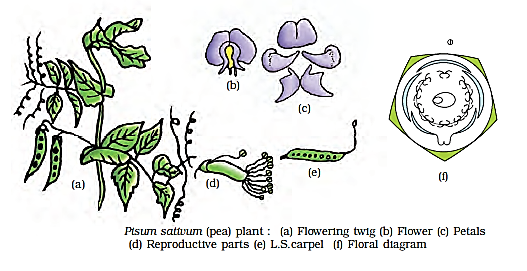
Inflorescence: racemose. Flower: bisexual, zygomorphic. Calyx: sepals five, gamosepalous; valvate/imbricate aestivation. Corolla: petals five, polypetalous, papilionaceous, consisting of a posterior standard, two lateral wings, two anterior ones forming a keel (enclosing stamens and pistil), vexillary aestivation. Androecium: stamens ten in number, diadelphous, anther dithecous. Gynoecium: ovary superior, monocarpellary, unilocular with many ovules, style single. Fruit: legume; seed: one to many, non-endospermic. Ex: Peas, trifolium
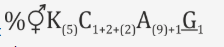
Solanaceae: Commonly termed as potato family, Solanaceae are mostly herbs, shrubs and rarely small trees. Stems are herbaceous, rarely woody, aerial; erect, cylindrical, branched, solid or hollow, hairy or glabrous, underground stem in potato. Leaves are alternate, simple, rarely pinnately compound, and exstipulate with reticulate venation.
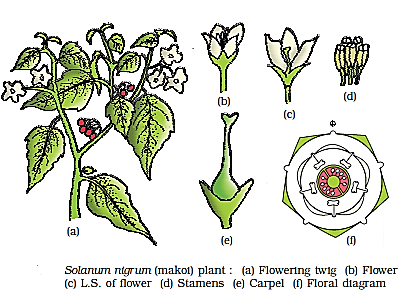
Inflorescence: Solitary, axillary or cymose as in Solanum. Flower: bisexual, actinomorphic. Calyx: sepals five, united, persistent, valvate aestivation. Corolla: petals five, united; valvate aestivation. Androecium: stamens five, epipetalous. Gynoecium: bicarpellary obligately placed, syncarpous; ovary superior, bilocular, the placenta is swollen with many ovules, axile. Fruits: berry or capsule. Seeds: many, endosperms. Ex: Brinjal, chilli, ashwagandha, petunia.
Check This Out: Cell Cycle and Cell Division Topics and Solutions
Question 5.10. Describe the various types of placentations found in flowering plants.
Solution:
Placentation in flowering plants refers to the arrangement of ovules within the ovary. The main types are:
– Marginal: The placenta forms a ridge through the ventral suture of the ovary. Ovules are borne on the ridge to form two rows. Example – Pea.
– Axile: placenta is axial, and ovules are attached to it in a multilocular ovary. Example – tomato and lemon.
– Parietal: ovules develop on the inner wall of the ovary or on the peripheral. It is single-chambered, but due to the formation of a false septum, it becomes two-chambered. Example- Mustard.
– Basal: The placenta develops at the base of the ovary, wherein a single ovule is attached to it. Example – Marigold and sunflower.
– Free central: ovules are borne on the central axis, and septa are absent. Example – Primrose and Dianthus.
Question 5.11. What is a flower? Describe the parts of a typical angiosperm flower.
Solution:
The flower is the reproductive organ of an angiosperm. It is a modified shoot in which the floral meristem replaces the shoot apical meristem. On the enlarged end of the pedicel or stalk, called the receptacle or thalamus, a typical flower has four different types of whorls arranged consecutively. These four components fall under the categories of reproductive and auxiliary organs.
1. Calyx: It is the lowermost and outermost whorl of the flower, and they are called sepals. They render support and protection to other floral structures.
2. Corolla: Corolla is composed of petals which are brightly coloured to attract insects for pollination. Located inner to the sepals and outside the stamens.
3. Androecium: Androecium consists of stamens which represent male reproductive organs of a stalk, filament and an anther. Anthers are bilobed, where each lobe has two chambers, the pollen sacs where pollen grains are produced.
4. Gynoecium: The female reproductive component of a flower, known as the gynoecium, is made up of one or more carpels, which are further divided into three parts: the stigma, ovary, and style. The style is an extended tube that is carried by the larger ovary at the base. One or more ovules connected to the placenta are carried by each ovary.
Quick Read: Ecosystem Topics and Solutions
Question 5.12. How do the various leaf modifications help plants?
Solution:
Leaves fundamentally perform photosynthesis. But in some plants, leaves are modified to carry out different functionalities, as mentioned below:
– Tendrils: Tendrils helps with climbing as in peas.
– Spines: Thorns are modified leaves that protect plants from animals, serving as an organ of defence.
– Pitcher: Leaves of this plant are modified into pitcher-like structures containing digestive juices aiding in trapping and digesting insects.
– Synthesis of food: Fleshy leaves of garlic and onion store some food. These are modified leaves.
– Phyllodes: Phyllodes emerging from the petioles of leaves synthesize food. Phyllodes are flattened, green structures that replace the short-lived leaves.
Question 5.13. Define the term inflorescence. Explain the basis for the different types of inflorescence in flowering plants.
Solution:
The arrangement of flowers on the floral axis is known as inflorescence. Depending on whether the apex develops into a flower or keeps growing, there are two main forms of inflorescence. They are as follows:
Racemose: An inflorescence in which flowers are borne laterally in acropetal succession, meaning that the older blooms are at the base and the newer flowers are close to the apex. The primary axis keeps expanding.
Cymose: A kind of inflorescence with restricted growth where the main axis ends in a flower. The arrangement of flowers is basipetal, with older flowers at the apex and younger flowers close to the base.
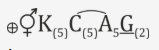
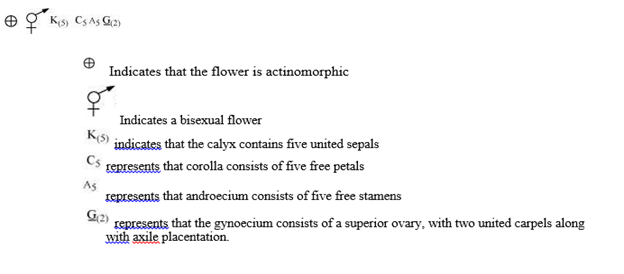
Question 5.14. Write the floral formula of an actinomorphic, bisexual, hypogynous flower with five united sepals, five free petals, five free stamens and two united carpels with superior ovary and axile placentation.
Solution:
Read Next: Excretory Products and Their Elimination Topics and Solutions
Question 5.15. Describe the arrangement of floral members in relation to their insertion on the thalamus.
Solution:
The arrangement of floral members in relation to their insertion on the thalamus are of three types:
Hypogynous: The gynoecium occupies the highest position while the other parts are situated below it. The ovary is said to be superior. Example – Brinjal.
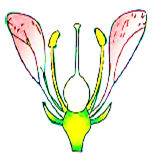
Perigynous: The gynoecium stays in the centre and other parts of the flower are located on the rim of the thalamus, almost at the same level. The ovary is said to be half inferior. Example – Rose.
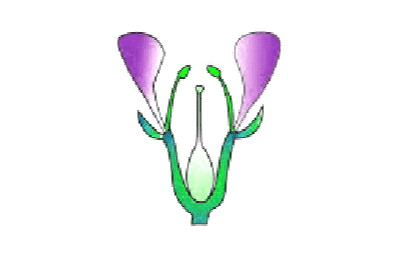
Epigynous: The margin of the thalamus grows upwards, enfolding the ovary. Here the ovary gets fused with the thalamus, and other parts of the flower arise above the ovary. Hence ovary is said to be inferior. Example – Flowers of guava.

Also Check: Molecular Basis of Inheritance Topics and Solutions
Why Class 11 Biology Chapter 5 Matters in NEET
Class 11 Biology Chapter 5: Morphology of Flowering Plants is highly important for NEET because it explains the external structure, modifications, and functions of different parts of flowering plants. Students learn important concepts such as root, stem, leaf, inflorescence, flower, fruit, and seed, along with their structural features, modifications, and important examples. NEET frequently includes direct NCERT-based questions on root and stem modifications, leaf arrangement, venation, phyllotaxy, types of inflorescence, floral parts, aestivation, placentation, fruits, seeds, and important plant families. A thorough understanding of this chapter helps students build a strong foundation in plant morphology, identification, reproduction, and classification while improving their performance in the examination.
Preparation Tips for Class 11 Biology Chapter 5
Begin by understanding the basic morphology and functions of roots, stems, and leaves. Study different types of root systems, root modifications, stem modifications, leaf modifications, venation, phyllotaxy, and leaf arrangement carefully. Learn the important characteristics and examples associated with each modification.
Pay special attention to the structure of a flower, including sepals, petals, stamens, carpels, floral symmetry, sexuality, ovary position, aestivation, placentation, and types of inflorescence. Study the different types of fruits and seeds and understand their important characteristics and examples. Learn the semi-technical description of a typical flowering plant and practise identifying different floral parts from diagrams. Memorise the important characteristics of Fabaceae, Solanaceae, and Liliaceae, including their floral formulae and diagrams. Prepare comparison tables for quick revision and complete all NCERT diagrams, tables, examples, and exercise questions. Finally, practise NEET previous-year questions regularly and revise important terms, examples, floral structures, and family characteristics to improve accuracy, speed, and confidence.
FAQs
What are the most important topics in Class 11 Biology Chapter 5?
The most important topics include root, stem, leaf, their modifications, venation, phyllotaxy, inflorescence, flower, aestivation, placentation, fruits, seeds, semi-technical description of flowering plants, and important plant families. These topics are frequently tested in NEET.
What are the major parts of a flowering plant?
The major vegetative parts of a flowering plant are root, stem, and leaves, while the reproductive structure is the flower. Fruits and seeds develop after fertilisation and play important roles in reproduction and dispersal.
What are the main types of root systems?
The three main types of root systems are tap root system, fibrous root system, and adventitious root system. Tap roots generally develop from the radicle, while fibrous roots arise from the base of the stem and are commonly found in monocot plants.
What are the main types of phyllotaxy?
Phyllotaxy refers to the arrangement of leaves on the stem or branches. The main types are alternate, opposite, and whorled. Examples include China rose for alternate arrangement, Calotropis for opposite arrangement, and Alstonia for whorled arrangement.
What is aestivation?
Aestivation refers to the arrangement of sepals or petals in a floral bud with respect to one another. Important types include valvate, twisted, imbricate, and vexillary aestivation. Understanding their characteristics and examples is important for NEET.
What is placentation?
Placentation refers to the arrangement of ovules within the ovary. The main types include marginal, axile, parietal, free central, and basal placentation. Questions based on the types of placentation and their examples are commonly asked from NCERT.
Which plant families are important in Class 11 Biology Chapter 5?
The three major families discussed in the chapter are Fabaceae, Solanaceae, and Liliaceae. Students should learn their characteristic features, floral formulae, floral diagrams, important examples, and economic importance.
Is Class 11 Biology Chapter 5 important for NEET?
Yes. Class 11 Biology Chapter 5: Morphology of Flowering Plants is highly important for NEET because it contains many direct NCERT-based questions on plant structures, modifications, floral characteristics, placentation, aestivation, fruits, seeds, and important plant families. Regular revision of NCERT concepts, diagrams, floral formulae, tables, examples, and previous-year questions is essential for scoring well in the examination.