
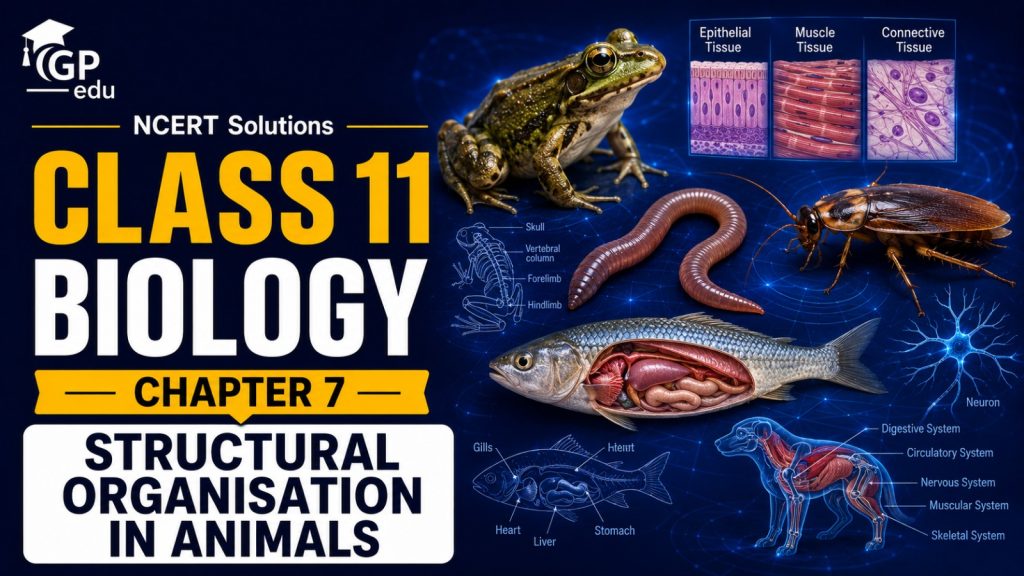
The chapter Structural Organisation in Animals introduces students to the structural organisation of animals and explains the arrangement, characteristics, and functions of different animal tissues. It covers epithelial, connective, muscular, and nervous tissues, along with their important types, structural features, locations, and functions.
Students learn about the different types of epithelial tissues, connective tissues, muscles, and nervous tissue, including the structure and functions of neurons. The chapter also explains the structural organisation and anatomy of earthworm, cockroach, and frog, including their external features and major organ systems. A clear understanding of this chapter provides a strong foundation for studying animal tissues, anatomy, organ systems, and structural organisation, making it an important topic for NEET preparation.
Class 11 Biology Chapter 7 Overview
Students learn about the four major types of animal tissues—epithelial, connective, muscular, and nervous tissues, along with their structural features, functions, and important types. The chapter also covers the structural organisation and anatomy of earthworm, cockroach, and frog, including their external features and major organ systems. Students are introduced to the organisation and functions of different tissues and organs, helping them understand how specialised structures work together in animals. A clear understanding of Structural Organisation in Animals helps students develop a strong foundation in animal tissues, anatomy, organ systems, and structural complexity, making it an important chapter for NEET preparation.
NCERT Solutions for Class 11 Biology Chapter 7 – Structural Organisation In Animals
Question 7.1. Answer in one word or one line.
(i) Give the common name of Periplaneta americana.
(ii) How many spermathecae are found in earthworms?
(iii) What is the position of ovaries in cockroaches?
(iv) How many segments are present in the abdomen of cockroaches?
(v) Where do you find Malpighian tubules?
Solution:
i) American cockroach
ii) 4 pairs of spermathecae are found in earthworms.
iii) Two ovaries are found lying laterally around the $2^{\text{nd}}$ to the $6^{\text{th}}$ abdominal segments.
iv) 10 segments
v) Malpighian tubules are found at the junction of the midgut and the hindgut of the alimentary canals of insects.
Also Check: Anatomy of Flowering Plants Topics and Solutions
Question 7.2. Answer the following.
(i) What is the function of nephridia?
(ii) How many types of nephridia are found in earthworms based on their location?
Solution:
i) Nephridia in earthworms carry out the roles of osmoregulation and excretion.
ii) The earthworm contains three different kinds of nephridia depending on where they are found: Septal nephridia (both sides of the intersegmental septa from segment 15 to the final one that exits into the gut), integumentary nephridia (from segment 3 to the final opening on the body surface, connected to the lining of the body wall), and pharyngeal nephridia (three paired tufts in the fourth, fifth, and sixth segments).
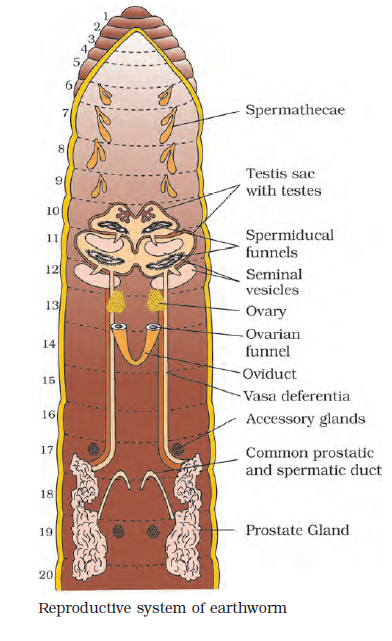
Question 7.3. Draw a labelled diagram of the reproductive organs of an earthworm.
Solution:
The diagram of the reproductive organs of an earthworm is as follows:
Read Next: Animal Kingdom Topics and Solutions
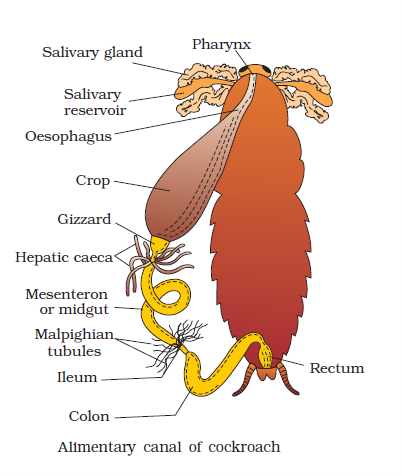
Question 7.4. Draw a labelled diagram of the alimentary canal of a cockroach.
Solution:
The diagram of the alimentary canal of a cockroach is as follows:
Question 7.5. Distinguish between the following.
(a) Prostomium and peristomium
(b) Septal nephridium and pharyngeal nephridium
Solution:
(a) Prostomium and peristomium:
| Prostomium | Peristomium |
|---|---|
| The small, fleshy lobe serves as a covering for the mouth and as a wedge to force open cracks in the soil as the earthworm crawls. | It is the crescentic aperture at the anterior end of the first segment of the earthworm comprising the mouth. |
(b) Septal nephridium and pharyngeal nephridium:
| Septal nephridium | Pharyngeal nephridium |
|---|---|
| Found at the anterior and posterior surface of septa occurring after segment 15 in earthworm. | Found in three pairs in the $4^{\text{th}}$, $5^{\text{th}}$ and $6^{\text{th}}$ segments located on either side of the alimentary canal. |
| The excretory matter is discharged into the lumen of the alimentary canal. | The excretory matter is discharged into the gut, in the pharynx or buccal cavity. |
Quick Read: Biological Classification Topics and Solutions
Question 7.6. What are the cellular components of blood?
Solution:
The cellular components of blood are Red blood cells (RBC), white blood cells (WBC) and platelets.
Question 7.7. What are the following, and where do you find them in an animal body?
(a) Chondrocytes
(b) Axons
(c) Ciliated epithelium
Solution:
(a) The cartilage cells are called chondrocytes. In adults, cartilage can be found between neighbouring bones of the hands, limbs, and vertebral column, as well as in the tip of the nose and outer ear joints. They are huge, mature, rounded cells that are located in clusters within the cartilage matrix.
(b) A long, thin projection of a neurone or nerve cell is called an axon. They can be found all over the body. They are in charge of carrying nerve impulses out of the cell body after emerging from the cyton. They come to an end in terminal arborisations, which are collections of branches.
(c) Columnar or cuboidal cells are referred to as ciliated epithelium if they have cilia on their free surface. They are found on the inside of hollow organs such as the fallopian tubes and bronchioles. Its free surface is made up of tiny, vibratile cytoplasmic structures known as cilia. The purpose of this cilium is to capture dust and other foreign objects.
Check This Out: Biotechnology Principles and Processes Topics and Solutions
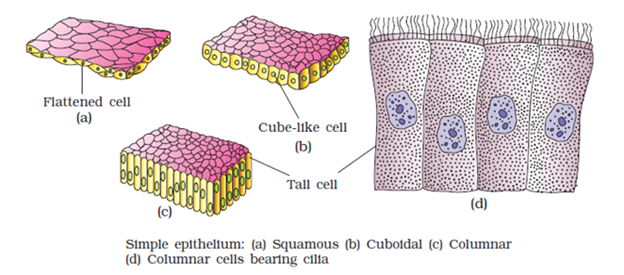
Question 7.8. Describe various types of epithelial tissues with the help of labelled diagrams.
Solution:
Epithelial tissues are found lining the body surface forming a protective surface. These cells are densely packed with a very little intercellular matrix.
Various types of epithelial tissues are:
i) Simple epithelium: It is a single layer of cells which functions as a lining for body cavities, ducts, and tubes. Based on the structural modifications of the cells, Simple epithelial cells are further divided into 4 types:
– Squamous epithelium: A single layer of a flattened cell with asymmetrical borders makes up simple epithelium. They are present in the lungs’ air sacs and blood vessel walls.
– Cuboidal epithelium: Made up of a single layer of cube-like cells. Commonly found in ducts of glands and tubular parts of nephrons in kidneys.
– Columnar epithelium: A single layer of tall, thin cells present in the lining of the stomach and intestine.
– Ciliated epithelium: Cuboidal or columnar epithelium that bears cilia on their free surface. Present in the inner surface of hollow organs like fallopian tubes and bronchioles.
ii) Compound epithelium: As in human skin, the compound epithelium is a layer of two or more cells that serves a protective purpose. They cover the inner lining of the pancreatic and salivary ducts, the moist surface of the buccal cavity, and the dry skin surface.
Question 7.9. Distinguish between
(a) Simple epithelium and compound epithelium
(b) Cardiac muscle and striated muscle
(c) Dense regular and dense irregular connective tissues
(d) Adipose and blood tissue
(e) Simple gland and compound gland
Solution:
a. Simple epithelium and compound epithelium
| Simple epithelium | Compound epithelium |
|---|---|
| Composed of one layer of cells | Consist of many layers of cells |
| They are involved in the function of absorption and secretion | They are involved in the protection |
| Present in the stomach lining and intestine | Present in the lining of the buccal cavity and pharynx |
| Cells rest on the basement membrane | Cells of the lowermost layer rest on the basement membrane |
b. Cardiac muscle and striated muscle
| Cardiac muscle | Striated muscle |
|---|---|
| It is involuntary in function and never gets fatigued | It is voluntary in function, hence gets fatigued sooner |
| It is found in the heart | Found in the triceps, limbs and biceps |
| Branched fibres | Unbranched fibres |
| Uninucleated | Multinucleated |
c. Dense regular and dense irregular connective tissues
| Dense regular connective tissue | Dense irregular connective tissue |
|---|---|
| Collagen fibres are present in rows between parallel boundless fibres | Consists of Fibroblasts having several fibres that are differently oriented |
| Regular patterns of fibres observed | Irregular patterns of fibres observed |
| They are present in tendons and ligaments | They are present in the skin |
d. Adipose and blood tissue
| Adipose tissue | Blood tissue |
|---|---|
| It is made of collagen fibres, fibroblasts, macrophages and adipocytes | It consists of RBC, WBC, platelets and plasma |
| It is a loose connective tissue | It is a fluid connective tissue |
| Its function is to synthesise, store and metabolise the fats | Its function is to transport food, gases, hormones and waste |
| Present beneath the skin | Present in the blood vessels |
e. Simple gland and compound gland
| Simple gland | Compound gland |
|---|---|
| It contains isolated glandular cells | Contains cluster of secretory cells |
| It is unicellular | It is multicellular |
| Ex: Goblet cells of the alimentary canal | Ex: salivary glands |
Quick Read: Breathing and Exchange of Gases Topics and Solutions
Question 7.10. Mark the odd one in each series.
(a) Areolar tissue; blood; neuron; tendon
(b) RBC; WBC; platelets; cartilage
(c) Exocrine; endocrine; salivary gland; ligament
(d) Maxilla; mandible; labrum; antennae
(e) Protonema; mesothorax; metathorax; coxa
Solution:
(a) Neuron: because it is not a connective tissue.
(b) Cartilage: because it is not part of blood.
(c) Ligament: because it is connective tissue, whereas the rest are glands.
(d) Antennae: because the rest are the mouthparts of a cockroach.
(e) Protonema: because it is a thread-like chain of cells found in the life cycle of moss, whereas others are the parts of segments of a cockroach’s leg.
Question 7.11. Match the terms in column I with those in column II.
| Column I | Column II |
|---|---|
| (a) Compound epithelium | (i) Alimentary canal |
| (b) Compound eye | (ii) Cockroach |
| (c) Septal nephridia | (iii) Skin |
| (d) Open circulatory system | (iv) Mosaic vision |
| (e) Typhlosole | (v) Earthworm |
| (f) Osteocytes | (vi) Phallomere |
| (g) Genitalia | (vii) Bone |
Solution:
| Column I | Column II |
|---|---|
| (a) Compound epithelium | (iii) Skin |
| (b) Compound eye | (iv) Mosaic vision |
| (c) Septal nephridia | (v) Earthworm |
| (d) Open circulatory system | (ii) Cockroach |
| (e) Typhlosole | (i) Alimentary canal |
| (f) Osteocytes | (vii) Bone |
| (g) Genitalia | (vi) Phallomere |
Question 7.12. Mention the circulatory system of earthworms briefly.
Solution:
The earthworm’s heart, capillaries, and blood arteries make up its closed, circular system.
Because earthworms have a closed circulatory system, blood is limited to the heart and blood arteries.
Blood flows in a single path during contraction.
The fourth, fifth, and sixth segments have blood glands. They create haemoglobin, which is a type of blood cell that dissolves in blood plasma.
The cells in the blood are phagocytic.
Because they lack a specific respiratory system, their wet body surface facilitates respiratory exchange with their circulation.
Also Check: Body Fluids and Circulation Topics and Solutions
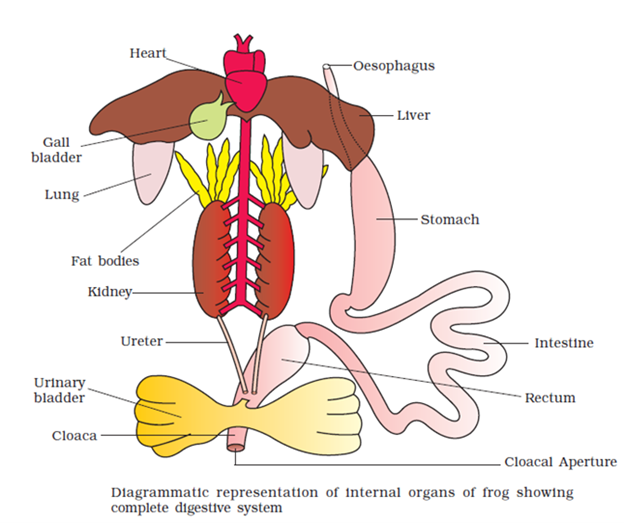
Question 7.13. Draw a neat diagram of the digestive system of a frog.
Solution:
The diagram is as below.
Question 7.14. Mention the function of the following:
(a) Ureters in frogs
(b) Malpighian tubules
(c) Body wall in earthworms
Solution:
(a) Ureters in frog – Acts as a urinogenital duct which carries urine and sperm in the male frog.
(b) Malpighian tubules – Malpighian tubules are excretory organs in cockroaches.
(c) Body wall in earthworm – Helps in movement and burrowing.
Why Class 11 Biology Chapter 7 Matters in NEET
Class 11 Biology Chapter 7: Structural Organisation in Animals is highly important for NEET because it explains the structural organisation, tissues, and organ systems of animals. Students learn important concepts such as animal tissues, epithelial tissue, connective tissue, muscular tissue, nervous tissue, and the anatomy of important animals. NEET frequently includes direct NCERT-based questions on the characteristics, structure, and functions of different animal tissues, along with the organisation of organs and organ systems. A thorough understanding of this chapter helps students build a strong foundation in animal anatomy, tissue organisation, physiology, and structural complexity while improving their performance in the examination.
Preparation Tips for Class 11 Biology Chapter 7
Begin by understanding the four major types of animal tissues—epithelial, connective, muscular, and nervous tissues. Study their classification, structural features, locations, and functions carefully. Pay special attention to different types of epithelial tissues, connective tissues such as areolar, adipose, cartilage, bone, blood, and lymph, and the characteristics of skeletal, smooth, and cardiac muscles.
Study the structure and functions of neuron and nervous tissue, and understand how different animal tissues are organised to perform specialised functions. Pay special attention to the structural organisation and organ systems of the animals discussed in the NCERT chapter, particularly earthworm, cockroach, and frog.
Learn important anatomical features and practise identifying structures from NCERT diagrams. Prepare comparison tables for different tissues and organ systems for quick revision. Complete all NCERT diagrams, tables, examples, and exercise questions. Finally, practise NEET previous-year questions regularly and revise important tissue types, structures, functions, and anatomical features to improve accuracy, speed, and confidence.
FAQs
What are the most important topics in Class 11 Biology Chapter 7?
The most important topics include animal tissues, epithelial tissue, connective tissue, muscular tissue, nervous tissue, neuron structure, and structural organisation of earthworm, cockroach, and frog. These topics are frequently tested in NEET.
What are the four major types of animal tissues?
The four major types of animal tissues are epithelial tissue, connective tissue, muscular tissue, and nervous tissue. Each tissue is specialised to perform specific functions in the animal body.
What is epithelial tissue?
Epithelial tissue forms the covering or lining of external and internal body surfaces. It provides protection and may also perform functions such as absorption, secretion, and excretion. Major types include squamous, cuboidal, columnar, ciliated, and glandular epithelium.
What are the main types of connective tissue?
The major types of connective tissue include areolar tissue, adipose tissue, dense connective tissue, cartilage, bone, blood, and lymph. Connective tissues provide support, protection, binding, storage, and transport within the body.
What are the three types of muscular tissue?
The three main types of muscular tissue are skeletal muscle, smooth muscle, and cardiac muscle. Skeletal muscles are generally voluntary, smooth muscles are involuntary, and cardiac muscles are specialised for the rhythmic contraction of the heart.
What is nervous tissue?
Nervous tissue is specialised for receiving and transmitting electrical signals. Its main cells are neurons, which transmit nerve impulses, and supporting cells that help maintain and protect nervous tissue.
Which animals are studied in Structural Organisation in Animals?
The NCERT chapter discusses the structural organisation and anatomy of important animals, particularly earthworm, cockroach, and frog. Students should focus on their external features, tissues, organs, and major organ systems.
Is Class 11 Biology Chapter 7 important for NEET?
Yes. Class 11 Biology Chapter 7: Structural Organisation in Animals is highly important for NEET because it contains many direct NCERT-based questions on animal tissues, their structures and functions, and the anatomy and organ systems of important animals. Regular revision of NCERT diagrams, tables, concepts, and previous-year questions is essential for scoring well in the examination.