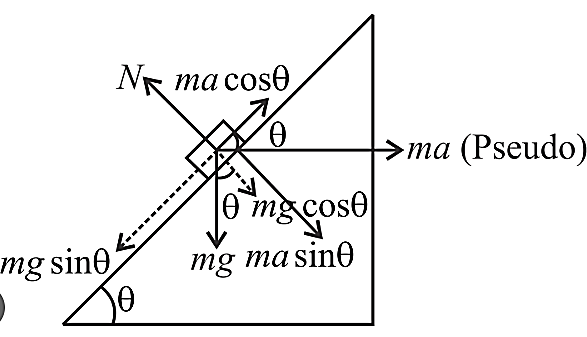
A block of mass m is placed on a smooth wedge of inclination  . The whole system is accelerated horizontally so that the block does not slip on the wedge. The force exerted by the wedge on the block (g is acceleration due to gravity) will be
A

B

C

D

Text Solution
Verified by ExpertsThe correct answer is:
D
The wedge is given an acceleration to the left.
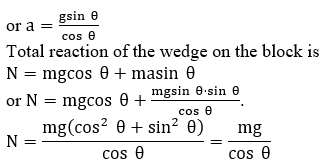
 The block has a pseudo acceleration to the right, pressing against the wedge because of which the block is not moving.

Prepare Smarter with CGP Edu
Get practice questions, solutions, and test series in one place.
Write a Review
Share your experience with this question and solution.
Commentary
Send your comment, doubt, correction, or feedback to admin.
Similar Questions
Explore conceptually related problems
If a bullet of mass 5 gm moving with velocity 100 m /sec, penetrates the wooden block up to 6 cm. T…
A force of 100 dynes acts on mass of 5 gm for 10 sec. The velocity produced is
An object will continue moving uniformly until
A diwali rocket is ejecting 0.05 kg of gases per second at a velocity of 400 m/sec. The acceleratin…
A body of mass 2 kg moving on a horizontal surface with an initial velocity of 4 m/sec comes to res…
A body of mass 2 kg is hung on a spring balance mounted vertically in a lift. If the lift descends …