Published by:
CGP EDU Academic Team
Published on: September 12, 2026
In the circuit shown in figure, the capacitor is initially uncharged. At t = 0, the switch is closed at position (1) and remain closed for long time. Then at t =t', switch is shifted to position (2).
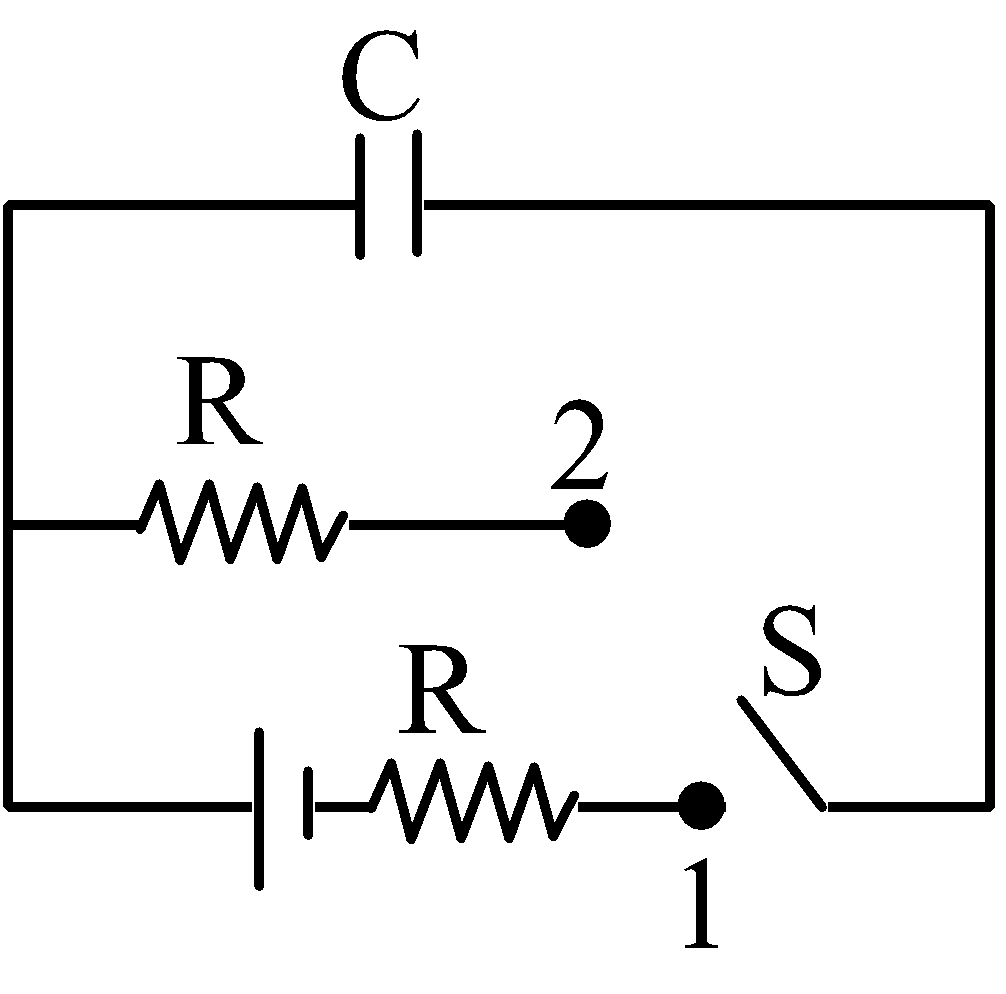
Column-I | Column-II |
(i) As the capacitor charges from t = 0 to t = t' | [A] Current in the circuit falls exponentially |
(ii) As the capacitor discharge i.e. for t > t' | [B] Current in the circuit grows exponentially |
(iii) Maximum current in the circuit depends on | [C] R, C |
(iv) Time to achieve 50% charging of the capacitor depends on | [D] R |
Correct Matrix Matching
Text Solution
Verified by ExpertsThe correct answer is:
A
Step 1: When the switch is closed at position (1), the capacitor begins to charge through the resistor R. The current I in the circuit during this charging phase can be described by the equation:
$$ I(t) = \frac{V}{R} e^{-\frac{t}{RC}} $$
where V is the voltage across the capacitor. As the capacitor charges, the current decreases exponentially, which aligns with the option [A].
Step 2: After a long time, the capacitor is fully charged, and at t = t', when the switch is moved to position (2), the capacitor starts to discharge through the second resistor. The initial current during discharge is determined by the charge stored in the capacitor at that moment and also decreases exponentially.
Step 3: Maximum current depends on the capacitor charge and can be influenced by the resistor values and capacitance (R, C) as indicated in option [C].
Step 4: The time to achieve 50% charging of the capacitor is also influenced by the resistance (R) according to the time constant, which shows its significance in option [D].
However, focusing purely on the current behavior during charging, the correct option when considering the current falls significantly is option [A]. Therefore, A.
$$ I(t) = \frac{V}{R} e^{-\frac{t}{RC}} $$
where V is the voltage across the capacitor. As the capacitor charges, the current decreases exponentially, which aligns with the option [A].
Step 2: After a long time, the capacitor is fully charged, and at t = t', when the switch is moved to position (2), the capacitor starts to discharge through the second resistor. The initial current during discharge is determined by the charge stored in the capacitor at that moment and also decreases exponentially.
Step 3: Maximum current depends on the capacitor charge and can be influenced by the resistor values and capacitance (R, C) as indicated in option [C].
Step 4: The time to achieve 50% charging of the capacitor is also influenced by the resistance (R) according to the time constant, which shows its significance in option [D].
However, focusing purely on the current behavior during charging, the correct option when considering the current falls significantly is option [A]. Therefore, A.
Prepare Smarter with CGP Edu
Get practice questions, solutions, and test series in one place.
Write a Review
Share your experience with this question and solution.
Commentary
Send your comment, doubt, correction, or feedback to admin.
Similar Questions
Explore conceptually related problems
Two equal negative charge – q are fixed at the fixed points (0,a) and $(0,-a)$ on the Y-axis. A pos…
An electric line of force in the xy plane is given by equation $x^{2} + y^{2} = 1$ . A particle wit…
A positively charged ball hangs from a silk thread. We put a positive test charge $\alpha_0$ at a p…
If on the concentric hollow spheres of radii r and $R(>r)$ the charge $QED$ is distributed such tha…
Two equal charges of opposite sign separated by a distance constitute an electric dipole of dipol…
A point charge q is placed at a distance a/2 directly above the center of a square of side a. The e…