A variable capacitor is adjusted in position of its lowest capacitance C 0 and is connected with a source of constant voltage V for a long time, Resistance of connecting wires is R. At t = 0, its capacitance starts to increase so that a constant current I starts to flow through the circuit. Calculate at time t.
(i) power supplied by the source,
(ii) thermal power generated in the connecting wires and
(iii) rate of increase of electrostatic energy stored in capacitor.
(iv) What do you infer from above three results?
Text Solution
Verified by ExpertsCHECK THE SOLUTION.
Sol. (i) Since, voltage V of the source is constant and circuit draws a constant current I from it, therefore, power supplied by the source is P = VI
(ii) Thermal power generated in connecting wires, H= I 2 R
(iii) Since, initial capacitance of the capacitor was equal to C 0 and it was connected with the source for long time, therefore, initial charge on capacitor was equal to q 0 = C 0 V
Since, a constant current I starts to flow at t = 0, therefore, at time t , charge on capacitor becomes equal to q = (C 0 V + I t)
At time t, circuit will be as shown in Fig.
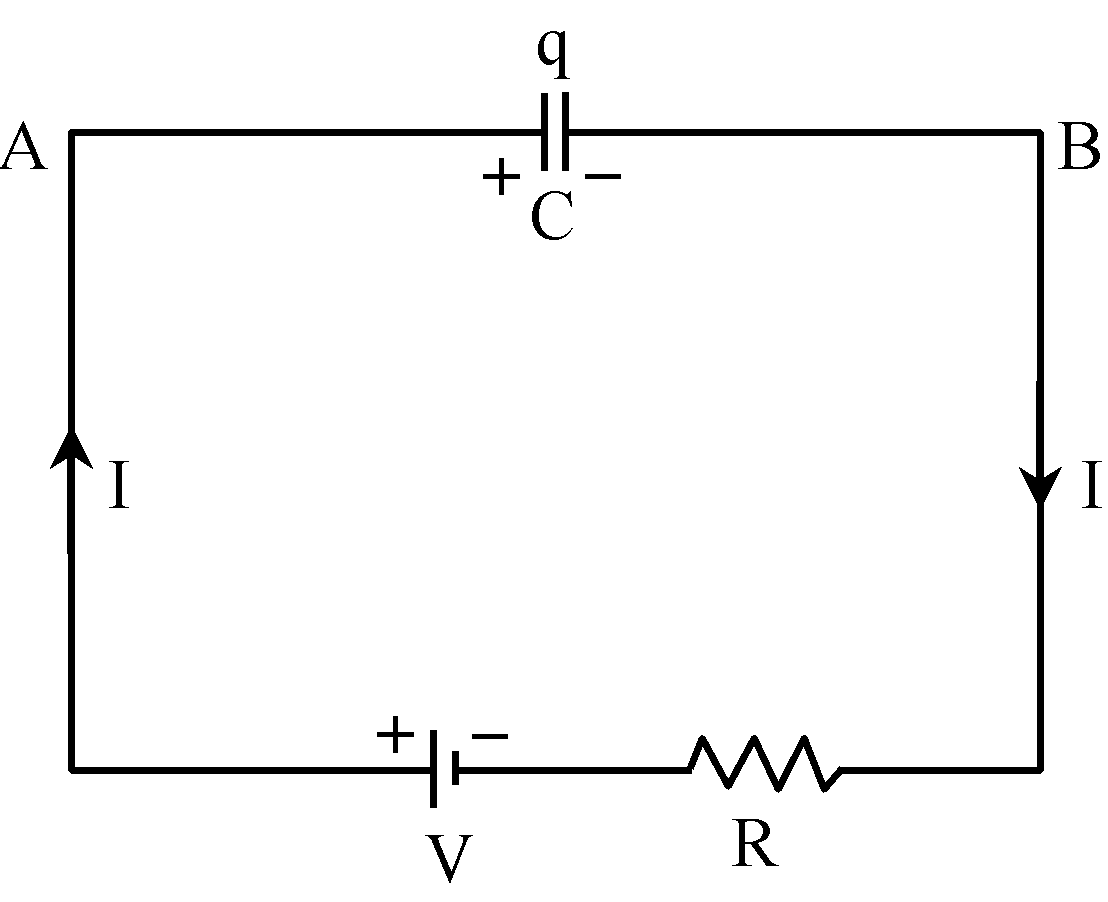
Potential difference across the capacitor is
V C = V A – V B = (V – IR)
∴ Electrostatic energy in capacitor at this instant is
U =  qV C
qV C
Rate of increase of electrostatic energy = 
=  V C
V C  =
=  (V – IR)I
=  (VI – I 2 R)
(iv) But power acting across the capacitor at this instant is P C = P – H = (VI – I 2 R) while rate of increase of electrostatic energy in capacitor is half of it.
In fact, a force of attraction exists between surfaces of the capacitor. When these surfaces move towards each other capacitance increases.
Hence, remaining part of the power acting across capacitor is used to increase kinetic energy of surfaces (plates) of the capacitor.
Prepare Smarter with CGP Edu
Get practice questions, solutions, and test series in one place.
Write a Review
Share your experience with this question and solution.
Commentary
Send your comment, doubt, correction, or feedback to admin.
Similar Questions
Explore conceptually related problems