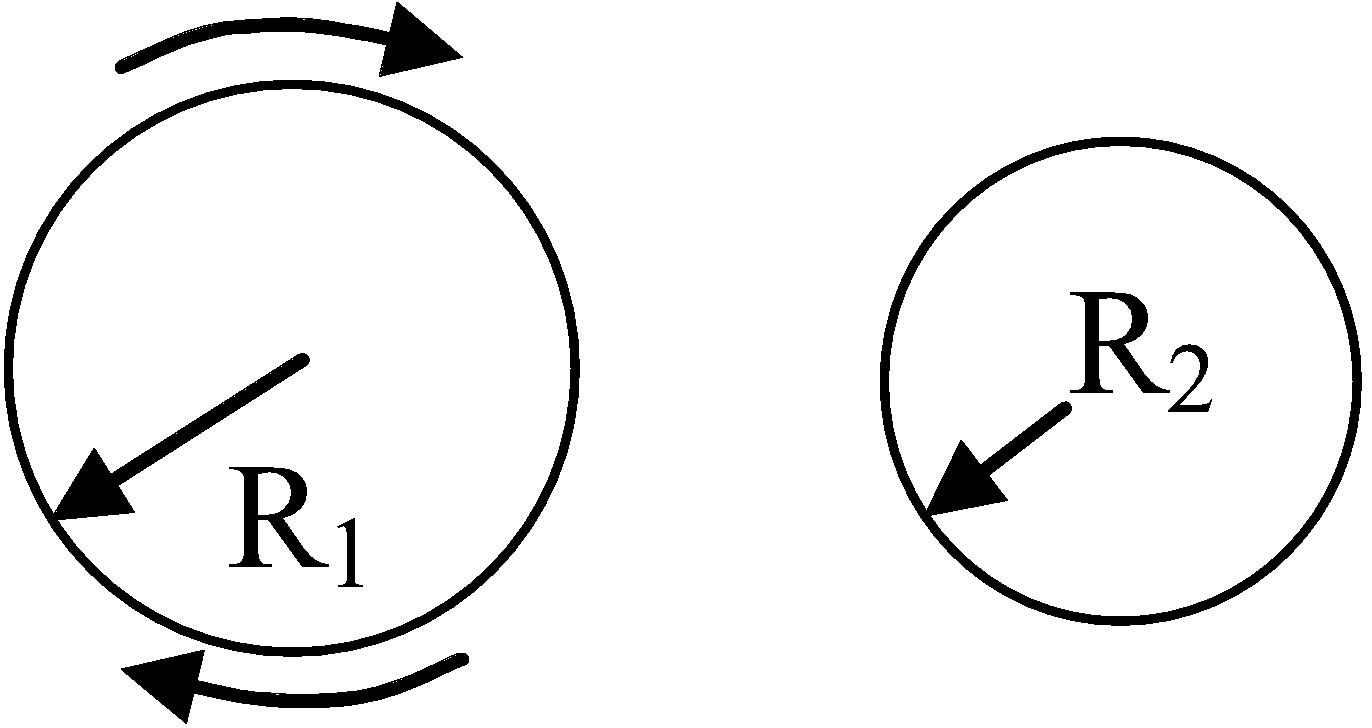
The two flywheels in fig. are on parallel frictionless shafts but initially do not touch. The larger wheels has f = 2000 rev/min while the smaller is at rest. If the two parallel shafts are moved until contact occurs, find the angular velocity of the second wheel after equilibrium occurs (i.e. no further sliding at the point of contact), given that R 1 = 2R 2 , I 1 = 16 I 2 .
Text Solution
Verified by ExpertsCHECK THE SOLUTION.
Sol. Suppose the impulse of the interacting force between the two wheels from contact to equilibrium is J. Then the torque of the impulse acting on the larger wheels is JR 1 and that on the smaller wheels is JR 2 .
We have I 1 ( ω 1 – ω 1 ') = JR 1 , JR 1 , I 2 ω ' 2 = JR 2 , where ω 1 and ω ' 1 are the angular velocities of the larger wheels before contact and after equilibrium respectively, and ω ' 2 is the angular velocity of the smaller wheel after equilibrium. As is no sliding between the wheels when equilibrium is reached.
ω ' 1 R 1 = ω ' 2 R 2
The above equations give
ω ' 2 =  Ans.
Ans.
Prepare Smarter with CGP Edu
Get practice questions, solutions, and test series in one place.
Write a Review
Share your experience with this question and solution.
Commentary
Send your comment, doubt, correction, or feedback to admin.
Similar Questions
Explore conceptually related problems