Published by:
CGP EDU Academic Team
Published on: September 12, 2026
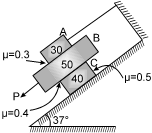
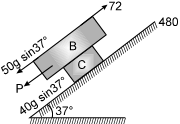
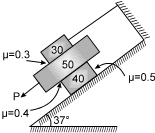
The three flat blocks as shown in the figure are positioned on the 37º incline and a force P parallel to the inclined plane is applied to the middle block. The upper block is prevented from moving by a wire which attaches it to the fixed support. The masses of three blocks in kg and coefficient of static friction for each of the three pairs of contact surfaces are shown in the figure. Determine the maximum value which force P may have before slipping take place anywhere. (g = 10 m/s 2 )
Text Solution
Verified by ExpertsThe correct answer is:
A
Step 1: Analyze the forces acting on each block.
For each block on the incline, we need to consider:
- The gravitational force acting on the block, which can be found using the formula: $F_g = m \cdot g$ where $m$ is the mass and $g = 10 \text{m/s}^2$.
- The component of the gravitational force acting parallel to the incline is given by $F_{g_{//}} = m \cdot g \cdot \sin(\theta)$ where \(\theta = 37^\circ\).
- The component of the gravitational force acting perpendicular (normal force) to the incline is $F_{N} = m \cdot g \cdot \cos(\theta)$.
For block one (30 kg):
- $F_{g1} = 30 \cdot 10 = 300 \text{N}$
- $F_{g_{1_{//}}} = 300 \cdot \sin(37^\circ) = 300 \cdot 0.6 = 180 \text{N}$
- $F_{N1} = 300 \cdot \cos(37^\circ) = 300 \cdot 0.8 = 240 \text{N}$
- Maximum friction force for block one: $f_{max1} = \mu_1 \cdot F_{N1} = 0.3 \cdot 240 = 72 \text{N}$.
For block two (50 kg):
- $F_{g2} = 50 \cdot 10 = 500 \text{N}$
- $F_{g_{2_{//}}} = 500 \cdot \sin(37^\circ) = 500 \cdot 0.6 = 300 \text{N}$
- $F_{N2} = 500 \cdot \cos(37^\circ) = 500 \cdot 0.8 = 400 \text{N}$
- Maximum friction force for block two: $f_{max2} = \mu_2 \cdot F_{N2} = 0.4 \cdot 400 = 160 \text{N}$.
For block three (40 kg):
- $F_{g3} = 40 \cdot 10 = 400 \text{N}$
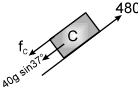
- $F_{g_{3_{//}}} = 400 \cdot \sin(37^\circ) = 400 \cdot 0.6 = 240 \text{N}$
- $F_{N3} = 400 \cdot \cos(37^\circ) = 400 \cdot 0.8 = 320 \text{N}$
- Maximum friction force for block three: $f_{max3} = \mu_3 \cdot F_{N3} = 0.5 \cdot 320 = 160 \text{N}$.
Step 2: Find the maximum static friction:
To find the maximum force $P$ before slipping occurs, we can sum up the maximum friction opposing the motion of block two (the middle block):
We need to check that the total friction forces can counteract the down-slope forces when $P$ is applied.
Maximum friction force opposing motion for all blocks is:
$f_{total max} = f_{max1} + f_{max2} + f_{max3} = 72 + 160 + 160 = 392 \text{N}$.
Now we compare this with the total downhill force:
Downhill forces acting on block two are:
$F_{g_{downhill}} = F_{g2} + f_{max1} - f_{max3}$, thus $300 + 72 - 160 = 212 \text{N}$.
Step 3: Find maximum force P:
Solving for $P$, we have:
$P_{max} = f_{max1} + f_{max2} + f_{max3} - (weight_{total})$
where $weight_{total} = F_{g_{downhill}}$
Thus, $P_{max} = 392 - 212 = 180N$.
Therefore, the maximum value which force P may have before slipping takes place anywhere is:
Therefore, A.
For each block on the incline, we need to consider:
- The gravitational force acting on the block, which can be found using the formula: $F_g = m \cdot g$ where $m$ is the mass and $g = 10 \text{m/s}^2$.
- The component of the gravitational force acting parallel to the incline is given by $F_{g_{//}} = m \cdot g \cdot \sin(\theta)$ where \(\theta = 37^\circ\).
- The component of the gravitational force acting perpendicular (normal force) to the incline is $F_{N} = m \cdot g \cdot \cos(\theta)$.
For block one (30 kg):
- $F_{g1} = 30 \cdot 10 = 300 \text{N}$
- $F_{g_{1_{//}}} = 300 \cdot \sin(37^\circ) = 300 \cdot 0.6 = 180 \text{N}$
- $F_{N1} = 300 \cdot \cos(37^\circ) = 300 \cdot 0.8 = 240 \text{N}$
- Maximum friction force for block one: $f_{max1} = \mu_1 \cdot F_{N1} = 0.3 \cdot 240 = 72 \text{N}$.
For block two (50 kg):
- $F_{g2} = 50 \cdot 10 = 500 \text{N}$
- $F_{g_{2_{//}}} = 500 \cdot \sin(37^\circ) = 500 \cdot 0.6 = 300 \text{N}$
- $F_{N2} = 500 \cdot \cos(37^\circ) = 500 \cdot 0.8 = 400 \text{N}$
- Maximum friction force for block two: $f_{max2} = \mu_2 \cdot F_{N2} = 0.4 \cdot 400 = 160 \text{N}$.
For block three (40 kg):
- $F_{g3} = 40 \cdot 10 = 400 \text{N}$
- $F_{g_{3_{//}}} = 400 \cdot \sin(37^\circ) = 400 \cdot 0.6 = 240 \text{N}$
- $F_{N3} = 400 \cdot \cos(37^\circ) = 400 \cdot 0.8 = 320 \text{N}$
- Maximum friction force for block three: $f_{max3} = \mu_3 \cdot F_{N3} = 0.5 \cdot 320 = 160 \text{N}$.
Step 2: Find the maximum static friction:
To find the maximum force $P$ before slipping occurs, we can sum up the maximum friction opposing the motion of block two (the middle block):
We need to check that the total friction forces can counteract the down-slope forces when $P$ is applied.
Maximum friction force opposing motion for all blocks is:
$f_{total max} = f_{max1} + f_{max2} + f_{max3} = 72 + 160 + 160 = 392 \text{N}$.
Now we compare this with the total downhill force:
Downhill forces acting on block two are:
$F_{g_{downhill}} = F_{g2} + f_{max1} - f_{max3}$, thus $300 + 72 - 160 = 212 \text{N}$.
Step 3: Find maximum force P:
Solving for $P$, we have:
$P_{max} = f_{max1} + f_{max2} + f_{max3} - (weight_{total})$
where $weight_{total} = F_{g_{downhill}}$
Thus, $P_{max} = 392 - 212 = 180N$.
Therefore, the maximum value which force P may have before slipping takes place anywhere is:
Therefore, A.
Prepare Smarter with CGP Edu
Get practice questions, solutions, and test series in one place.
Write a Review
Share your experience with this question and solution.
Commentary
Send your comment, doubt, correction, or feedback to admin.
Similar Questions
Explore conceptually related problems
A body of mass 5 kg is kept on a rough horizontal surface. It is found that the body does not slide…
In the given figures find the accelerations and the friction forces involved
(i)
(ii)
(iii)
(iv)
In the given figure find the accelerations of blocks A and B for the following cases (g = 10 m/s 2 …
Column II gives certain situations involving two blocks of mass 2 kg and 4 kg. The 4 kg block lies …
In the arrangement shown tension in the string connecting 4kg and 6kg masses is
In the given figure the coefficient of friction between 4kg and 5 kg blocks is 0.2 and between 5 kg…